Shop
Showing 145–160 of 208 results
-
Oisin & Conol Hernon – Up and Coming
Up and Coming – O Ghluin go Gluin is a new album of traditional music from Oisin and Conal Hernon, released on the Clo lar-Chonnachta label.
Brothers Oisin and Conal Hernon are two young musicians from the Aran Islands who, although just sixteen and thirteen years of age respectively, display the musical ability and skills of musicians twice their age. They began playing music when they were very young, both starting out on tin whistle, with Oisin moving to button-accordion at the tender age of six and Conal taking up banjo at the age of nine. It wasn’t long before they began playing in competitions and they have amassed a long list of prizes over the years, including All-Ireland titles on button-accordion and banjo. They have performed music on many stages, with one of the highlights being a performance for visiting EU ministers and dignitaries during Ireland’s hosting of the EU Presidency in 2004. The brothers’ musical talents come as little surprise because their mother, Marion, is also an accomplished musician who has won the All-Ireland title for button-accordion, as well as prizes for singing in English and Irish. Her own parents are also musical – her mother is from Milltown Malbay in west Clare, a town renowned for traditional music, and her father is an accomplished box player who toured Ireland with his band, The Inky Craven Dance Band. This exceptional family can boast seventeen All-Ireland titles between them, spread over three generations, and all three generations can be heard playing on Up and Coming – O Ghluin go Gluin.
The tunes on the album include two of Conal’s own compositions – ‘The Renmore Jig’, named after the place where his grandparents live, and ‘Philomena’s Fancy’, named after his grandmother as well as a song by Marion, ‘Sean-Phadraic’. The brothers turn their music skills to a different genre of music for the final track, an instrumental version of ‘The Way I Are’ by Timbaland!
Oisin and Conal will be performing in Aistear Ceilteach – Celtic Passage, a traditional music and dance show on Inis Mor, throughout the summer.
Press Reviews
wwwLiveIreland.com
Oisin and Conal are 16 and 13, respectively, as of the time of this recording. Oisin is on the button box, Conal on the banjo. Of course, it goes without saying they come from an incredibly talented musical family. The immediate family, including the brothers, has 17 All-Ireland titles to its credit. To hear two musicians this good, this mature and this young can get depressing. Stunning. Stunning. This much talent and their whole lives ahead of them. Who wins? All of us! Especially us. We get to hear them for years, God willing. Get up,’ya boyos! It is on Clo-iar-Chonnacta. Is this label capable of producing anything less than perfection from each of its artists? Rating: Four Harps Bill Margeson
£14.99 -
Oisin MacDiarmada – On the fiddle (ar an bhfidil)
Press Reviews
Irish Music Review
One of the brightest young stars in the panoply of Ireland traditional music, this is fiddler Oisín Mac Diarmada’s third album, though the first to bear just his own name. First came, in 2000, the sparkling Traditional Music on Fiddle, Banjo & Harp, recorded with banjo player Brian Fitzgerald and harper Micheál Ó Ruanaigh, followed earlier this year by Oisín’s band Téada’s self-titled debut album, also on Ceol Records. However, Ar an bhFidil (‘On the fiddle’) tops the lot, fully confirming Mac Diarmada’s position as a wonderfully adept and evocative musician.
Oisín’s early years were spent in County Clare where he learnt his first music before the family moved to South Sligo where he took lessons from the notable fiddle teacher, Paddy Ryan. Now noted as a music tutor in his own right, and still only in his early twenties, Oisín’s playing on Ar an bhFidil creates a relaxed confection of the music of Sligo and Clare, topped with the delicacies of an astounding technique given full expression by the sheer imagination of his tune settings. His playing of the slow air Bean a ‘leanna, associated with the late Connemara singer Joe Heaney, simmers with an unrequited passion. Jigs and reels are threaded with an innate merriment and, above all, Oisín has the power to invest very familiar tunes, such as The Lark in the Morning with new life fashioned by the pure merriment in his playing. Thoroughly enjoyable throughout, this is unquestionably an album that merits repeated listening.
The Living Tradition Dec/ Jan 2004
This is really good fiddle playing by a 24 year old who’s got more talent than many older fiddlers. Moving from Clare to Sligo as a lad must have done something for him because he has a mixture of both styles as well as his own personality stamped on his playing.
He wrote his own concise but thorough sleeve notes giving due credit to the players he got the tunes from and they show the wide range of the players who influenced him, Coleman, James Morrison, John McKenna, and Ennis (of course).
He seems to be able to change style as easily as changing key, from the old Clare style of the first track, to the 1920s James Morrison/ Michael Coleman tracks on The Tap Room/The Kerryman’s Daughter, via John McKenna, Josie McDermott, Denis Murphy and Ed Reavy. Yet throughout, he puts his own style of playing on every tune. In some ways, his ability to do this is reminiscent of Frankie Gavin in one of his mischievous moods.
There’s a good mix of tunes, mostly well known but with rarities like a Seamus Ennis version of The Lark in the Morning that’s not often played now. Reels predominate, of course, but ther are single and double jigs, hornpipes, and Leitrim style polkas too. A big surprise is The Strayaway Child, composed by Maggie Barry (who’s become known as Margaret lately), that Michael German used to play But the big one for me is The Morning Thrush, composed by Seamus Ennis’s father James. I’ve never heard anyone else but Ennis play this, and Mac Diarmada makes a great fist of it. It’s a great pipe tune that deserves more playing.
My old friend Paddy Ryan wrote the introduction to the CD and says at the end that he can highly recommend it. I sometimes disagreed with Paddy in the past, but not this time. This is great music, well played by a fine young fiddler. I look forward to his next release. Mick Furey
Irish Music Magazine April 2003
Of late, there seems to have been a trend among traditional musicians of a younger generation to move from fiery blistering pyrotechnics to more mellower and laid back means of musical expression. By that, I mean players are engaging themselves with the details of the music and it’s manifold subtleties rather than kick stepping their ways to oblivion. Martin Hayes is one such example and on this showing, Oisin MacDiarmada is another.
Oisin MacDiarmada’s debut solo album, Ar an bhFidil typifies this laid back approach. MacDiarmada’s fiddle playing is rooted in the Sligo style. While the frantic wildness of a Michael Coleman is evident on, The Tap Room, he is no idle speed merchant. He favours the low-fi approach with the music speaking for itself; the result is a warm natural sounding album.
Ar an bhFidil revels in the small dry sounds so beloved of Television’s, Tom Verlaine on their seminal Marquee Moon album. This is low-key traditional music, yet rich in character, subtlety, and individual strength. The 17 tracks on show augurs well for the purse strings along with a plentiful supply of notes for each track detailing source musicians and other details. We aren’t talking encyclopedia type documentation, but enough for the casual reader to get the gist of what’s going on, and yet nail the vital facts down.
The accompaniments are also sparse with a minimum on one extra instrument whether, it’s piano, flute, second fiddle or bouzouki – the balance between featured protagonist and guests is just right. Add to that, a concise production from Harry Bradshaw and this becomes one well thought and enacted affair. Ar an bhFidil is a work of discernment and quality, check it out. John O’Regan.
Claddagh
A very pleasing trait of some current young musicians is that quite a few of them are happy to play in the way their antecedents played; one thinks immediatly of the Kane sisters, Harry Bradley, Martin Hayes. Oisin MacDiarmada is another such. He has the lonesome touch, and quite a few of the tracks are totaly unaccompanied. Where accompaniment is used, it is not as an offensive weapon, and throughout. he proves that he is not just a very fine fiddler, but a young man with an understanding of exactly what the music means. Yet another very worthwhile release in a year that has provided us with many great recordings.
Hot Press November 6th 2002
This debut solo CD by 24-year-old Sligo fiddler Oisín Mac Diarmada opens with a superbly confident set of tunes played without accompaniment, full of lovely raw scraping double-stops and rolls. Elsewhere on the album, Séamus Quinn contributes a bouncy piano to a few tracks, a set of reels played by Mac Diarmada on the whistle has bodhrán backing from Tristan Rosenstock, and several others feature bouzouki or guitar accompaniment; there are also a couple of fine duets with fellow fiddler John Carty. Mostly, though, it does exactly what it says on the tin – pure traditional fiddling, raw and unadorned, and all the better for it. The album was produced by RTÉ’s Harry Bradshaw, who’s done a beautiful job at keeping the sound natural and letting the tunes take centre stage. Sarah McQuaid. Nine out of Ten.
The Irish Times (Irish Newspaper) September 26th 2002
Fiddle music for folks who like their trad infusion unadulterated. Oisín Mac Diarmada, Sligo fiddler and member of young turks téada, is already on his second solo run, and how his pace has slowed – but admirably so. Ar An bhFidil is exactly what is says on the tin: a stripped down sally (back and) forth through the Sligo tradition. Duelling and duetting with fellow fiddler John Carty on the set of Michael Coleman jigs, Jackson’s Morning Brush/The Rambling Pitchfork, Mac Diarmada’s playing is feisty and earthy at the same time. Not afraid to let the fiddle’s hoarseness seep through, this is a player who cajoles his instrument through nooks and crannies in the tradition that lesser players would avoid. Lonesome magnificence.
Siobhán Long**** (4 stars)
The Irish Examiner (Irish Newspaper).September 26th 2002
In traditional music, as in other forms, solo albums are rarely what they claim to be. At a minimum, musicians like to use the safety net of an accompanist. Other players are added, sometimes in a perfectly valid attempt to recreate some fondly remembered session. When the process is taken to extremes, the leading player is often relegated to the background. In his new album, Ar an bhFidil, Oisín Mac Diarmada sets a brave course.
This is a solo fiddle album and, on many tracks, solo fiddle is exactly what we get. When he moves beyond the strictly solo format, it is in the company of another melody player – John Carty on fiddle and Damien Stenson on flute. Or in tandem with a single accompanist – Séamus Quinn on piano, Seán McElwain on bouzouki, Tristan Rosenstock on bodhrán and John Blake on guitar all take turns. Mary Brennan’s Favourite kicks off, slow and steady. The pace picks up for The White Leaf, but the velocity remains on the leisurely side. John Carty joins for the jigs, Jackson’s Morning Brush/The Rambling Pitchfork, and the hornpipe/schottische Peter Wyper’s/The Killarney Wonder. The two players meld wonderfully. Mac Diarmada shows another part of his musical personality in switching to whistle for the reels The Flannel Jacket/The Maid That Dare Not Tell. The Cisco Hornpipe and Walsh’s Hornpipe are taken at a strolling pace, which allows both the music and the musician room to breathe. The Morning Thrush – written by Séamus Ennis’ father James – is a beautifully clear and expressive slow reel. A jokey piano line introduces The Tap Room, pushing forward to the point of interference. In contrast, the bouzouki background on The Rainy Day is unobtrusive.
Ar an bhFidil is warm, rich music that combines a high level of technical skill with a sense of humour. Pat Ahern
Pay The Reckoning Web Site
Pay The Reckoning was captivated by Teada’s recent offering and so we were excited to hear rumours that Oisin MacDiarmada, the band’s fiddler, was in the process of putting together a solo recording. Well, folks, the patient wait is at an end and the results of MacDiarmada’s time in the studio have surpassed our high expectations.
MacDiarmada proves himself yet again to be one of the most sensitive and soulful fiddlers around. The album’s design, simple and straightforward, reflects his own approach to his craft. MacDiarmada isn’t a man for pyrotechnics, he doesn’t batter a tune into submission and then bends it to his will. His is a more subtle approach; he gives the tune room to develop in a seemingly organic way, so that his ornamentation and embellishments seem natural, unforced.
However, as any musician will tell you, such apparently natural ease with a tune is the product of two elements – natural talent and hard work. MacDiarmada has no end of the former and has no fear of the latter. The result is pure magic!
MacDiarmada’s knowledge of, and captivation by, the music of the 20s and the 30s (the “golden age” of Irish music, as some have dubbed the period) is worn proudly on his sleeve as he gives us versions of a number of tunes and sets on the album which were recorded by such legends as Coleman, Morrison, John McKenna, Patsy Tuohey and Paddy Killoran. However, you mustn’t get the impression that MacDiarmada’s an academic. His interest isn’t so much in the history of the tunes as their timelessness and his playing of the tunes represents a reawakeneing rather than a resurrection.
There are moments of savage, soulful (there goes that word again) perfection on this album. His playing of “The White Leaf” – a version of the more widely known “Mason’s Apron” – is so elementally powerful a sound as to cause the listener to wonder how one tune can express at the same time such extremes of joy and melancholy.
On the polka set “The Merry Girl/Charlie O’Neill’s”, MacDiarmda lays claim to Sligo/Leitrim influences. But to our ears, the latter tune in particular sounded as if it was being played by the ghost of the long-dead John Doherty (and we know of no higher compliment), so refined was the blend of dazzling technique and sheer emotion.
The reel set “The Flannel Jacket/The Maid That Dare Not Tell” is of interest in that MacDiarmada shows us another aspect of his musical ability as he gives both tunes an airing on the whistle. Accompanied by Tristan Rosenstock on inventive, yet rock-solid bodhran, the “spare” feel of the track conjures up an atmosphere which a more busy production could never capture.
And so, throughout the album, MacDiarmada, along with various musical sparring partners (Seamus Quinn on piano, John Carty on fiddle, Damien Stenson on flute, with guest cameos by fellow Teada members Sean McElwain on bouzouki, John Blake on guitar and Trisan Rosenstock on bodhran), lays out his stall of mighty talent, a great ear for a tune and a great feel for capturing mood.
However, even amid all the excellent music which MacDiarmada provides, his solo version of “The Strayaway Child” stands out as a defining moment of the album. Played to great effect by Kevin Burke in his Bothy Band days, MacDiarmada nevertheless manages to inject the tune with so much of his own feeling that it’s difficult to imagine it ever having been played by anyone before and almost impossible to imagine anyone else ever doing the tune justice.
A massive album. Honest, passionate and quietly defiant. You’d do well to visit http://go.to/copperplate and get yourself a copy. And while you’re at it, grab hold of a copy of Teada’s debut!
Live Reviews
Teada Live Review
The Herald (Scottish Newspaper) April 25th 2003
The name, like k d lang’s, is determinedly lower case. It’s pronounced “tay-day”. It’s Irish for “strings”, and it might be advisable to get used to it because there was a feeling of portent as pronounced as a poteen hangover about this gig. The band are young – how young you can guess by the news of teada’s bodhran player’s absence due to exams – and maybe it was the novelty of having an accordionist make up the quartet, but loathers of football clichés look away because I’m going to use one: this was a game of two halves – bloody good and bleedin’ marvellous. The first established the group’s liking for variety of metre and arrangement, pairing off for fiddle and flute duets, and employing numerous other instrumental permutations, from solo to quartet. It also confirmed that, in Oisin Mac Diarmada, teada have a fiddler of quite starting old-head-on-young-shoulders ability. You could hear centuries of tradition and doubtless long hours of dedication in his sweet and graceful melodiousness. If at times, then, his colleagues seemed to be playing catch-up, later they were right on the pace, adding richness and precision on banjo, bouzouki, box, and flute. Flautist John Blake, English-accented but Galway-based, takes stick for his origins but brings natural aptitude and technique on tunes, and in doubling upon guitar he offers harmonic invention and real drive. One complaint might be their one song per set ration. Mac Diarmada sings well, interestingly, and with feeling, and might do even more so with some practice. But with such quality of musicianship and attention to a tune’s essential shape, they’ll so as they are for now. Rob Adams
Teada Live Review
Edinburgh Evening News (Scottish Newspaper) April 24th 2003
Edinburgh’s Ceilidh Culture programme continued last night as young Irish band Teada brought their classic Celtic credentials to town in their debut Scottish gig. Now a five-piece outfit since the recruitment of accordion player Paul Finn earlier this year, Teada were shorn of their bodhran player Tristan Rosenstock, back home in Dublin preparing for his finals, but, in his absence, the band, with Oisin Mac Diarmada leading on fiddle and excellent vocals certainly passed this test. Traditionally Irish but with a punkish edge to their style, Teada, which is Irish for strings, genuinely enjoy their music, and their repertoire had enough shifts in pace and style to keep the band, and their audience, on their toes, raucous one minute, sensitive and serene the next, traditional Irish music with attitude. Seemingly playing well within themselves in their first set, with an intriguing mix of reels, jigs and hornpipes, the band cut loose in a second set that got one encore, but could have received several, such was the reception they received. Mac Diarmada is a real talent, his fiddle-playing of the highest order, but with a distinctive, almost discordant edge to it, and his Irish vocals were full of Irish passion. Teada, however, are no one-man-band, and with banjo/bouzouki player Sean McElwain offering subtlety and style, Finn on accordion and John Blake on guitar and flute, they are a refreshing addition to the genre. The highlights were the numbers in celebration of the piping tradition shared on both sides of the Irish Sea, and the hornpipes, especially Tom Connor’s and Mayday, and reels such as Teetotaller and Billy McCumiskey’s showed the versatility of Teada goes across the spectrum of Irish music. Teada are a tight, traditional Irish band with something quite intangible to separate them from the rest, and if there is a better new band on the Emerald Isle, then they must be very, very good. Mike J. Wilson
Customers Comments.
I was having a few tunes with Marcus O’Murchu this evening, (as you do) & he happened to have a few copies of this new CD about his person, so I took out one of those crisp foldy things & exchanged it for Oisin’s brilliant new CD – fair exchange is no robbery.
It is lovely piece of work, from this highly accomplished young musician, who is confident enough to play many of the tracks without any accompaniment, & his playing stands up beautifully on it’s own, a joy, especially for Fiddlers, to listen to.
He is joined by John Carty on a couple of tracks for some super double Fiddle magic. Seamus Quinn comes in on a couple of tracks on Piano, while Sean McElwain does the same on Bouzouki, John Blake lends a hand on Guitar on one track & Tristan Rosenstock accompanies Oisin’s whistle playing, on Bodhran, on track No. 5.
Paddy Ryan writes about how ‘the music is tastefully played by a musician who knows his art form. He has a deep understyanding of the richness & beauty of the music & an innate ability to interpret a good tune.
The imaginative tune settings, the intricate variations & technical mastery, & the full-bodied, sweet tone are the hallmarks of his superb musicianship. His style is very distinctive & very personal with influences from Clare & North Connaught showing through. This recording encapsulates the artistry of Oisin MacDiarmada as a top class Fiddler. The music flows with clarity & fluency, & the rich variety of tunes displays his extensive musical range.’
Paddy concludes by saying he ‘can highly recommend it’. Well I concur, it’s a beezer, & if your a Fiddler, it will be added to your collection, sooner or later, mark my words.
One wee gripe, & it’s nothing to do with this CD, or it’s incredible music, which is sure to delight all who are fortunate to listen to it. It’s just that since James Morrison’s Orchestra recorded this tune in the 20’s, & someone miss spelt the name, nobody has since checked up, they just copy the fault. For anyone interested, take out an atlas & find Aberdeen, on the NE coast of Scotland, now travel due west until you come to the village of Monymusk – not Money Musk. OK – you have now been warned!
Posted on August 30th 2002 by PtarmiganSligo fiddle-player Oisin Mac Diarmada, at 24 years of age, is an honours graduate in Music Education from Trinity College, Dublin. In addition to widespread performing activity whish has brought performances in venues and festivals throughout Europe and the USA, Oisin is respected internationally as a fiddle tutor and his journalistic, lecturing, examining and production work. He is fast becoming one of the most exciting young musicians on the traditional music scene, his playing on a previous release, CICD144 Traditional Music on Fiddle, Banjo and Harp (available from Copperplate) was described by renowned music journalist, Simon Jones as “so sensitive it’s enough to make grown men cry”.
Now, performing with exciting young traditional band, teada, who have released their highly successful debut album (available from Copperplate) recently, Oisin’s performances bring a strong flavour of the rich Sligo tradition of fiddle-playing, together with what fiddler/ researcher/ broadcaster, Paddy Ryan describes as ” a deep understanding of the richness and beauty of the music, and an innate ability to interpret a good tune”.
On this new release, Oisin predominately features traditional Irish fiddle-playing in a pure, solo context, performed in a uniquely personal and traditional style with flavours of the great Sligo fiddle tradition. Additionally there are a number of tracks which separately feature artists of the calibre of John Carty, on fiddle, Seamus Quinn on piano, Sean McElwain on bouzouki, Damien Stenson on flute, John Blake on guitar and Tristan Rosenstock on Bodhran.
We at Copperplate will be supporting this release with a high profile promotional campaign and full-scale mail out to media and retail sectors. Feedback always welcome. Thank you for your support.
£14.99 -
Oonagh Derby – Harmony Street
Oonagh on the songs.
About You Now: Is a Cathy Denis cover – this was a club hit for the Sugababes and we had great fun stripping it right back to a simple love song.
Sore and Tired: Is a cheeky number about being in a band and missing everyone at home.
Harmony Street: I wrote this song very quickly whilst recording the album – the studio is off Harmony Street in Belfast. I read a lot so you will find a lot of lines from books in my songs. “A sleepless bed is a haunted place” is in Harmony Street – I think it’s a great line.
September: I live behind a woodland and park in Moira and one day in autumn I noticed the swallows getting ready for their big journey and I thought to myself, September is a month of tremendous change, the world preparing for winter. It’s something similar to coming to the end of a relationship – you know there’s a dark time ahead, but you also know there will be spring.
I Still Believe: Is about being married and how life circumstances change but you have to remember why you got together in the first place.
Beauty the Betrayer: Is a woman’s delicate relationship with beauty and how it is like an adulterous husband who has left her for youth – but she still loves him.
Jigsaw Pieces: There is no joy on this earth like your children – this song is about my son Leo, but hopefully all parents will relate to this song because as parents we all have to make the same journey.
Lovely Friend: I am blessed to have three sisters who I couldn’t do without. There’s an old saying, “you can pick your friends but not your family”. This song says ‘I’d choose you anyway’.
Silver Shoes: About the nights out I have with my university friends – they are treasured and precious.
l Am Because: I wanted something simple and catchy for this number; it sort of does what it says on the tin -I am because we are! Gerry O’Connor (producer) thought it lent itself to a pop sound – so we did a big production on this one – sort of threw the kitchen sink at it.
Dear Miss Lonely Hearts: I love Thin Lizzy and think Phil Lynott was a fantastic songwriter -1 just had to do one of his songs.
The Dove Children: Is about Northern Ireland – it’s the story of a boy who has grown up without first-hand knowledge of the Troubles (thank God) but his father is still embittered. I suppose we need to be careful what we say to our children – give them a chance if we can.
Latest News
www.liveireland.com The Livie Awards 2012 Thunder on the Horizon Award – Oonagh Derby
We have never done this before. Harmony Street by Oonagh Derby is a fantastic album. This talented woman from Northern Ireland has a voice from heaven. She is a superior songwriter and a massive talent. It is thrilling that Ireland can still produce such as she. Here’s the thing. This is not a traditional album. As we said, we have never done this before. I mean, it’s just not traditional. But, she is that good. You heard it here first. Find her. Find this album. Find something brand new and special.
more detail at www.oonaghderby.com
Press Reviews
www.LiveIreland.com Christmas Recommendations
If you’ve bought every one of these cd’s and now you want something that is completely Irish to the bone, but not traditional, look no further than Oonagh Derby’s Harmony Street. This singer from Northern Ireland has put out an overpowering first album of mature music and lyrics, perfectly performed. What a future. She is a star already. Get ready to tap your foot, and Imelda May, stand back.
Stirrings Magazine
Oonagh Derby is a singer/songwriter from Armagh who here presents ten self-penned song together with two covers: The Sugar Babes’ About You Now, on which I will make no comment, being unfamiliar with the original, and an excellent take on Dear Miss Lonely Hearts, one of my favourites from the Phil Lynott canon and superb demonstration on how to cram as many internal rhymes as you possibly can into one set of lyrics.
Many of her own songs are on the subject of love, lost (September, Harmony Street), found (I Am Because), for a friend (Lovely Friend – underpinned by some fine 60s/70s folk finger-style guitar), for a father (The Dove Children – a few seconds of pure celtic blues here from Barry Kerr’s uilleann pipes) and for a child (Jigsaw Pieces – loved Colin Henry’s discreet use of dobro).
Oonagh has a fine voice, writes good strong tunes and is a more , than competent lyricist. She gets sympathetic support from some very able musicians on guitar, flute, fiddle, bass, pipes, percussion, banjo, viola etc and the arrangements are well thought out and executed. Stylistically she rings the changes sufficiently to maintain interest throughout, from the country rock of Sick, Sore and Tired to Beauty the Betrayer – for me the standout track, a lament spoken over a slow air on the pipes (a minor niggle here, I wish she’d stuck to “you” throughout instead of going into classical poetry mode and throwing in a few “thee’s” and “thou’s”) Recommended. Ian Spattford
www.netrhythms.com
Oonagh’s an Armagh singer-songwriter whose original songs, written from a modern-day woman’s perspective, are musically accessible while remaining edgily contemporary in outlook. Her debut CD’s 12 tracks comprise ten original compositions and two covers, and employ a comfortingly familiar-sounding instrumental backdrop that makes good capital of acoustic instrumentation alongside occasional use of a radio-friendly rhythm section. Oonagh has evidently found a sympathetic producer in Gerry O’Connor (of Four Men And A Dog fame), who also brings his own brand of banjo and fiddle virtuosity to the mix on several tracks.
Perhaps against the odds, Oonagh has chosen to kick off the CD with one of the covers, a neat and perky take on The Sugar Babes’ About You Now with some pleasing guest dobro work from Colin Henry well up in the mix. After that encouraging opener, though, I was surprised to find Oonagh’s own compositions, for all their well-sung and pleasantly scored qualities, rather lacking in individuality, at any rate the first pair, Sick Sore And Tired and the title track, these being little more than pop-rock confections with not a great deal of musical substance to fire the imagination. Things seem to improve with Oonagh’s poetic expression of regret on the more lyrical September and the cautious optimism of I Still Believe.
The album’s centrepiece, Beauty The Betrayer, is the odd-track-out in that it pits Oonagh’s spoken lyric against Barry Kerr’s keening uilleann pipes, and the wistful acoustica of Jigsaw Pieces (one of four songs jointly penned with Stephen Derby) is an affectionate expression of love for a child couched in a gentle and attractive musical setting. Lovely Friend continues in a similar vein, while the uptempo country-styled Silver Shoes explores the fantasies and regrets of a modern multi-tasking mother. However, the spell is then broken by I Am Because, another slight, pop-styled excursion that doesn’t really do anything special. Oonagh’s individual and clearly heartfelt cover of Thin Lizzy’s Dear Miss Lonely Hearts brings the disc’s final interlude, and qualifies as another successful reworking, leading effectively into one of the album’s standout cuts, The Dove Children, which closes proceedings in reflective mood with a beautiful guitar-and-dobro backing that (sparse though it is) feels almost too sumptuous for its tearfully questioning and confused lyric.
In all, while I can appreciate the superb quality of Oonagh’s voice and some of her songwriting certainly engages appropriately, I still don’t feel wholly convinced by her debut offering, even after a number of visits to Harmony Street. David Kidman August 2011
The Irish Post 14.8.11
ARMAGH-BORN singer/songwriter Oonagh Derby has written 12 tracks on this debut album. Although Oonagh’s family roots are in traditional music the album opens with her very own interpretation of The Sugar Babes’ About You. It works incredibly well, as indeed does the whole project.
The album is a mixture of different influences but somehow Oonagh manages to knit them all together to produce a very impressive and enjoyable sound. Particularly impressive are her own harmonies.
The arrangements by guitarist Gerard Thompson are melodious, well-crafted and beautiful – it seems Oonagh has gathered a wonderful collection of musicians to complement the choice of material. Sometimes it is easy to pick a favourite track but this album is different because so many of the songs are of equal strength.
Since radio play is such a lottery these days I wonder where Oonagh will get the exposure she deserves because some of these songs deserve recognition – I can see some of them being covered by other artistes.Track 4 September is simply gorgeous.
The brilliant Gerry O’Connor, who also plays a number of instruments as well as producing the album, shows his considerable production skills by getting the feel of the songs just right.
Other guest musicians include Barry Kerr on uilleann pipes/ whistles, Colin Hendry on dobro, Cormac O’Kane on keyboards and Liam Bradley on drums.
This is a cracking debut album that has manifestly been given a lot of thought. It should certainly help establish Oonagh Derby’s reputation as a singer and songwriter of real quality. Joe Giltrap
www.liveIreland.com
Oonagh Derby has Harmony Street out. A great singer. Fab songwriter. Okay. This is not strictly trad. It IS strictly Irish, and this talented young woman from Armagh is set for a very long run, indeed. This is a fast train leaving the station. Get on board. Big time talent. Stunning. Check her out, and we know Copperplate in London has this, as well. If Copperplate is handling it, and it is not trad, it tells you how good this is. Bill Margeson
R2 Reviews Shorts.
Oonagh Derby makes her solo debut with Harmony Street, helped by guitarist Gerard Thompson. Pop-rock with folkish overtones – flute, fiddle and pipes, it’s pleasant Radio 2 fare.
www.liveIreland.com June 11
Speaking of Copperplate, they are representing the fantastic, Oonagh Derby and her brand new album, Harmony Street. Full review coming next month. Suffice it to say that this Armagh young woman is a stunner of an alto singer. It is available through the Copperplate site, and we’re sure you could also get it from her directly, as well as th usual outlets such as cdbaby and Claddagh. Google. We may well be listening to Newcomer of the Year! Bill Margeson
Fatea Online Magazine
Oonagh, pronounced Una, Derby’s impressive debut album “Harmony Street” is contempory country with the odd Celtic twist. Songs like “Sick Sore And Tired”, a look at the tedious side of touring, give the album an honest feel, this is not an album that allows you to wallow in false sentimentality, rather one that introduces you to a fresh perspective on country songs. Produced by 4 Men and A Dog’d Gerry O’Connor, it’s an album with clean lines and one that picks up Irish instrumentation along the way to give the whole project a distinctive feel.Tim Carroll
FolkWords Album Reviews (June 19, 2011)
Oonagh Derby – gorgeous debut album ‘Harmony Street’
An outstanding cover of ‘About You Now’ immediately connects (this is how it should be sung) delivered by the emotive voice of singer songwriter Oonagh Derby. Her debut album ‘Harmony Street’ also includes 10 outstanding original songs plus an engrossing version of Thin Lizzy’s ‘Dear Miss Lonely Hearts’. And it’s a momentous album.
Harmony StreetOonagh’s voice carries the passionate, accented edge of Armagh with songs that are piercing, meaningful and memorable. From her startling rendition of ‘Beauty the Betrayer’ (the most eloquent piece of poetry set to music that I’ve heard in a long time) to the awesome, almost frightening beauty of ‘The Dove Children’ — this is earth-shattering, intense and evocative. The forceful ‘Sick, Sore & Tired’ with its biting, uncompromising cut of truth and the passionate yearning of the title song ‘Harmony Street’ together stand testimony to Oonagh’s impressive vocals.
Songs rejoicing in the wonder of childhood run the risk of syrupy sweet talk — not so with ‘Jigsaw Pieces’, Oonagh sings this tender tale with soothing sincerity that touches with its careful observations. There’s a bluegrass feel to ‘Silver Shoes’ enhanced by a subtle banjo, which cuts into a longing desire to return to a time with less responsibilities — easy to identify with that one; while the lilt of ‘I Am Because’ with its infectious hook sticks in your mind.
Bathed in the traditions of her heritage yet written and delivered in a ‘bang up to date’ style, ‘Harmony Street’ displays both depth and originality – seldom will a debut make such an impression.
Playing alongside Oonagh on various tracks on ‘Harmony Street are Gerard Thompson (guitar) Gerry O’Connor (banjo, fiddle, viola) Nicky Scott (bass) Liam Bradley (percussion, backing vocals) Cormac O’Kane (bass, keyboards) Barry Kerr (flute, pipes) Colin Henry (dobro, Wiessenborne slide guitar). Tim Carroll
£14.99 -
Open The Door For Three: The Joyful Hour
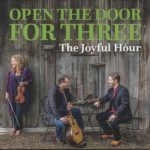
Open The Door For Three: The Joyful Hour
Open the Door for Three is fiddle player Liz Knowles, uilleann piper Kieran O’Hare, and Dublin-born singer and bouzouki player Pat Broaders. Their music is a rare combination of unearthed tunes from centuries-old collections, newly composed melodies, fresh arrangements of songs old and new, homages to the musicians and bands they grew up listening to, and the unmatched energy of a trio of good friends playing great Irish music together.
“A road-tested, audience-approved, high-octane, fist-in-glove, laughing-out-loud trio of Irish musicians…” “Theirs is a big and brilliant sound!” — Sean Smith, Boston Irish Reporter
Liz, Kieran, and Pat have been mainstays of the Irish music scene around the world, having distinguished themselves over the last two decades as soloists with Riverdance, Cherish the Ladies, String Sisters, Secret Garden, Anúna, and The New York Pops. As a trio, they have played to a wide range of audiences in venues large and small, from Irish festivals, to concert halls, house concerts, and pubs. They have performed around the world: on Broadway and at Carnegie Hall, at L’Olympia and the Palais des Congrès in Paris, in Malaysian rainforest festivals, in theatres from Shanghai to São Paulo, and even in a bullring in Mallorca. Most recently, they have been featured at The Kennedy Center’s Ireland 100 festival, the Celtic Colours festival in Cape Breton, at The Milwaukee Irish Festival, and in The Masters of Tradition series in Bantry, County Cork, Ireland.
Irish music is a living, breathing part of Irish and Irish-American culture, and there is no single story that can sum up its history, its charm, grace, and drive. The soul of Open the Door for Three’s music is filled with connections: the connections to people and places, to teachers and heritage and audiences, and to the stories and humor that bring us all together. From these connections comes inspiration, which fills a bottomless well that keeps the trio coming back again and again – to refill, refuel, reinvent, and share.
-
Paddy O’Brien – Mixing the Punch
MIXING THE PUNCH features Paddy O’Brien playing his old 1947 Paolo Soprani button accordion (an instrument that once belonged to legendary Dublin musician Sonny Brogan). The new CD offers a wide mixture of jigs, reels, and hornpipes, one slow air, and one selection of polkas, which are Paddy’s own compositions. The tunes included are particular versions from Counties Clare and Donegal, or settings from players Paddy has known over the years, and filtered through his own taste and musical expression.
Paddy is accompanied on MIXING THE PUNCH by Teresa Baker, a wonderful piano player who hails from Portland, Oregon. Fellow Offalyman, Felim Egan from Cloghan, plays a selection of jigs on solo accordion as a guest artist.
PADDY O’BRIEN
A product of County Offaly in the midlands of Ireland, Paddy O’Brien is regarded by serious players and collectors of Irish traditional music as one of the tradition’s most important repositories. In a career that spans the last half-century, Paddy has earned a reputation as a walking encyclopedia of Irish traditional music; according to conservative estimates, he carries in his head more than 3,000 Irish melodies – jigs, reels, hornpipes, airs, and marches, including many rare and unusual tunes. His mastery of the two-row button accordion was also acknowledged through prestigious awards: he was named Direachtas champion four times, and All-Ireland senior accordion champion in 1975.
Paddy’s particular skill is in remembering not just melodies, but particular individual and regional settings learned from older players who are now gone. He has made his mark on Irish traditional music in many different ways: through live performances with some of Ireland’s best-loved traditional bands, through classic recordings in the tradition; and, not least of all, through his work on The Paddy O’Brien Tune Collection: A Personal Treasury of Irish Traditional Music, a monumental undertaking that documents 1,000 melodies from his repertoire.
Paddy is also known for putting his own distinct stamp on the music of the groups he has founded: Bowhand, Hill 16, Chulrua, The Doon Ceili Band, and O’Rourke’s Feast. He has worked to create a distinct sound with each group, in the process earning major accolades in the world of Irish traditional music.
In Ireland, Paddy played and recorded with the famed Castle Ceili Band and Ceoltoiri Laighean. In 1978, he began playing regularly in the United States, in Washington DC, Saint Louis, Saint Paul, San Francisco, Boston, New York, and many places between. He has been featured on six recordings with Shanachie Records since 1978, including two with fiddler James Kelly and guitarist/singer Daithf Sproule, which are now considered iconic examples of Irish traditional music all around the world. In 1988 Paddy released his first solo album, Stranger at the Gate, on the Green Linnet label (and recently re-released by Compass Records). His most recent recordings include The Sailor’s Cravat, with fiddler Tom Schaefer, bouzouki player Paul Wehling, and singer Erin Hart (who happens to be his wife); and a new solo CD, Mixing the Punch. Both of these recent recordings are available from Copperplate.
Paddy has taught at the Willie Clancy Summer School held in Milltown Malbay, County Clare, Goderich Celtic College, The Swannanoa Gathering, and the Catskills Irish Arts Week, and served several times as a master artist in the Minnesota State Arts Board Folk Arts Apprenticeship Program. Since 1994, he has received a number of prestigious fellowships and grants tc support his work with traditional musicians, and The Paddy O’Brien Tune Collection.
“In its recalling of past masters, in its thoughtful and well-crafted performances, this recording is at once a wakeup call and a reminder of the things that matter in Irish traditional music.” — Irish Music Magazine
“The music. Button box wizard Paddy O’Brien gets it. Really gets it. ‘What I like inra musician now,’ states Paddy, “is the one who plays the nicest tune, even more than the technical musicianship.” In that one sentence the legendary Offaly born button box player encapsulates a life spent in the center and soul of Irish music. And that center is the music itself. Not the current fashion. Not the current ‘hot’ group. Not ‘the buzz.’The music. Period. Full stop.”— Irish Music Magazine
TERESA BAKER
A native of Missouri, now resident in Portland, Oregon, Teresa Baker has been playing Irish traditional music on the tin whistle and piano for many years. She will sing if provoked. Teresa has performed at the Alaska Folk Festival, Portland’s “Art in the Pearl” Kell’s Irish Pub Festivals, and countless dances, weddings and parties.
FELIM EGAN
Button accordion virtuoso Felim Egan hails from Cloghan in County Offaly. Born into an accomplished musical family, Felim began playing at the age of four. Tutored first by his father and then later by the legendary Irish fiddler Dan Cleary, Felim spent his youth in Ireland competing in numerous competitions on button accordion and bodhran (Irish hand drum).
Also by Paddy O’Brien: The Sailor’s Cravat
Press Reviews
The Living Tradition
Paddy O’Brien, originally from County Offaly, is, by any standard you care to mention, one of the outstanding players of the two-row button accordion, with a string of awards to his name. He is also a prodigious collector of tunes, with an ability to retain regional variations and styles, as well as recalling the individual techniques of players who have now left us. He is quoted as saying that he likes musicians who play the nicest tunes even more than those who have technical musicianship — surely the sort of thing that can only be said by someone whose own technical musicianship is an absolute given.
Paddy’s technical playing gives some of the cleanest, clearest playing that you could hope for, but never at the expense of the heart and soul of the tunes. Each set here involves the listener straight away, and you just know that there’s been a lot of thought put into what you’re hearing, so that everything sounds just right. There is a lightness of touch here that is extraordinary and a passion for the music that is evident.
The tune sets take us on a tour all round Ireland, with Paddy’s playing reflecting the regional styles perfectly. Mostly jigs and reels, as you might expect, with hornpipes, polkas and slow airs thrown in for good balance, this selection really is a showcase to treasure.
Teresa Baker provides piano accompaniment, and her non-obtrusive, complementary style should be a lesson to any who aspire to the genre. There’s a guest appearance from fellow-Offaly man Felim Egan as well, to add some extras to this really splendid production. Class this as ‘essential listening’. Gordon Potter
£14.99 -
Padraig Rynne – Bye a While
Press Reviews
“This young concertina star from Clare has taken his time before releasing a debut CD, and it’s paid off. Bye A While shows maturity and style as well as virtuoso talent. The foibles of this fiddly instrument are usually apparent even in the hands of a master, but the opening Barbara Needham’s
and the great Christy Barry’s Jig are well past before the concertina is allowed to constrain Pádraig Rynne’s music. Not many players can achieve that. Even if you’ve come across Pádraig before as part of Cían or other groups, you can’t fail to be impressed by his performance here. Molloy’s and The
Palm Tree flow from his fingers. Paddy Fahy’s Jig, learnt from the man himself, fairly dances along. Pádraig’s talent is broad enough to encompass the wonderful bouncy Fusco from Galician band Berroguetto, the hypnotic Plevin by Brittany’s Soig Siberil, and a couple of other glorious oddities.
Amongst tunes by several great composers, he sneaks in a very decent jig of his own which provides the album’s title.
Pádraig has surrounded himself with some great session musicians on this recording. John McSherry plays angelic whistles and demonic pipes, John Jo Kelly beats all kinds of magic out of a goatskin.
Tóla Custy and Mirella Murray add their duo skills to the party, and the foundations are laid by Arty McGlynn and Paul McSherry on guitars, amongst others. The slow reels The Old Bush and The Swallow’s Tail are a definite highlight, with plenty of space for tune and accompaniment. The New
Century Hornpipe and the one that comes after it are a rare treat too, as is the set of reels which ends this album.
Check out Padraig’s own site for more info:www.padraigrynne.com
Irish Music Magazine, March 2006
“I first heard Pádraig Rynne in 1998 and was immediately taken with his vigourous, yet subtle musicianship, and his mastery of his chosen instrument. Pádraig is of open mind musically, and this is reflected with integrity and style, on this long awaited debut album, which includes some of the best musicians in this country today. Enjoy.”Brendan O’Regan
Froots Magazine
“One of the freshest sounds in Irish music..
Claddagh Records.
“This is top class music. Pádraig is a young concertina player from County Clare, but he’s a vastly experienced one. He has gathered a group of similarly experienced friends to make a recording of mostly Irish music, with a sprinkling of Breton and Galician. The friends include Arty McGlynn, Mirella Murray, John Jo Kelly, John McSherry and Donal O’Connor, so you can see the respect with which Pádraig is regarded.”
All Celtic Music.
“Jigs to go! And we do, at a nice pace with clean clear playing. There is a strong supporting line-up on this debut CD and that generally hints at a player respected by his peers and a guy folk just want to play along with.”
Trad Magazine France, French version on: www.tradmagazine.com
“First there was Turas. It was a long time ago, a group of unknown but talented young men, with amongst them an outstanding concertina player… A very young Pádraig Rynne.
A couple of years later, Cian emerged. More modern and catchy and once again the public discovered Pádraig Rynne, concertina player amongst the best of his generation. This was in 1999.
Here we are in 2005 with this youths work of art finished. Like Niall Vallely and Mícheál O’Raghallaigh, two-masters on their subjects, Pádraig Rynne recorded one of the most beautiful CDs on concertina. Long awaited by his fans, the CD is self-produced, recorded with some of his friends
like Tóla Custy, Mirella Murray, John Joe Kelly, and the appearance of John McSherry. Accompanied by Kevin Dorris playing bouzouki, Paul McSherry and Arty McGlynn playing guitar.
If you were an unconditional fan of Cian but frustrated by the intrusion of the keyboard, then in Padráig’s CD the alchemy is a dream come true. The repetoir, principally trad, is highlighted by original arrangement, giving a little tribute to The Bothy Band with The Fisherstreet jig! Padraig
Rynne explores Irish music with a sensitivity and a taste as good as his fabulous variations and whoever had the privilege to be at his concerts, knows what this magician of a Concertina player is able to do… Anne Girard
Custy’s Music, 2005
“October 2005 release of a CD by another of Co. Clare’s young crop of fine young concertina players. Lissycasey-native, Pádraig, has made a huge impact latterly with his band, Cian, and his debut solo album has been eagerly awaited.”
Celtic Grooves, 2006
“A former member of the band Cian, Padraig Rynne is a high-power concertina player whose choice of material and arrangements set him firmly among the modernists. So one shouldn’t be surprised to find quite a few new compositions as well as a smattering of Breton and Galician tunes on the album. Nor will the list of guest musicians, a who’s who of the “fast and the furious” of today, leave any doubt about the approach to music, generally full steam ahead with high-wire virtuosic detours.
Rynne is capable of a mellower groove, as on the “Old Bush” track of slow reels–but one whishes the accompanist would have followed suit with less adventurous harmonies. But it’s all so well played that it’s hard to resist. A guilty pleasure to be sure.**** 4 stars.”
FolkWorld – Issue 32 – 12/2006 Source: www.folkworld.de”Pádraig Rynne from County Clare is one of the finest concertina players in the Irish music scene. He started his career with the band Turas when he was seventeen and joined in 1998 another Irish band, Cían. Since he left Cían in 2001 he has worked with some of the best traditional musicians like John McSherry and At First Light, John Joe Kelly and Flook, Paul Meehan (Lunasa, Karan Casey Band, North Cregg) and fiddle maker Paul Bradley. I saw him live in 2004 with Rogaire Dubh (see my review in issue 28 from April 2004) and I was very pleased to receive his first solo CD “Bye a while” for reviewing.
Pádraig Rynne wrote the title track “Bye a while” and named it after a favourite saying of his father. He has been joined by a bunch of brilliant guest musicians; some of them long time musical partners from the At First Light/Flook connection. The album is composed of nine traditional and
contemporary Irish tunes – jigs, slip-jigs, reels, slow reels, hornpipes – as well as two Breton instrumental tracks.
The first set of jigs “Barbara Needham’s/Christy Barry’s/Bye a while” starts with a brilliant duo with Rynne on concertina and John McSherry on the uilleann pipes. Another great playing together with McSherry on low whistle and pipes can be heard on the beautiful Breton “Dans Loudieg”. But the
concertina also matches very well with Mirella Murray’s piano accordion on the reels “Not Safe with a Razor/The Palm Tree/Jimmy’s Return”. The Galician/Breton set “Fusco/Plevin” is a perfect showcase for Murray’s musical partner Tóla Custy on fiddle and John Joe Kelly on bodhrán. Arty McGlynn and Paul McSherry add their excellent guitar playing throughout the album and thus together with Kevin Dorris on bouzouki and Kelly on bodhrán they guarantee the breathtaking rhythms. I also love Rynne’s playing on the slow reels “The Old Bush/The Swallow’s Tail” and Dónal O’Connor’s keyboards on the jig/slip-jig/reel set “Fisherstreet/The Wingflapper/The Céilíer”.
The CD is a wonderful sample of Irish music brought forward by some of the finest traditional musicians of the Irish music scene.
Adolf “Gorhand” Goirup
Folk Radio UK
“This is a wonderful album from Padraig Rynne in which he has chosen a unique mix of music to show off his great talent with the concertina
Band Details,
Pádraig Rynne, Tóla Custy, and Paul McSherry
Regarded as one of the finest concertina players in Irish music today, Pádraig Rynne was born in Co. Clare. He won five All-Ireland titles as well as three Oireachtas titles and began his recording career with the bands Turas and Cían. More recently, Pádraig has worked and recorded with artists of the calibre of Arty McGlynn, Alan Kelly, John McSherry, John Jo Kelly, At First Light, Flook, and Tamalin. Other recordings include Live in Belfast with Paul Meehan and Paul Bradley, and Pádraig’s first solo album Bye A While which was released in 2005 to great critical acclaim.
Tóla Custy is a highly accomplished fiddle player from a renowned Clare musical family. He recorded his first solo album in 1994 and is now one of Irish music’s busiest performers and composers.Tóla was a founder member of the Cork-based group Calico and he has also played and recorded
with many artists including Cyril O’Donoghue, Mirella Murray, Flook, Alan Kelly, Arty McGlynn, Heidi Talbot, Pauline Scanlon, Gráda and Chara. Tóla’s many compositions can be heard in sessions, albums and performances throughout the Irish music industry.
Paul McSherry hails from West Belfast and began playing guitar at the age of 14. He played and recorded with the Belfast band Commonalty and also with Tamalin who released their debut album Rhythm and Rhyme in 1997. Paul has accompanied on stage and recorded with a wealth of well-
known musicians including Liam O’Flynn, Paddy Keenan, Paddy Glackin, Cathal Hayden, Tommy Peoples, Siobhán Peoples, Michael McGoldrick, Gerry (banjo) O’Connor, Kevin Crawford, Gerry (fiddle) O’Connor and John McSherry as well as singers Tommy Makem and Brian Kennedy.
Guest members include John McSherry on Uileann pipes and John Joe Kelly on Bodhran.
£14.99 -
Peter Horan & Gerry Harrington – Fortune Favours the Merry
Press Reviews
#13 / Best Irish Traditional Albums of 2005
The Irish Echo / CEOL Column By Earle Hitchner
Irish Music Magazine 8.05
Fortune Favours the Merry, and if you buy nothing else this year you wont be disappointed, perhaps as they say in crossword clues you’ll be blessed and delighted by your windfall! Sean Laffey
The Irish Post
“This is an album of joyous, uncontrived music on flute, and fiddle from two musicians with both talent and experience”. Joe Mullarkey
The art of duet playing has long been an integral part of the traditional music ethos. One has only to look back to the recordings of the great masters of traditional music in the early years of the last century; along with their solo recordings, they also recorded duets with fellow musicians. This tradition is continued with this release.
Peter and Gerry create a tight blend of wind and string in which neither dominates. The music is played in a clean, spirited fashion without sacrificing any of their individual capacity to grace the music. You will enjoy listening to their music as much as they enjoy playing it. Paddy Ryan
Both are well-known musicians and being from different musical backgrounds, parts of Ireland and even generations, is not a problem as far as their blend of flute and fiddle music is concerned. There is freshness and life in the wide variety of tunes they have chosen – some are classics of our tradition – and while others are not so well-known, you’ll wonder why when you hear them played on this disc.
There are reels, jigs, hornpipes and other dance tunes, as well as a slow air. There are solos and duets, music with and without accompaniment and, where there is accompaniment, the piano of Ollie Ross (a very well-known name in traditional music through his father, the legendary accordion player, George Ross) does this most ably in a way which complements and adds to the overall pleasure of hearing this music. Peter Browne, RTE Producer and uilleann piper. February 2005
The Irish Echo / CEOL Column By Earle Hitchner
Best Irish Traditional Albums of 2005
Shortly after coming to the Irish Echo in 1991, I decided to compile an annual top 20 list of Irish traditional recordings that would stubbornly resist the trend to place albums in several, often arbitrary categories. I felt then, as I do now, that such category-crammed lists were thinly veiled attempts to pacify as many musicians, publicists, and record labels as possible by spreading acclaim like cheap margarine.
Critics, if they really are critics, should have the courage of their convictions and rank the recordings, no matter how difficult the process and unwieldy the challenge. To me, it’s a matter of put up or shut up, and each year I choose to put up for “Ceol” readers.
Every one of these standout albums from 2005, unflinchingly ranked 1 to 10, belongs in your listening library.
(13) “Fortune Favours the Merry,” by Peter Horan and Gerry Harrington (CICD 158):
Sliding into the fiddle chair beside Killavil, Sligo, flutist Peter Horan, whose nearly 30-year partnership with fellow Sligoman Fred Finn (1919-1986) on fiddle is the stuff of legend, could have unnerved another fiddler, but Kenmare, Kerry-born Gerry Harrington complemented Horan beautifully. The pace was exemplary, and the investment of feeling in every note conveyed a sincerity that was nearly palpable.
[Published on January 25, 2006, in the IRISH ECHO newspaper, New York City. Copyright (c) Earle Hitchner. All rights reserved. Reprinted by permission of author.]
The Irish Post 17th Dec.05
Traditionalists play a merry tune going back to their roots
FORTUNE Favours The Merry is the new album from Peter Horan and Gerry Harrington. Peter and Gerry create a tight blend of wind and string in which neither instrument dominates. The music is played in a clean, spirited fashion without sacrificing any of their individual capacity to grace the music.
This is an album of joyous, uncontrived music on flute, and fiddle from two musicians with both talent and experience.
Peter Horan is from Killavil in Co. Sligo and is a veteran of Irish traditional music. Growing up in fiddle country meant that his flute style was largely free of the influence of other players and he is now the last exponent of a unique style of playing which is not unlike the local fiddle style.
Gerry Harrington is from Kenmare in Co. Kerry and is now living in Lismore in Co. Waterford. His fiddle style is predominantly that of Sliabh Luchra. Gerry is a highly-respected musician who has made several other recordings.
Ollie Ross brings a lovely touch to the album with lively, intuitive accompaniment on piano.
Although Gerry and Peter are from different generations and from musical backgrounds they blend beautifully. Like many older musicians Peter values expression within music far more than technicality.
The music on this album is full of feeling and comes from the very roots of the tradition. Tunes on the album include Tell Her I Am, Lord Gordon, Lad O’Beirne’s Hornpipe, The Skylark and the slow air She Sailed From Dublin. Joe Mullarkey
East Bay Express Best of 2005
Though they represent not only very different regional styles but different generations, flutist Horan and fiddler Harrington combine beautifully on this beguiling record. Nobody is trying to prove anything here, but like all great traditionalists, these guys know how to let a tune tell its own magical tale. They also know how to select a fine program. It really doesn’t get much better than this. Duck Baker
The Irish Echo 27.7.05 CEOL Column.
Give Kenmare, Kerry-born fiddler Gerry Harrington credit. It is not easy sliding into the fiddle chair beside 79-year-old Killavil, Sligo, flutist Peter Horan, whose nearly 30-year partnership with fellow Sligoman Fred Finn (1919-1986) on fiddle is the stuff of legend. Horan and Finn were a hand-in-glove duo, beautifully in sync with each other, so comfortable and capable that the music they made seemed effortless and was seamless.
Two years after Finn’s death in Jan. 1986, Comhaltas Ceoltóirí Éireann released the “Music of Sligo” LP. It comprised five tracks from a Dec. 1985 recording session by Horan and Finn in Dublin, four tracks from their 1976 session in Dublin, two tracks from a 1959 Radio Éireann recording of them made by Ciarán Mac Mathúna, and five tracks selected from their playing during the 1970s in South Sligo. Albums cobbled together in this fashion are often uneven, and the sonic quality of the LP was that. But the playing was extraordinary and has stood the test of time.
Gerry Harrington is from a younger generation and different regional style, Sliabh Luachra, so the match between him and Horan in their “Fortune Favours the Merry” CD on Cló Iar-Chonnachta may appear strange and improbable. But this album of more than an hour of music recorded at Doddy’s Pub in Ballymote, Sligo, largely works because these two instrumentalists start from a bond of respect and care for the tradition they serve. If speed in Irish traditional music is about ego and effect, then the more fluid, unhurried tempo heard on this CD is about melody and how to deepen its appeal without artifice.
Is Peter Horan on “Fortune Favours the Merry” the Peter Horan of “Music of Sligo”? No. But that doesn’t mean he still can’t put across a tune with all the soul and spirit for which he’s known.
The grace and lift Horan brings to his flute playing in “The Pigeon on the Gate/Trim the Velvet” reels dovetail expertly with Harrington’s steady, dance-inspired fiddling, backed by Ollie Ross on keyboards. The pace is exemplary, and the investment of feeling in every note played conveys a sincerity that’s nearly palpable.
In one sense, it’s hard to make “The Skylark/Roaring Mary” reels, “Tell Her I Am/Brennan’s Favourite” jigs, “The Foxhunter/Captain Rock” reels, “Lord Gordon” reel, and “Dowd’s No. 9/The Hunter’s House” reels sound new, given the countless times they’ve been recorded over the decades.
Horan and Harrington reinvigorate them not with machine-gun velocity, exotic ornamentation, or winking novelty in arrangement, but with sheer, expressive joy in playing them. This isn’t old wine in old or new bottles, but old wine allowed to breathe and spread its bouquet naturally. Not to strain the metaphor, but this is a sipping rather than a guzzling contest overseen by two sommeliers of impeccable taste.
Hornpipes such as “John J. Kimmel’s/O’Callaghan’s” from Harrington and “McDermott’s/The Flowers of Antrim” from Horan and Harrington, backed by
Ross, luxuriate in melodic texture, while “The Corkin Cross/The Lakes of Sligo/Memories of Ballymote” show Horan’s ability to match his Sliabh
Luachra partner in some polkas.
My sole, small complaint about the album is in the relationship between melody and rhythm instruments on occasion. In “Lad O’Beirne’s/Sault’s
Hornpipe,” for example, fairly inflexible dynamics and almost paint-by-numbers vamping on keyboards by Ross, an otherwise able player, distract from Horan’s lovely flute solo.
Accompanists must adjust to melody players, not vice versa, especially when the melody player is a flutist of Horan’s reputation. This has nothing to do with that silly saw, “A good backer is the one you don’t notice.” Listeners should notice–and appreciate–rhythmic accompaniment that sets into relief or elicits standout melody playing.
If fast and flashy Irish traditional music is what you’re seeking, then skip this CD. But if you’re looking for unslick, turf-scented instrumental music rooted in and drawing on the longstanding strength of the Irish tradition, “Fortune Favours the Merry” is for you.
Kudos to Cló Iar-Chonnachta (CIC), an independent recording label in Inverin, Connemara, Galway, for its commitment over the past 20 years to
preserve and present Irish traditional music as well as Irish-language and Gaeltacht culture of quality. Earle Hitchner
The Irish Echo
For anyone who loves Irish traditional music in its pure drop state, unvarnished and unflashily virtuosic, there are two new, can’t-miss albums from Galway’s Cló Iar-Chonnachta label: “Fortune Favours the Merry” by Sligo flutist Peter Horan and Kerry fiddler Gerry Harrington, with piano accompaniment from Ollie Ross (his father was Wexford’s 1956 All-Ireland senior button accordion champion George Ross), and “Within a Mile of Kilty” by John Gordon, Brian Rooney, Séamus Quinn, and Ben, Charlie, and Maurice Lennon, with backing from Altan’s Ciarán Curran on cittern, Beginish’s Noel O’Grady on bouzouki, Frank Kilkelly on guitar, and Gabriel McArdle on concertina.
Harrington has absurdly large musical shoes to fill, as the flute-fiddle duo of Horan and fellow Sligoman Fred Finn (1919-1986) is the stuff of legend. But the Sliabh Luachra fiddler acquits himself well beside Horan, who will only increase his reputation as one of Ireland’s finest flutists ever with this new CD. If you enjoyed Mike Rafferty’s exceptional “Speed 78” solo debut last year, you will also revel in this Horan-Harrington collaboration, recorded in Doddy’s Pub, Ballymote, Sligo. Earle Hitchner
Irish Music Magazine 8.05
Gerry Harrington told me that there were only two days of rehearsals allotted for this exceptional album. “Peter Horan reckoned that if I was good enough then I’d be able to get it all down in those two days, if not then I’d never be good enough to play with him” he told me. Well the judgement is that there really was some thermal chemistry going on when these two met and the combination of flute and fiddle resulted in an alloy of truly astounding properties.
The album opens with The Gold Ring/The Rambling Pitchfork with Ollie Ross adding the undertow of piano accompaniment. The tracks just gets better as the musicians settle into their playing, giving the album a really live sound.
Recorded by Bruno Staehlin in his Open Ear Studios in Galway, he has a great set of lugs and has recorded this album so that you can hear every nuance from the fiddle and flute. And you really have to hear this album, it’s simply not enough to passively listen to it; Peter Horan’s flute playing is so full of variety, little yelps and barks, unexpected trills and flourishes, and yet all the time Harrington matches these pyrotechnics with tight ensemble playing never once thrown off by the vibrancy of Horan’s work.
There are chances for solo performances too, with Harrington first out to bat with John J. Kimmel’s Hornpipe/ O’Callaghan’s both from the Sliabh Luachra tradition (attributed on the album liner notes to Julia Clifford and Dennis Murphy). Horan’s masterpiece is the slow air She Sailed from Dublin, he has an original method of playing slow airs, about as far from Keltic Muzak and all those wispy low whistle albums as you can imagine, slow the air may be, but is full of music. And a word about those liner notes, short perhaps but full of information on where their source recordings can be found.
One remarkable feature of the album is how well Horan and Harrington have gelled together, as they come from truly distinct Irish music traditions, did they really get on musically I asked Gerry Harrington, well he told me Peter is already keen to make another album. And if you need proof of the potential inspect track fifteen, Dowd’s No. 9 and The Hunter’s House, the latter taken at a handy pace, it’s composer Ed Reavy would surely be delighted by it’s treatment here.
For the time being you’ll have to do with Fortune Favours the Merry, and if you buy nothing else this year you wont be disappointed, perhaps as they say in crossword clues you’ll be blessed and delighted by your windfall! Sean Laffey
The Irish World 15.07.05
Peter Horan and Gerry Harrington are two musicians from very different traditional Irish musical backgrounds. With a large generation gap between them and different styles of playing, hailing from almost opposite ends of Ireland, Peter from Sligo and Gerry from Kerry, maybe you’d dismiss the thought of these two men putting together fiddle and flute to bring us a collection of ‘oh-I-recognise-that-one’ Irish tunes.
Well you’d be mistaken. Peter grew up in Killavil Co. Sligo, known as ‘fiddle country’, and he developed a style of playing which was very much his own. He has carried with him this unique style and is a veteran of traditional Irish music today, earning much respect over the years.
Gerry Harrington, despite being of a younger age is also a respected musician whose fiddle style is that of Sliabh Luachra, an area spanning the Cork, Kerry and Limerick borders, famous for its contribution to Gaelic cultural heritage.
Gerry’s collaboration with Peter Horan in ‘Fortune Favours The Merry’ is the latest in a series of duets with other respected musicians, namely Charlie Piggott and Nancy Conescu.
For those of you who have remained in touch with the traditional Irish music scene I’m sure you’ll be delighted to hear such tunes as ‘The Skylark’, ‘She Sailed from Dublin’ and ‘Lad O’Brien’s Hornpipe’. For those who have perhaps lost touch a little there are, and I’ll say it again, ‘oh-I-recognise-that-one’ tunes which ring a bell and bring back memories of times spent in Ireland or with the relatives.
The fruit of this collaboration, with the lively accompaniment of Ollie Ross on the piano, brings you back to your roots. The fiddle and flute skilfully compli-ment each other and in the words of Peter Horan in reference to their music “You have to feel it”. PATRICK COYLE
£14.99 -
Peter Horan & Gerry Harrington – The Merry Love to Play
Peter Horan is a legendary flute player from Killavil, Co. Sligo and this is the second album that he has recorded with Gerry Harrington, a talented fiddler from Kenmare, Co. Kerry.
Their first album, Fortune Favours the Merry, was released in 2005 to critical acclaim and The Merry Love to Play will do much to confirm their excellence as a duet. The new album is completely unaccompanied, a very rare occurrence in commercial music, allowing the listener to focus entirely on the two melody instruments and also maximizing the opportunity to hear Peter Horan’s unique flute playing. The musicians’ distinct styles complement each other superbly, with Gerry’s delicate and airy playing providing the perfect counterbalance to Peter’s rhythm-driven style. For Peter Horan to undertake an unaccompanied album at the age of 81 was no mean feat; however both musicians felt strongly that an unaccompanied recording was the best choice for the new album. They wanted to go back to the roots of the music, to a simpler sound that would showcase the instruments and best reflect the way that music has traditionally been played. The Merry Love to Play does just that, and provides listeners with a rare example of traditional Irish music in its purest state.
Gerry Harrington has provided meticulous notes in the booklet on the sources for the tunes. The Merry Love to Play will be launched on Monday 16 July in Tubbercurry, Co. Sligo as part of a tribute concert to Peter Horan during the South Sligo Summer School.
Copperplate is very proud to have this title on our roster and to help it achieve its full potential will be supporting this release with a full-scale promotional mail out to media and retail.
Also available from Copperplate Distribution
CICD158: Peter Horan & Gerry Harrington: Fortune Favours The Merry
CICD142: Gerry Harrington & Charlie Piggott: The New Road
Press Reviews
Irish Music Magazine
One of the great things about our music is that it’s meant for sharing among friends. No finer example could be found than this collection. It’s a follow-up to the first CD, Fortune favours the merry. It is also a powerful argument for having at least some tunes played unaccompanied, especially when the players have such good rhythm and understanding. And the solos are very fine. Listen to Peter Horan at the age of 81, giving a masterly account of the “High Level” hornpipe, not an easy tune at any age. And he also has a lovely waltz, the “Killavil Waltz”, that came from his own mother.
There’s sometimes a complaint that traditional players don’t achieve great tone. Gerry’s playing on the slow air “Her Mantle So Green” will easily give the lie to that. Full praise to CIC for the detailed bi-lingual notes, including background on each tune. Listen to the instinctively good playing on an old war-horse like “The old grey goose”. Gerry shows his Kerry roots with a couple of fine polkas, including the showpiece “Primrose”, once made famous by Jimmy Shand.
Above all, this is happy and contented music, no shapes to throw, nothing to prove, except that when you love the music as much as this, the sharing is wonderful. John Brophy
www.liveireland.com
For the pure trad lover comes a “must have”. “The Merry Love To Play”. Out of the West comes 81 year old Peter Horan on wooden flute (of course!) and Gerry Harrington on fiddle. This is a follow up to their highly regarded and loved, “Fortune Favours The Merry” of a few years ago. This is unaccompanied. A daunting challenge today, both in artistic and commercial areas. This takes musicians of quality and real substance. This is not easy to pull off. These two do it gloriously. Again, this is for the real, true, down to the bone trad fanatic. Others of a more commercial bent may want to stay away. But, if the real deal is your deal, this is for you. This is brilliant. Horan’s solo version of “The Coolin” is worth the price of admission, alone! Rating: Highly Recommended For The True Trad Purist! Bill Margeson
£14.99 -
Peter McAlinden – Happy to Meet, Sorry to Part
In last year’s festival Peter gave an exciting performance on tin whistle as a guest of Karen Tweed and he returns this year to launch his debut album on tin whistle, accompanied by Pete Quinn on piano. He is dedicating this recording to the memory of his parents Jim and Kitty McAlinden and Kathleen Murray.
Peter McAlinden won the Senior All-Ireland title on the tin whistle in Buncrana, County Donegal, in 1979. Thirty-one years on, having just passed the milestone of fifty, he has made this recording using a favourite old “generation” whistle in the key of D.
Deeply touched last year by the loss of two enormously influential figures in his life – his mother Kitty McAlinden and his musical mentor and friend Kathleen Murray – he has found himself on a journey back to his musical soul and roots, the result of which is this solo recording.
Peter McAlinden is one of a rare breed of people whose way of being reminds me every day why I play music. Peter is, amongst my generation, a well loved and highly respected musician – his technique, phrasing and choice of tunes is second to none… but it’s how he thinks about music, people and life that transcends everything and, in turn, makes his music so great. His tin whistle playing and superb humour were, and still remain, one of my greatest and earliest influences. I was overjoyed when Peter told me of his plans to make this album and touched by his wish to dedicate it to the people that meant so much to him. Lovers of traditional Irish music can now enjoy this long awaited debut recording that showcases Peter’s virtuosity on the tin whistle. Karen Tweed August 2010
‘Happy to Meet, Sorry to Part’
To say that this debut album from Peter McAlinden is long awaited could be considered understatement of the year. Since winning the senior All-Ireland tin whistle competition in 1979, Peter has been a highly regarded figure on the London Irish music scene both as a whistle and piano player. Dedication to his teaching career robbed him from us for too many years, but I’m delighted to say that he has recently returned to the scene with a bang. Many musicians and listeners are discovering him for the first time, and it’s hugely enjoyable to watch their positive reactions to his music. His enthusiasm for the music, as well as his ‘joie de vivre’, is completely infectious – he’s a great man to have around.
This album captures all that is great about Peter’s tin whistle playing – beautifully executed rolls, cuts and trebles with amazing fingerwork throughout (and a few sneaky staccato trebles thrown in), breath control which defies the laws of physiology, and gorgeous variations without ever losing sense of the tune.
It is apparent that a lot of thought has gone into this album. The tune playing is immaculate and the chordal accompaniment is perfectly tailored to each piece. The dance tune tracks are full of uplifting and crisp changes from the two Petes, and yet the album also manages to capture the spontaneity of two great musicians just bouncing off each other’s playing, making for some very exciting music.
Tunes featured on the album include Peter’s own fresh interpretations of the classics (see track ? in particular to make you fall in love with the Salamanca all over again) and some obscure gems. Peter is unashamedly fond of Reels, but the album has a healthy dose of other types of tunes and the final track (Star of the County Down) is testament to his mastery and absolute feel for a traditional tune no matter what the time signature.
For any young (or old) players looking for inspiration in their whistle playing – look no further. In fact, for any traditional Irish music enthusiast this album is a must for the collection. Karen Ryan, Return to Camden Festival Director.
New Friday night session starts at Keenan’s on Fri 4 February with Paddy Egan (concertina), Peter McAlinden (keyboard/whistle/flute) and friends
Keenan’s Bar, 87, Colney Hatch Lane, Muswell Hill, London NW10 1LR tel 0208 883 7174
Press Reviews
Musical Traditions web site
London born Peter McAlinden is one of five children of Irish immigrants. His early interest in Irish traditional music was encouraged by a neighbour Kathleen Murray who taught Peter his first tunes and introduced him to many of the musicians associated with the heyday of Irish music in London, such as Danny Meehan, Bobby Casey, John and Julia Clifford and Raymond Roland. Peter drifted away from the music in the early 1990s and has only recently returned to playing. On this CD he plays a selection of old and new tunes on the tin whistle accompanied by Pete Quinn on piano.
From the opening bars of the Concert reel it’s obvious that Peter McAlinden is a confident and tasteful whistle player. The pace is steady, the rolls are crisp and there are nice subtle melodic variations. Peter also shows he has studied the classic recordings and adds his acknowledgement of the legacy of the greats in his tasty interpretation of The Boys of the Lough and The Woman of the House, both following Coleman’s variations while putting his own slant on the tunes. He does the same later with The Salamanca, although the treatment of Dr Gilbert in the same set somehow fails to raise the excitement of the Coleman original. Maybe too many rolls smooth out the spikiness of the reel or it just doesn’t translate well from fiddle to whistle.
There are three slow airs on the record. The stand out track is a lovely version of Anach Cuan learned from Seamus Tansey. There’s a lot of reverb of this track but it doesn’t distract too much. Peter follows the air with a Sligo jig, The Killavil but then makes an awkward change into a reel. This reviewer isn’t keen on mixing time signatures, a lesson learnt long ago from Julia Clifford, and while it’s a nice effect to follow an air with a dance tune, adding a reel seems a bit contrived. The last track, played in tribute to Peter’s mother gives the Star of the County Down a similar treatment as hornpipe, jig, and reel follow the original air. Peter’s playing of the Coolin, while faithful to the ancient setting just sounds a bit too syrupy for today’s audience.
Generally, Peter plays an interesting mix of jigs and reels through the record with one set of hornpipes and one of slip jigs. The Sligo roots of his teacher come through in the selections but there’s enough borrowings from Clare and Galway to show a wide repertoire and eclectic taste. The jig called Tom McElvogue’s and credited as Tom’s composition is very popular with the younger set of musicians as it offers scope for a lot of syncopation. Peter’s version is clearly the regular setting and dates back to his days with St Colmcille’s Ceili Band. The young bucks should take note!
The whistle does not always sound in tune with itself and it’s the same Generation whistle played throughout. An hour of whistle playing could get a bit tedious but here Pete Quinn’s piano accompaniment successfully creates varied moods and feelings on each track, with the odd tune played one time through before he comes in.
The accompanying booklet has a bit a family history and background and short notes about each selection of tunes. It’s not unusual for musicians to be stuck for a name for many of the tunes they play but it’s a pity Peter didn’t have anybody to check tune titles with, as many of the selections are named after Peter’s source but some have more familiar names. Josie McDermott’s is usually known as Devanny’s Goat and Conway’s is Old Joe’s jig. This record would be a great source for somebody learning Irish music to get some good solid settings and having the right names is helpful.
Overall this is a well produced record that deserves a wide audience. Currently available through Copperplate, it’s a worthy tribute to Peter’s parents and his mentor. Ken Ricketts and Marya Parker
R2 Rock’n’Reel
It’s a simple question: do you like Irish whistle playing? If the answer’s no, just move on nothing to see here. If, on the other hand, you’re a devotee of that high, soaring beauty, here’s an album that will very delicately blow your socks off.
With sympathetic, rhythmic piano by Pete Quinn (London Lasses) the only accompaniment, there is a decidedly ‘old-fashioned’ feel to the performance, which makes this selection as charming as it is dazzling, as McAlinden shows just what the humble tin whistle is capable of.
Breath control and fingering are masterful throughout, whether on the dizzying ‘Limestone Rock’/’JosieMcDermott’s’or the eloquently plaintive ‘An Coolin’. But the real mastery here is that it’s all unobtrusive, with nothing about McAlinden’s playing that’s just showy for its own sake.
No, this is an album that’s all about the tunes; and what tunes they are, polished up like a newly painted wagon heading off down the lane on a bright summer morning. Happy to meet, indeed, but I think I’ll pass on the parting and just jump on for the ride. Oz Hardwick ****
www.liveIreland.com
Happy To Meet and Sad To Part is the new album from master whistle player, Peter McAlinden from Ireland. The tin whistle can either be a lovely thing altogether, or a curse from God. Depends, like everything, on the player. When Copperplate and Alan O’Leary tell us someone is great our ears perk up. Again, he is right. This guy is a lovely, lovely whistle player with great taste and phrasing. A big selection of some of the great trad tunes here. You might just sort past another whistle album in your Irish music hunt. That would be a mistake with this album. Wow, can this guy play! Peter McAlinden is going to get a LOT of fans with this one. Count us as one of them! Mary Bergin, watch out!! Bill Margeson
Taplas, The Welsh Folk Mag. Feb/March 11
London Irishman Peter McAlinden was an All Ireland champion on whistle in 1979 and is a stalwart of the city’s session scene. Rather sentimentally presented in the liner notes as a tribute to his late parents and a musical mentor, the album is a kind retrospective tour through an extensive traditional repertory, endearingly all played on a favourite old Generation D whistle (in the process illustrating both the strengths and weaknesses of that instrument – sweet, mellow sound, clarity of response to fingering, but occasionally distractingly dodgy intonation!).
Pete Quinn’s keyboard accompaniment is unobtrusively supportive but, with such restricted forces, the album is a trifle monochrome for uninterrupted listening, despite Peter’s musical and technical dexterity. It would be a fine resource for tune learners and would-be whistlers, with many well known tunes executed in a clear and exemplary fashion. Jem Hammond
Irish Music Magazine
This CD has subconsciously become my travel companion. It is instinctively reached for when a musical interlude is needed. It’s easy listening at its very best and all instigated through the scratchy meanderings of a well-worn Generation whistle. Peter McAlinden is a former All-Ireland Champion of the whistle (1979) and, like so many, chose a teaching path rather than pursuing a career in music. Thankfully, over thirty years later, after a stint with Karen Tweed at the Return to Camden festival and the poignant passing of his mother and mentor, a decision to share his undoubted talent was made and the result is Happy to Meet, Sorry to Part.
I’m straight away drawn to a haunting lament on track four entitled Anach Cuan which echoes evocatively then settles smoothly into the Killavil jig. The supplementary key stirrings of the piano are ably administered by Pete Quinn of London Lassies fame and as he jauntily steers the chords into The Morning Dew, McAlinden picks up pace and implements the notes with stylish ease. Touch me if you Dare ambles into Peter’s self penned tune Ambie’s Favourite named for Galway fiddle player Ambie Whyms and these invigorate and charm. The grand finale of Star of the County Down flows through an amalgam of timing as it’s played as an air into a march, a jig, a reel then back to an air and fading until only a whisper of audible contentment is left.
There are eighteen tracks to peruse which are packed with tune renditions that define familiarity. This CD will be a welcome addition to any collection as, it’s evident from listening, that there’s a character in that whistle and the man who plays it. Eileen McCabe
www.netrhythms.com
Before comparatively recently, Peter’s name may not have sparked recognition in anyone, even those involved in the wider Irish music scene, except perhaps for those with long memories. His early introduction to the London Irish music scene (in the milieu of which he grew up) culminated in 1979 by his winning (while still in his late teens) the Senior All-Ireland title on the tin-whistle, then proceeded to devote his life to teaching, becoming “lost to academia” for the best part of the ensuing 30 years.
However, last year the death of two enormously influential figures in his life – his mother Kitty and his musical mentor and neighbour Kathleen Murray – coincided with an invitation from Karen Tweed to perform at the Camden Town Irish music festival, and Peter’s dormant musical muse was rekindled; spurred on by the success of that concert and pleading from fellow-musicians, Peter has now recorded this CD with the help of that London-based doyen of the capital’s Irish music scene Pete Quinn. This redoubtable gentleman, best known hereabouts for his work with the London Lasses, brings the benefit of his keyboard expertise to accompanying Peter’s tin-whistle on a generous collection of 18 sparkling tracks that breathe abundant life into assorted tune-sets that pair reels, jigs or hornpipes with each other, interspersed with the occasional air or set-dance.
As Peter says in his booklet notes, these traditional tunes have, it appears, been around for ever, but they sure retain their charm in his confident yet affectionate and committed renditions that retain that essential twinkle in the eye. His playing is admirably fluent and never seems breathless, thoroughly musical at whatever pace he adopts – which to his eternal credit is not at any time showily over-fast! Measured in the most delightful and lively way, while taking inspiration from many of the classic interpreters of the tradition (I rather liked his way with the Michael Coleman tunes on track 3 for instance). Peter’s playing is always tasteful, and often quite masterly. And Pete’s keyboard work is complementary in its subtlety, in its own right conveying both sympathy with the inflections and phrasings of the tin-whistle and its player, and a feeling for the contours of the music itself that allows for sensitive nuances alongside of the main instrumental focus or principal melodic input.
I’d be the first to admit that the restricted palette of the two musicians might seem a touch unvaried – this would be unavoidable whatever the calibre of the musicians involved – but the balance is always ideally judged, the recording given an intimate presence (the whistle doesn’t pierce your orifices!), and then playing contains sufficient intrinsic contrast to satisfy within the sequence of tunes presented. For the slow airs, Mr Quinn departs from the “pure” piano and instead provides understated keyboard chordings and embellishments: no more is needed. I do feel the keyboard tone encourages a touch of over-sweetness in intonation on Peter’s part at times, though. There’s a touch of low-key doubletracking of keyboard parts here and there, but nothing at all obtrusive.
Economy is a watchword in the performances generally, for no individual track lasts longer than three-and-a-quarter minutes, and the vast majority clock in at well under three minutes – with one exception, a 4:56 rendition of The Star Of The County Down which Peter presents in the form of a fantasia that metamorphoses from slow air through jig and hornpipe to fleet-footed reel and then back to lament in its thematic treatments; this latter track forms a poignant tribute to Peter’s parents, and a fitting close to the album.
I’m not always convinced by the juxtapositions of different rhythms within a given set – some instances where reel follows jig (such as The Morning Dew on track 4) seem a touch forced – but on the whole the groupings are sensibly coordinated by the two musicians. But there’ll be no argument that the music on this disc is still beautifully played and impeccably registered, and the two musicians are evidently completely in tune with one another and their craft; thus it proves impossible to find fault with that aspect of the disc (I’ll pass that task over to the hard-core specialists in this genre, but I suspect it will be a tough challenge). Peter’s own booklet notes are friendly and companionable, and provide some delightful personal-historical anecdotes amidst the informativeness, although some of his choices of tune namings may puzzle the aficionado. David Kidman January 2011
Earle Hitchner’s Top 30 of 2010 in The Irish Echo 20.1.11
“Happy to Meet, Sorry to Part” by Peter McAlinden (self-issued): All-Ireland senior tin whistle champion of 1979, McAlinden steps out of his long-term role in London academia to fashion this stirring debut.
The LivingTradition
A very handy whistle-player in the Irish style, Peter McAlinden was a stalwart of the London session scene many years ago, and has come back to the music in his forties. He puts his heart and soul into this album, recorded and accompanied by Pete Quinn. I’ve played in a few sessions with Peter, and heard his solos in a couple of concerts: he has a very nice touch, without the pyrotechnics of younger players. His music deserves to be recorded and widely heard, and here he trots out a fine selection of old reels and jigs with the occasional slower number.
There are two remarkable things about this CD. One is that Peter sticks to the old brass Generation whistle throughout – so much so that Pete Quiinn’s grand piano had to be retuned for the recording to the slightly sharp pitch of this humble instrument. Peter copes skilfully with the shortcomings of the Generation, compensating for its inconsistent tuning and getting the best from its limited dynamics, to give a very good account of this whistle’s potential – as a result, his debut album has a very seventies feel, early Chieftains or Mary Bergin perhaps, emphasised by the choice of material.
The material is hardcore traditional Irish. There isn’t a tune here I didn’t recognise instantly, many from classic seventies and eighties recordings, with the exception of Peter’s own reel Ambie’s Favourite. Reels and jigs are in the ascendant: The Concert Reel, Molloy’s Jig, Woman of the House, The Killavil Jig and The Morning Dew all feature on the first four sets of this eighteen-track disc. Many of the pieces here are challenging for any whistle-player – Lucky in Love, Sweet Biddy Daly, Dr Gilbert’s and others, but Peter McAlinden makes them his own without apparent difficulty. I can’t say this CD is technically perfect, but the occasional wobble or overblow is more than made up by the warmth and joy in Peter’s playing, and his breath control in particular is exemplary.
The second remarkable thing about Happy to Meet, Sorry to Part is the minimal accompaniment. Pete Quinn does a great job on piano and keyboards, but his discreet chords and runs are all the backing the whistle gets – or needs, for McAlinden’s music holds the ear throughout. The slower pieces are perhaps the test case: Anach Cuan and the great slow air The Coolin are beautifully played, and the set dance Piper in the Meadow Straying vies with a pair of old hornpipes for the most evocative track here. Peter ends this impressive CD with a virtuoso version of Star of the County Down – played as an air, a march, a jig and a reel. The notes are also excellent, informative with many personal touches. I’d recommend this release to any whistle-player, and I’m hoping to hear a lot more of Peter McAlinden in the near future.
Alex Monaghan
The Irish Post 25.12.10 Joe Giltrap reviews the best of folk and roots CDs
I must confess that I had not come across tin whistle virtuoso Peter McAlinden before I heard this CD – his first release but hopefully not his last. I have long been in awe of people who can produce such fantastic music on this humble instrument because I have tried and failed miserably. Anybody who has ambitions to play the tin whistle should get inspiration from this recording. It is indeed magical.
Peter is a former senior All-Ireland whistle champion (1979) but a teaching career then took priority and his musical talent went on the shelf. However, the loss of two of the most influential people in his life, his mother and his musical mentor Kathleen Murray, was the catalyst for his return to his musical roots and this CD is the result. Peter is joined on the album by his special guest Pete Quinn on piano and keyboards, signed on loan from The London Lasses, who provides a perfect complementary backing.
Picking out favourites from an album like this is always difficult but if forced to do so then the two tracks I would have to select are An Coolin and The Star Of The County Down. The latter is a great arrangement that starts off like a slow air, showing just what a beautiful melody it is in the hands of an expert, before gradually picking up a gentle lilt and then into jig time and reel time ‘ before fading out as a slow air – simply masterful. A great album from a great musician. Joe Giltrap
FolkWords man
Album Reviews
Happy to Meet, Sorry to Part
(December 01, 2010)
Just occasionally you hear an album that grows on you from the first until you find it’s one you fall back on whatever your mood, ‘Happy to Meet’, Sorry to Part’ is one of those albums. This gem from Happy to MeetPeter McAlinden is dedicated as his tribute to his parents, Jim & Kathy McAlinden and Kathleen Murray. It’s a tribute that engages, enthrals and captivates – what more need to say?
As well as the superb talents of Peter on tin whistle, Pete Quinn joins in on piano and keyboard. And if at that point anyone thinks that this is a simple collection of music, think again. In Peter’s hands the tin whistle takes on giant stature and delivers a depth and power beyond all expectation.
There are 18 tracks on the album and each one stands proud and strong as it takes its turn. The understanding and skill on display here is awe-inspiring as the tunes leap and swirl from reel to jig through air to dance. ‘Anach Cuan, Killavil Jig and the Morning Dew’ opens with the haunting air Anach Cuan, followed by the jaunty Killavil jig and then the Morning Dew – these tunes have never blended so well. There are some fine collections of reels on this album but ‘Limestone Rock and Josie McDermotts’ is pure pleasure to hear, as is ‘Touch Me if You Dare and Ambie’s Favourite’ – pairing the first with one of Peter’s own tunes. Alternatively, if jigs are your medicine then ‘Happy to Meet and Sorry to Part and Paddy Taylor’s’ will both raise your spirits and add a tear to your eye, while ‘Jim Donoghue’s and Eddie Moloney’s’ skip and leap its way into your soul.
This album is a masterpiece of tin whistle. It will without doubt become the standard by which any other tin whistle-driven album will be judged. And that’s only right too. It’s also a personal journey that we are privileged to share. It’s released on 13 December — you should buy it … go to www.copperplatemailorder.com
£14.99 -
Providence – A Fig for a Kiss
- The Road to Lisdoonvarna / Carthy’s Reel / The Mermaid of Mullaghmore. (4.16)
- Smuggling the Tin. (3.20)
- The Lurgadaun / Dancing Eyes / Down the Back Lane. (3.44)
- The Curlew Hills / Father Dollard’s. (4.04)
- Will Ye Go to Flanders. (4.02)
- The Arragh Mountains / The Rakes of Westmeath / A Fig for a Kiss. (3.55)
- The Providence / Roscommon Reels/ Fred Finn’s. (4.24)
- Muiris O Coinnleain. (3.10)
- McDonagh’s Air. (4.08)
- The Jolly Young Ploughboy. (3.37)
- In Memory of Coleman / Farewell to London / The Sunny Banks. (3.20)
- Se Fath Mo Bhurtha. (3.42)
- Music in the Glen / Sean sa Cheo. (4.14)
Providence
Providence have just completed a very successful year of gigging which saw them release their second album A Fig for a Kiss, RoRi CD 002, on their own label Rolling River Productions. Their eponymous debut album received great acclaim both in Ireland and abroad. The band’s first tour outside Ireland brought them to the Arctic Circle for St. Patrick’s Day. The band also appeared at some major European festivals during the summer including Dranouter Festival in Belgium and Waidhofen Festival in Austria, the Finnish Irish Folk Festival Tour as well as making numerous appearances around Ireland, Éigse Mrs Crotty, Mary of Dungloe Festival and the world famous Queens Festival in Belfast to mention but a few. Providence were also special guests on the prestigious Iain Anderson Show on BBC Radio Scotland prior to an appearance at the Callander Festival. Since the launch of their second album the band have featured live on the legendary John Creedon Show, RTÉ Radio 1 and on RTÉ TV’s Open House. They also featured on the award-winning series on TG4 Geantraí. Apart from touring Ireland in February the band will also be touring Italy, Germany, UK, Norway and the USA over the coming months.
Providence are:
Joan McDermott from County Wexford is the group’s singer. Joan formerly sang with the famed a cappella group The Fallen Angels which included Frances Black and Máire Bhreathnach among its ranks over the years. Joan toured extensively with the Fallen Angels and appeared at many major festivals including Cambridge Folk Festival, Leysin Rock Festival in Switzerland, and Fairport Convention’s Reunion Festival. She has also performed with Kieran Halpin, Kieran Goss, Steve Cooney, Manus Lunny, Mark Kelly, and Macalla among others.
Mícheál Ó Raghallaigh hails from a musical family in County Meath. He has played concertina and accordion from an early age. Mícheál has taught workshops and has toured all over Europe and the USA. He is also a member of the three-time All-Ireland winning Táin Céilí Band.
John Wynne plays flute and whistle. From Roscommon, he was immersed in the North Connacht flute tradition, playing with such eminent players as Patsy Hanly, Tommy Guihan, and Peter Horan to mention a few. John has won numerous All-Ireland titled for whistle and flute. He plays and teaches at various workshops and festivals around the country.
Clodagh Boylan also comes from a musical family from Glenullin, Co. Derry. She plays with members of her family in the Gleann an Iolair Céilí Band. She has toured England, USA and Australia extensively with Comhaltas Ceoltóirí Éireann and has also toured Italy with All Set.
Paul Doyle is the band’s bouzouki/guitar player. Formerly he was a member of Arcady which included Frances Black, Sharon Shannon and Cathal Hayden. Paul also played with Martin Hayes, the Máire Bhreathnach Band, and the Seán Keane Band with whom he toured such countries as Poland, Germany, Finland, Sweden. Over the years Paul has also recorded with many of Ireland’s most respected musicians among them Matt Molloy, Paul O’Shaughnessy, Paul McGrattan, Gay McKeon, and Arty McGlynn.
Press Reviews
Pay The Reckoning August 2002
Pay The Reckoning has already waxed lyrical over the solo CD “The Nervous Man”, by Providence’s concertinist and accordionist Micheal O’Raghallaigh. We are no less impressed by this, the second CD by one of Ireland’s most exciting traditional groups, which in addition to O’Raghallaigh comprises Clodagh Boylan (fiddle), John Wynne (flute, low whistles), Joan McDermott (vocals) and Paul Doyle (guitar, bouzouki, backing vocals, bodhran).
The instrumentation invites comparisons to Altan, and indeed if Providence have musical peers, then the Donegal-based outfit are a convenient reference point. (Or at least the early incarnation of the band, when Frankie Kennedy was still with us and the band were wedded to exploring the rich musical traditions of North-West Ulster.) However, although they may be as exciting, as vibrant and as accessible (without ever diluting the music) as the early Altan, Providence plough their own furrow, and a deep and productive furrow at that.
The album’s opening is perfectly judged to raise the hairs on the back of the tradophile’s neck. The opening reel in the set of three (The Road To Lisdoonvarna/Carty’s Reel/The Maid Of Mullaghmore) kicks off with Boylan underpinning O’Raghallaigh’s edgy concertina with an eerie, bittersweet drone. The tension between the two instruments builds to a climax at the end of the first go-round and then, as we knew – or hoped – resolves at the repeat as Boylan picks up the melody with O’Raghallaigh. Wynne takes up the rein for the second tune and then all democracy breaks loose as the band give the final reel (long associated with John Doherty) a lash.
The precise yet characterful playing and intelligent, uncluttered arrangements witnessed in this first set set a standard for the album which Providence never after fail to meet. On reel sets such as “The Providence Reel/Roscommon Reel/Fred Finn’s”, “In Memory of Coleman/Farewell To London/The Sunny Banks” and “Music In The Glen/Sean Sa Cheo”, the same spine-tingling mixture of control and abandon is in evidence. McDermott’s voice is a revelation. Clear as a bell, unforced and untainted by any form of “artfulness”, she is utterly compelling in her renditions of “Muiris O Coinnleain” and “Se Fath Mo Bhuartha”. However her best work is reserved for the English language songs “Smuggling The Tin” and “The Jolly Young Ploughboy”. The former is a great comic song from the Second World War when there was a trade in smuggled tin between Northern Ireland and the Free State and concerns the misadventures of a group of hapless reprobates whose efforts at lawlessness come to nothing. The second, originally from England, McDermott picked up from the singing of the saintly Frank Harte and delivers with great commitment. (Incidentally, are we alone in detecting in the song’s air the embryo of the tune of that American folk classic “Jesse James”?)
Two tune sets in particular are worthy of special mention. The jig set “The Lurgadaun/Dancing Eyes/Down The Back Lane” is instantly gripping and as fine an example of ensemble musicianship as you’re likely to hear. And as for the hornpipe set “The Curlew Hills/Father Dollard’s”, we’re at a loss to describe the inventiveness and sophistication of the band’s mastery of the crooked rhythm. The second tune in this set in particular must surely rank as one of the most definitive of Irish hornpipes.
“A Fig For A Kiss” is the sort of CD which, given a wide audience, will establish Providence at the very forefront of the trad mob! So, do your bit for a great band; via http://go.to/copperplate and order a copy for yourself (and your friends – converted and non-believers alike!). For more information about the band itself, visit http://www.providence-trad.com
The Living Tradition. 01/02
I first came across Providence after hearing John Wynne’s solo flute album. Wanting to hear more, I bought the groups first album and liked it. This is their second, which is usually the trickiest for anybody. Not to worry, this is up to the standard of the previous outing. The only line up change is Clodagh Boylan on fiddle instead of Meabh O’Hare The instrumental balance is slightly different with a wee bit more prominence to Micheal O’Raghallaigh’s concertina this time out, but that’s no harm. They’re not out to make a particular sound, but to show different blends of instruments
Seven dance tracks, one slow air and five songs with nothing you wouldn’t be happy to listen to for a long time. The Road to Lisdoonvarna is mostly played as a jig, odd times as a reel, but Providence play a fling version that works well. The other tunes are a mix of old friends and less widely known tunes.
They’ve even adapted a tune learded from the McDonagh brothers of Ballinafad as a waltz and made a slow air of it. It probably was originally an air, as many of the older players used to play airs in 3:4 time, so they’ve restored it to its rightful place.
I get the feeling that Joan McDermott is more at home with the two songs in Irish than the three in English. Maybe they’re more suited to her singing style, but they do flow more easily. None of the songs are hackneyed though and include some gems. She’s done her homework in the National Archives, and found a fine song in ‘Muiris O’ Coinnleain’, from the Waterford tradition.
Providence have overcome the dreaded ‘second CD’ hazard; we’ll see more of them in future. Mick Furey.
Taplas Dec/Jan 02 (The Welsh Folk Magazine)
As I had predicted, Dublin based Providence’s second album marks a significant advance on their debut. When I reviewed that, I claimed their fiddler was Claire Boylan, Oops! On that CD it was Meabh O’Hare, whom Boylan replaces this time round. Otherwise, the line up is unchanged, with Roscommon flute player John Wynne and concertina player Micheal O’Raghallaigh very much to the fore. I still have reservations about singer Joan McDermott and really dislike the sleeve design. But, don’t let that put you off. This is fine traditional Irish music played with great swing and vitality. Nick Passmore.
Teletext
Some strong Irish albums emerge on the horizon, notably Providence’s A Fig For A Kiss. Top notch instrumentals plus a classy singer in Joan McDermott supplying a light and shade that bears comparison with the immortal Bothy Band. Colin Irwin
Hot Press
The Irish music scene is blessed with an embarrassment of riches where traditional bands are concerned, with outfits such as Sliabh Nulor, Dervish and many more appealing to a variety of constituancies. To that list must now be added the name of Providence. A Fig For A Kiss is their second album, and quite an advance on their debut. A sound, which will be refined even further, is beginning to evolve – a lively interplay between fiddle, flute and double leads, heard to fine effect on tunes sets like, The Road to Lisdoonvarna and The Arragh Mountains, jig set.
There is great internal space created within these tunes, with lead instruments dipping, weaving and walloping where appropraite, and backed up by Paul Doyle’s ever solid guitar work never threatening to overwhelm either the music or the listener.
In every crown there is a jewel and for this listener it’s the voice of Joan McDermott, bell like in its clarity, skittish as a young pup on Smuggling The Tin and solemn as is appropriate on Se Fath mo Bhurtha. With this album, Providence have done themselves a wealth of good, and I’d venture to say that it is one of the finest records of the year so far. Oliver P. Sweeney 10 out of 12
The Examiner
Dark fiddle provides the opening drone for the jaunty concertina driven fling, The Road to Lisdoonvarna. The tune develops nicely, maintaining its shape with the addition of flute and a drop of an octave on the fiddle. This is Providence, more mature and more assured than before.
A Fig for a Kiss is a mix of tunes and songs, a well designed vehicle for the individual and collective talents of Clodagh Boylan, fiddle; Micheal O’Raghallaigh, concertina/ accordion; John Wynne, flute/whistles; Joan McDermott, vocals and Paul Doyle, guitar/ bouzouki/ bodhran. There is a natural interplay on Junior Crehan’s sprightly Lurgadaun Jig, with an increasingly dense sound leading into Dancing Eyes. Precise fiddle opens The Curlew Hills, a second cousin of The Glenbeigh Hornpipe. The bands signature tune, The Providence Reel, is given a special surge of power, as is its follow up, Roscommon Reel. Fred Finn’s has a hint of raggedness that gives the music its fourth dimension. Doyle’s guitar comes to the fore on an air learned from the McDonagh Brothers of Sligo. He may rarely emerge from the background, yet his playing is the glue that holds the Providence sound together. The songs have a good balance. Smuggling The Tin, refers to cross – border trade during the Second World War. Will Ye Go To Flanders is an 18th century Scotish anti war song. The album closes with a live set, Music In The Glen/ Sean sa Cheo, recorded at Dougie McLean’s bar in Taybank, Scotland. Pat Ahern
£14.99