Vocals Male
Showing 33–48 of 55 results
-
Le Cheile – Out of the West
Le Chéile was formed from musicians who played regularly in The White Hart, Fulham Broadway in the early 1970’s. The 1960s and ’70s were golden years for traditional Irish music in London when musicians played before packed audiences and sparked the revival which went on to spread back home and around the globe. Le Chéile were the cult trad Irish group of 1970s London, producing some of the most memorable recordings of the time. The 1970s album Lord Mayo, was reissued on CD in 2006. To coincide with that release the surviving original band members — master fiddler Danny Meehan, Liam Farrell (banjo), John Roe (piano) and Kevin Boyle (guitar) — reformed alongside new recruits, flautist Paul Gallagher and Andy Martyn (box).
So now they’re back, adding powerful momentum to the revivalist movement within Irish music today with their exciting new big band mix of back to basics traditional Irish music from Donegal and Galway.
In March 2008 the boys began recording their long awaited third album which has now arrived.
This is the first new ‘Le Cheile’ album since 1977. A CD re-release in 2007 by Limerick University of a compilation of albums made in 1974 and 1977 reignited the band and with new members, Andy Martyn and Paul Gallagher, we returned to the studio in 2008 to put together recently developed selections of music. Though once entirely instrumental, we now incorporate songs into our repertoire.
We would like to thank our producer and engineer Gerry Diver for his great skill and remarkable patience during the recording of this album. Also, thanks to all of those who have supported and given endless encouragement to Le Cheile and the ‘Scene’ over the years. Particular thanks to the Cartys (Maureen, James & John), Annette Roland, Alan O’Leary, Austin Dawe, Bill Walsh, Lisa Knapp, Steve Dent, Karen Ryan and Noel & Mary at the ‘Kilkenny’ South Wimbledon. A particular thank you to Brendan Mulkere who is largely responsible for getting the band back together after all these years and to Niall and Sean Keegan of Limerick University for their work in releasing our 2006 CD ‘Lord Mayo’.
Also to our families and friends whose inspiration and encouragement helped us capture our music in this album.
Also available from Copperplate
Danny Meehan: The Navvy on the Shore
Kevin Boyle: Palestine Grove
Gerry Diver: Diversions
Press Reviews
Chicago Irish News
This group is a London-based quintet sent to us by Alan O’Leary at Copperplate Distribution and Promotions. Copperplate is the best and only handles the best. Le Cheile is wonderful. These guys make you feel that they are right there with you in an incredible session. They have a ball, and just play it ahead. Lay it out, and “Bob’s ‘yer uncle”. This is the stuff we all love. The vocals are not to be believed. Every now and then we hear an album and smile through the whole thing. This is one of those. Terrific, wonderful music. Bill Margeson
£14.99 -
Lorcan MacMathuna – Rogaire Dubh
Personal Details of Lorcán Mac Mathúna
I have been singing sean-nós songs for the past ten years over which time I have regularly competed in and attended festivals throughout the country. I am on the organising committee of sean-nós cois life, an annual festival in Dublin which promotes this type of singing.
I have collected a repertoire of sean-nós songs through listening to the exponents (past and Present) of Gaeltacht areas from around the country. I am not biased toward any particular style or local repertoire of singing or songs. My repertoire comes from Connemara, and the three Gaeltachts of Munster. I like to think that I have my own approach to all of the songs I have collected and my rendition of sean-nós is customised to my interpretation of the empathy between the lyrics and mood of the music.
Like all sean-nós exponents I have built a relationship with the songs I sing my style of presentation reflects the story in the cadence of the music and phraseology. Songs which exhibit the potential for this include: Cath Chéim an Fhia, Tuireamh Mhic Fhinghin Duibh, An Clár Bog Déal, An Scailpín Draighean, Johnny Seoighe, Na Táilliúirí. The list could include many more.
Collaborating musicians
Caoimhín Ó Raghaille
Caoimhín has been described as an eclectic musician. He has a love of and very intuitive appreciation of sean-nós and identifies the patterns of the music with great sensitivity. He has already recorded a solo album and another in conjunction with Mick O’Brien entitled Kitty Lie Over.
Mick O Brien
Mick O’Brien is a name recognised in Irish music circles as one of the finest pipers of his generation. His albums include “Kitty Lie Over”, and ” May Morning Dew
Jane Hughes: Jane is a professional musician who works with the RTE symphony orchestra. She has been playing professionally for over ten years.
Helen Lyons: Helen is a young harper with a background in classical and traditional music. A fine exponent of the instrument.
Conor Lyons: Conor plays the bodhrán. He has played on tours with Comhaltas and with various bands as far a field as Lorient.
The CD: Introduction
The concept of the CD “Rógaire Dubh” has been in my head for many years but I never had the opportunity to explore its potential. However, an opportunity arose recently for me to work with two very good musicians (Caoimhín O Raghaille -traditional, on fiddle and whistle, and Jane Hughes -classical, on cello) who were flexible enough to try something completely new.
The opportunity arose because of a recital we did in Bantry this St. Patrick’s Day which was a sort of cross pollination of sean-nós singing and traditional and classical music.
It was my intention to work with musicians with both classical and traditional styles to present some, or, most of these songs with a backing that is compatible with the songs. Songs such as:
£14.99 -
Mick Sands with Clive Carroll – The Ominous and the Luminous
It was while at university in Manchester he made lifelong musical friendships with Londoners Kevin Boyle and John Roe; here they befriended the wonderful musicians of Manchester and especially the iconic fiddler, Des Donnelly (senior).
After university he they moved to London and got involved with the wonderful London Irish trad scene. He and his sister, Susan joined Kevin, Paul and Maggie Boyle in the shortlived but much loved group, “Mah Bhi”. He was also briefly member of the legendary London super group, Le Cheile.
In recent years, Mick has concentrated his multi talents in theatre work, specialising in adapting medieval and ethnic vocal music for use in classical plays, he began composing original material which he continues today, working with Sir Peter Hall’s Company, The Royal Shakespeare Company and the Royal National Theatre. In 2002 he was the recipient of the prestigious Christopher Walken Award for Music in the Theatre. Mick has been involved in many award wining productions in the West End. Recently he has composed and performed music for a major TV film, Tantalus: Behind the Mask, which has been nominated for an Emmy.
Despite all this brilliant work has continued to be a stalwart of the London Irish session scene and has found time to complete this his debut album. All his musical friends can now share his talents with a broader audience, but the one question remains, “Why did it take so Long Mick”?
Mick includes his version of When the Boat Comes in which has been used on a TV commercial selling Young’s fish cakes!
Clive Carroll is a young member of the guitar maestro club whose fine playing and compositions have seen him establish himself at the forefront of the next generation of British guitar wizards. His musical contribution to Mick’s music is much more that an accompanist, his total commitment to the project has led to this pair forming a musical duet which they want to take to a broader audience, as a working duet. They hope you will enjoy this new musical partnership.
Copperplate is very proud to have this title on our roster and to help it achieve its full potential will be supporting this release with a full-scale promotional mail out to media and retail. Feedback welcome.
For more detail check out Mick’s own web site at www.micksongsands.com
Press Reviews
www.liveireland.com 5.13
In packing up the cd’s we were digging in nooks and crannies and found an album sent to us by the aforementioned, Copperplate. How we missed this, we don’t know. It is a few years old. We never heard it. We never reviewed it. Somehow, with getting 500 cd’s a year, it fell between the cracks. Criminal. The album is called The Ominous and the Luminous by Micks Sands. Alan O’Leary tells us that Mick is from Northern Ireland originally but now lives in London. He is one of the best Irish singers we have ever heard. Mick is also a gorgeous flute player. He sings and plays Irish music the way others want to. We know Alan has it at Copperplate. Just Google, Copperplatedistribution.com . This gem may be hard to find, otherwise. Don’t repeat our mistake. Find it.
Bill Margeson
The Folk Diary June/July 07
In many ways this is a low-key record. The song arrangements using flute and guitar and pleasing and really compliment the singing which is often quite laid-back and understated.
The repertoire is mainly traditional and has generally been recorded previously by others. The photographs show that this north-easterner is no
spring chicken and yet this is his debut album.So, nothing remarkable then? Well, the one thing is quite outstanding is the quality of Mick’s voice and the ease with which he puts over his well chosen programme.
The notes show that he learned songs from the likes of Paddy Tunney and Cathal McConnell and the evidence here is that he has learned more than repertoire from those two masterly singers. Clive’s guitar consistently adds to the enjoyment. (Vic Smith)
The Irish Times ****
Mick Sands is an English folk singer with an ear for the dramatic intricacies of folk song, a flute player and singer whose musical identity is infused with a rare sense of time and place.
His melding of Louis MacNeice’s Autobiography with an aptly disconnected melody line serves homage to the rich lyrics, while his reading of Midsummer Reels is an airy celebration of his buoyant flute in full flight. Sands strikes a minimalist, medievalist mood to Donai Og (an interesting counterpoint to the version beloved of Maighread Nf Dhomhnaill), which sacrifices none of the vulnerability of co-dependency inherent in the lyric. Sands’s bare-boned music is for wide open spaces and dark corners in equal measure. SIOBHAN LONG
Folk World 33
Mick Sands is a fine singer and flutist from the West Durham coalfields in the North East of England. After university Mick moved to London, where he was briefly a member of the legendary London group Le Cheile. Today Mick concentrates on theatre work, specialised in adapting medieval and ethnic vocal music for use in classical plays on the one hand, and in composing original music on the other. He mixed with the London Irish session scene and eventually has found some time to record his debut album. “The Ominous and the Luminous” is centred around his remarkable singing voice. Songs from Northumbria (“Up the Raw”, “I Drew My Ship”, “When the Boat Comes In”), Ireland (“Lough Erne’s Shore”, “Donal Og”, “Cunla”) and the Appallachians (“Silver Dagger”), even a traditional Sephardic text (“Tres Damas”) set to original music. There is a Louis MacNeice poem and Burns’ “The Slave’s Lament” (compare the Battlefield Band version -> FW#32). The original “Where the Deerness Flows” is about the decay of the coal industry in his native home. In the end, Mick takes up the flute and treats us to three self-penned reels and a medley of a Romanian air, a jig and a slip-jig. The album title “The Ominous and the Luminous” might be intended for guiding any reviewer, but there is some truth in it.
Walkin’ T:-)M
ROCK’N’REEL Magazine May/June 07 * * *
Despite the awful cover, thankfully the long overdue debut album from Mick Sands impresses. Sands himself is a performer semi-active on the folk and session scene since the mid-60s, originally around his native North East where he and sibling’s a cappella group shared the stage with Boys Of The Lough, Five Hand Reel and Eddie and Finbarr Furey; later, in Manchester, he developed his whistle and flute skills alongside many of the legendary musicians including the one and only Des Donnelly (senior).
A later move to London (where he’s now based) saw him team up with the Boyle family- Kevin, Paul and Maggie – in folk act Man Bhi.
Nowadays he adapts classical and medieval vocal music for use in plays and works with the Royal Shakespeare Company and the Royal National Theatre, but he still found time to put together this quietly confident and vocally assured selection.
From his cleverly inventive reworking of North-East trad song ‘Up The Raw’ which opens the album, another from the Northumbrian tradition – ‘I Drew My Ship’, through to his sensitive reading of Irish song Donal Og’, it’s a well-executed collection, albeit a little short of thrills. Steve Caseman
HOT PRESS
Singer and flute player Mick Sands hails from a musical family in the North East of England and has made quite a name for himself as a composer for the theatre, working with the Royal Shakespeare Company and the Royal National Theatre among others.
Meanwhile he’s continued to be a stalwart of the London Irish session scene, and this long-overdue debut album sees him wearing both of his musical hats, so to speak. He’s certainly convincing and pleasant as a singer and player of traditional material, and Clive Carroll’s accompaniment on guitar and banjo is delicate and tastefully understated.
However, it’s the original material that really stands out – notably ‘Autobiography’, Sands’ setting of the poem by Louis MacNiece, and ‘Tres Damas’, his darkly atmospheric setting of a traditional Sephardic text for a 2005 RSC production of the 1630 Philip Massinger play Believe What You Will.
Sarah McQuaid Seven / Ten
www.netrhythms.com
Why it’s taken this excellent singer/flute player so long to get round to recording a solo album is a real mystery. Mick’s been around music all his life: his Northumbrian background and musical family ensured early exposure to the delights of music-making, and together with his sister Susan he was heavily involved in the London Irish music scene after leaving university (he was in a group with the three Boyles at one point). Latterly Mick’s been concentrating on theatre work, among other things adapting medieval and ethnic vocal music for use in classical plays, but he’s not neglected folk music, keeping his hand in with the London Irish session scene.
But this slightly-offputtingly-titled CD (well it is a bit of a mouthful!) by and large steers clear of both of the above aspects of Mick’s talent, concentrating instead primarily on his fabulous singing voice. Having said that, it proudly encompasses a vastly more varied selection of source material than you might expect to encounter from Mick, even acknowledging his multi-talented nature.
The disc is bookended by truly delightful performances of two indigenous songs from the north-east: Up The Raw (taken from the Northumbrian Minstrelsy) and When The Boat Comes In – the latter backed percussively (and most creatively) by spoons and handclapping! – while a further reflection of Mick’s north-eastern lineage comes with I Drew My Ship. The second track, the beautifully melancholy Autobiography, is a superb setting by Mick of a favourite Louis MacNeice poem, accompanied by Siáned Jones’ keening violin and Clive Carroll’s guitar. On which subject, Mick couldn’t have chosen a finer guitarist to complement the unique character of his own singing voice – notwithstanding the fact that Clive’s immensely highly regarded as a skilled soloist, nay virtuoso, in his own right (and here on Mick’s record he’s no mere subordinate support artist). Back to Mick’s singing, the solo and/or unaccompanied tracks are tremendous: potent yet utterly unaffected renditions of Dónal Og (with only a pipe drone for backing) and Robert Burns’ Slave’s Lament, and a seductive rendition of Cunla which at times sounds almost casually tossed out of Mick’s mouth but by gum, its tongue-tripping lines are expertly handled! Instrumentally, Mick demonstrates his considerable skills (mostly on flute) on a lovely Forest Fields (a medley of Roumanian air, jig and slip-jig) and a set of Midsummer Reels (where you can marvel at Clive’s extraordinarily sympathetic guitar work), also an intriguing, freshly syncopated “Irish-flavoured” version of Maid On The Shore (though I hear as much of Eastern Europe in those dashing rhythms!). Mick’s treatment of Silver Dagger is set as a kind of Appalachian slow-drag-blues – and very effective it is too. As is Mick’s original song Where The Deerness Flows, a poignant lament for the loss of the west Durham coalfield and the area’s industrial heritage that has much of the feel of a traditional Irish ballad. And last but not least there’s Tres Damas, Mick’s mysterious, atmospheric yet simple setting of a traditional Sephardic text (originally done for a RSC production).
This is a landmark CD, a brilliant portrayal of Mick’s multi-faceted musical personality. David Kidman
The Living Tradition
This CD comes as a worthy addition to the canon of North East English folk, as well as introducing a fine selection of music and song from further afield. With an impressive pedigree in Theatre, Mick Sands brings together tunes and songs from England, Ireland, Romania and the Jewish Diaspora and manages to make a coherent whole.
Many of the arrangements and compositions were commissioned for specific theatre productions and provide a perfect platform for Mick’s versatility.
The recording quality is good and the whole thing is enhanced with excellent support from guitarist Clive Carroll.
At the heart of it all there is a sense of belonging, and a sense that wherever Mick’s musical iournevs take him, the music of the North East will always be at the heart of things. Thus for me the stand out tracks are his beautifully unaffected renditions of Up The Raw and When the Boat Comes In, for while there is occasional unevenness in the flute and whistle playing, Mick’s vocals are outstanding.
There is an accuracy and warmth to his singing, which lingers in the mind and brings the songs to life. Nick Keir
The Irish Democrat
THIS DEBUT album by Northumbrian singer and flautist Mick Sands is delightful mixture of original compositions and arrangements of mainly traditional tunes originating from the north east of England, Ireland and further afield.
Produced in collaboration with Chelmsford-born banjo player and guitarist Clive Caroll, a talented composer, performer and the recipient of numerous musical prizes and awards, it’s hard to believe, given Sands’ own pedigree, that the album is his first.
Born into a musical family, Sands has been performing since his youth. During a spell in Manchester where he was studying at university, he made lifelong musical friendships with Londoners Kevin Boyle and John Roe. He also befriended the legendary fiddler Des Donnelly (senior).
On moving to London, he soon became associated with the Irish session scene there, and still is. However, he has also built up a formidable reputation for adapting medieval and ethnic vocal music for use in the theatre, having worked for some of the most prestigious in the land, including as the Royal Shakespeare Company (RSC) and the Royal National Theatre (RNT).
There’s a definite nod in the direction Sands’ theatre work on the album with the inclusion of Tres Damas, a traditional Sephardic text, beautifully set to music by Sands for an RSC production of Philip Massinger’s play ‘Believe What You Will’, written in 1630.
The album also includes three reels written for an Irish version of Strindberg’s play ‘Miss Julia’, produced last year (2006) at the Theatre Hall, Bath, as part of a series of plays directed by Sir Peter Hall.
As might be expected given Sands’ background, there’s a fair smattering of songs from the north east. These include a number from what he describes on the album’s liner notes as ‘the Northumbrian Minstrelsy’
These include the album’s opener ‘Up the Raw’ , with its original arrangement by Sands, and ‘I Drew My Ship’, a song about lost opportunities in love.
The original Sands composition, ‘Where the Deerness Flows’, is a poignant reflection on the dramatic changes that have taken place in recent years in the once industrious west Durham coalfield. Sands’ love of Irish music can be found throughout the album. In addition to the reels already mentioned, there’s a haunting version of the pentatonic Fermanagh love song ‘Lough Erne’s Shore’, an 800-year-old song from the Irish medieval tradition,’Donal Og’, and an arrangement of ‘Cunla’, learnt from the legendary piper Seamus Ennis.
Spreading their wings even further, Sands and Carroll have included an arrangement of a traditional Appalachian murder ballad, ‘Silver Dagger’.
Between them these two multi-talented musicians have produced an album that will warm the hearts and stimulate the intelligence of folk music lovers, from wherever they hail. An absolute delight. David Granville
TAPLAS The Welsh Folk Magazine Dec 06/Jan 07
Initially a mainstay of the Irish music scene in North-East England, then relocating to London to concentrate on theatre work, singer and flute player, Mick Sands has remained a stalwart of the London Irish scene for many years.
On this his first recording, he is joined by guitar wizard, Clive Carroll. The songs are a varied selection, mainly from the Irish and North-Eastern traditions, with Mick’s theatrical background showing through on his arrangement of Louis McNiece’s poem, Autobiograph and, to a lesser degree, on his highly ornamented singing of Donal Og. He’s more successful with the less melodramatically delivered (though more dramatic in content) Slave’s Lament, which he sings unaccompanied to great effect. Other musicians include Tim Van Eyken (on one track briefly).
Overall quite an impressive, if long overdue debut, which reveals more with repeated listening. Nick Passmore
Irish Dancing & Culture Feb 07
Mick Sands is a singer and flautist from the North East of England, The Ominous and the Luminous is Mick Sand’s debut Album, although he has been involved in the theatre for many years and has won awards in this field.
When you listen to his works, it is surprising to think how long this CD has been coming, it’s hard to believe that this is Mick Sands debut album. It becomes clear the reason why so many of Mick’s peers were excited at the release of such an album. It’s a great CD.
The music has a refreshing traditional air about it, each track is very different from the other. All-in-all, a refreshing CD for fans of Irish culture! Leanne Nelson. Fab Rating * * *
£14.99 -
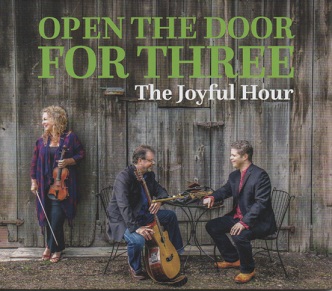
Open The Door For Three: The Joyful Hour
Open The Door For Three: The Joyful Hour
Open the Door for Three is fiddle player Liz Knowles, uilleann piper Kieran O’Hare, and Dublin-born singer and bouzouki player Pat Broaders. Their music is a rare combination of unearthed tunes from centuries-old collections, newly composed melodies, fresh arrangements of songs old and new, homages to the musicians and bands they grew up listening to, and the unmatched energy of a trio of good friends playing great Irish music together.
“A road-tested, audience-approved, high-octane, fist-in-glove, laughing-out-loud trio of Irish musicians…” “Theirs is a big and brilliant sound!” — Sean Smith, Boston Irish Reporter
Liz, Kieran, and Pat have been mainstays of the Irish music scene around the world, having distinguished themselves over the last two decades as soloists with Riverdance, Cherish the Ladies, String Sisters, Secret Garden, Anúna, and The New York Pops. As a trio, they have played to a wide range of audiences in venues large and small, from Irish festivals, to concert halls, house concerts, and pubs. They have performed around the world: on Broadway and at Carnegie Hall, at L’Olympia and the Palais des Congrès in Paris, in Malaysian rainforest festivals, in theatres from Shanghai to São Paulo, and even in a bullring in Mallorca. Most recently, they have been featured at The Kennedy Center’s Ireland 100 festival, the Celtic Colours festival in Cape Breton, at The Milwaukee Irish Festival, and in The Masters of Tradition series in Bantry, County Cork, Ireland.
Irish music is a living, breathing part of Irish and Irish-American culture, and there is no single story that can sum up its history, its charm, grace, and drive. The soul of Open the Door for Three’s music is filled with connections: the connections to people and places, to teachers and heritage and audiences, and to the stories and humor that bring us all together. From these connections comes inspiration, which fills a bottomless well that keeps the trio coming back again and again – to refill, refuel, reinvent, and share.
-
Rattle the Boards – The Parish Platform
BIOG:
Playing together since 1992,Rattle the Boards have been praised as one of the best traditional acts in Irelands music scene. Pat,John and Benny were all members of the Knocknagow Ceili Band who were based in Clonmel,Co.Tipperary and spend many years playing for dancers throughout Ireland.Benny is also leader of the International supergroup”Danu”and has toured all over the world. In 1999 Rattle the boards released their debut album to much acclaim. With many performances in Ireland and Europe over the past years Rattle the boards have grown into an act very much sought after.In 2002 Rattle the Boards provided the musical inspiration for a major Irish theatre show called Teac A Bloc by famous visual artist Des Dillon.Rattle the boards arranged and performed with Teac A Bloc to sold-out venues throughout Ireland and also performed two sketches from the show on Irelands premier tv show”The Late Late Show”This is only one of many TV appearances by Rattle The Boards todate.In March 2008 Rattle the boards released their long awaited second album “The Parish Platform”nearly a decade after the debut release.Their scense of fun and lift in the music of Rattle the boards makes them unique among their contempories.As their name suggests this is a group that will have its audience on their feet and rattling the floorboards.
Copperplate is very proud to have this title on our roster and to help it achieve its full potential will be supporting this release with a full-scale promotional mail out to media and retail. Contact Copperplate for all your PR needs.
The lads are generally available for interviews; please contact us to arrange a mutually convenient time. Please copy us on any reviews/features/airplay. Feedback always welcome.
Press Reviews
www.liveireland.com
THE LIVIES 2009
Newcomers of the Year: Rattle the Boards: Rattle the Boards
Benny McCarthy on accordion, Pat Egan on fiddle and banjo, John T. Egan on vocals, John Nugent on guitar and vocals and Donnchadh Gough on bodrhan have stormed onto the scene this year with one of the biggest selling and most loved debut albums in memory. The key? It is fun. It is a BALL!! Terrific tunes and songs, all imbued with a real sense of the joy that Irish music is. Mason’s Apron is our favorite tune, and Patrick Was a Gentleman our fav song. These guys get it. No self-involved navel-gazing here about ‘the meaning of the tradition’, and all that crap. No pretentious egos. Just a sense of the fun of it all. We love these guys and cannot wait to see them in person! Bill Margeson
Folk World Editors Best Loved Albums of the Year
Irish traditional music at its best — lively and real, spontaneous and passionate. Central to the band’s sound is the wonderful accordion playing of Danu’s Benny McCarthy, and he is joined by Pat Ryn (fiddle, guitar, mandolin), John Nugent (guitar) and the singing of John T Egan. A great mix of traditional tunes — from jigs and reels via polkas and airs to hornpipes and quicksteps — plus a number of trad songs. A few friends have joined the lads for a few numbers — and there is a bit of an unusual but very welcome interlude of a trumpet in one of the numbers, giving the number some jazzy flair.
All of this played with so much passion that the listener’s feet won’t stand still. This lot managed to distil the spirit of traditional music onto a CD, giving the listener the feeling that the foursome would just sit around the corner in his/her kitchen. And don’t be surprised that you find yourself rattling the boards of your wooden floor dancing away. An album that lifts your soul and just makes happy. Great stuff! Michael Moll
Rock’n’Reel
The brain child of Danu frontman, Benny McCarthy, Rattle the Boards second album continues their intention to revive the joie de vivre inherent in Irish music performed for pleasure and dancing before The Clancy’s and the ballad boom exposed the music and song of Ireland to a wider world.
It succeeds in its core ideal, in the verve, authority and drive of the performers attacking of the polkas, jigs and reels with flair and invention.
Of course, time hasn’t stood still and along the way, the players, John Nugent, John T Ryan, Pat Ryan, McCarthy and assorted guests contribute something of their own musical personalities. Consequently, there’s nothing precious here, with the rugged St Patrick Was A Gentleman making way for the innovative Whistling Rufus quickstep, where Decky O’Dwyer’s trumpet adds an air of Mariachi to the performance, and classic reels such as The Mason’s Apron are given a new alacrity and tempo courtesy of some dazzling melodeon from McCarthy.
Unpretentious and packing so much into its 12 tracks, Rattle The Boards enable much of the Irish tradition to breath anew. Danny Moore
The Living Tradition Aug/Sept 08
As if playing in Danu isn’t enough to fill in his days (and nights!), Benny McCarthy has got together with a bunch of his local musician friends, plus a few other guests, to produce an album of music for a good old hooley. This is not a recording for purists or musicologists to analyse and contemplate; rather it’s one for everyone just forgetting about the rest of life’s boring stuff, getting carried away with the atmosphere and having a dance, or, if that’s too much like hard work, just listen and enjoy, since this is a delight throughout.
The band line-up is Benny McCarthy on button box and melodeon; Pat Ryan, fiddle, mandolin and banjo; John Nugent, guitar; and John T Egan, vocals. Guests are Donnchadh Gough, bodhran; Des Dillon, harmonica; Jon Kenny, vocals; Decky O’Dwyer, trumpet (yes, trumpet!); Albie Grace, bass Paul Ryan, button box; and Bruno Stachelin, percussion. There is a strong Tipperary connection, with many having played in the Knocknagow Ceili Band. This is not a ceili band album, however, ditching the strict-tempo approach in favour of a free-flowing, good-time sound.
The majority of the tunes and songs are very well known and very popular indeed, and it sometimes takes a fresh, lively attack on them like this to help us all realise why they became popular in the first place. From the vocal hilarities of St Patrick was a Gentleman, via the inspired trumpet breaks on Whistling Rufus through to any other track you mention, this CD just oozes with the sounds of talented guys having a good time and infecting everyone who hears them with their sense of enjoyment.
As a nice touch, the CD is designed to look like an old-fashioned vinyl record (remember them?). Listen to this, but make sure you’ve left some space for dancing – that’s what you’ll feel like doing! Gordon Potter
TAPLAS, the Welsh folk magazine
The Parish Platform, on the other hand, is about as different as you can get while remaining within the style and repertoire of the traditional Irish genre.
Even- track is completely unlike the last. It is bright, sparkly and energetic. Each musician’s individual characteristics shine through.
The band includes Danu’s Benny McCarthy on accordion, John Nugent on guitar, John T. Egan on vocals and Pat Ryan on fiddle, mandolin and banjo.
There is also a long list of guest musicians including a cracking bodhran player and even some brass!
With all these different instrumentalists chopping and changing, soloing and blending and all playing with exuberance, dexterity and vigour, it doesn’t get stale for a second. The couple of songs are extremely engaging and entertaining and you even get to find out what happened to all the snakes in Ireland! This is a great one for the collection! Imogen O’Rourke
The Irish Democrat
EIGHT YEARS on from the release of their self-titled debut album, Rattle The Boards have come up with another toe-tapping collection of traditional Irish dance tunes and songs.
Based around a nucleus of founder members Benny McCarthy (button accordionist), John Nugent (guitar/vocals), Pat Ryan (fiddle/banjo) and former guest singer John T. Egan (vocals), Rattle The Boards have produced an album that is unashamedly nostalgic in feel. This time around featured guests include Jon Kenny (vocals), Decky O’Dwyer (trumpet), Donnchadh Gough (bodhran), Des Dillon (harmonica), Paul Ryan (accordion) and Bruno Staelhelin (percussion).
What could so easily have ended up as mere pastiche is anything but. This is entirely down to the excellent quality and vitality of the playing – though you’d hardly expect anything less from an ensemble that features two members of Irish traditional ‘supergroup’ Danu (McCarthy and Gough) and a bevy of renowned and respected musicians with more ceilis under their belt than you could shake a stick at.
While their unrepentantly backward-looking tribute pays homage to the musical culture of a bygone era it does so in style. Although their approach won’t please everyone, you’ll need a narrow mind and a cold heart not to find your spirit lifted and your feet tapping, providing a reminder of a time when virtually the sole purpose of music was to get folk on their feet.
In fact, if these tunes and songs don’t get you in the mood the volume’s probably not up loud enough – either that or you’re under the boards rather than in any position to rattle them. David Granville
“Tunes familiar to every parish but with a bit of fire under them” THE IRISH TIMES
Shake, ‘Rattle,’ and Roll On Music Meant for the Dancer in You
[Published on June 4, 2008, in the IRISH ECHO newspaper, New York City. Copyright (c) Earle Hitchner. All rights reserved. Reprinted by permission of author.]
The self-titled debut recording in 1999 by Rattle the Boards raised a smile for me when I read the group’s track note for “The Controversial Reel.” Listed as “trad.,” it was described as “a lovely reel which is around a long time.” Thirty-one years ago, the reel appeared on “Kiss Me Kate,” an album by fiddler Liz Carroll and button accordionist Tommy Maguire. So the track note is accurate–except for “trad.” It isn’t. The reel was composed by Brooklyn-born, Baltimore resident button accordionist Billy McComiskey. But the compliment to McComiskey comes from the assumption that a tune that good must be “trad.”
“Trad.” instrumental music is mainly dance music, and the latter dominates “The Parish Platform,” the new recording by Rattle the Boards. My hope is that the group, like “The Controversial Reel,” will be around a long time, for their music is an unvarnished joy meant to get your feet moving and, yes, rattling the boards.
The founding members of Rattle the Boards are Danu button accordionist Benny McCarthy from Waterford, banjo, fiddle, and mandolin player Pat Ryan from Tipperary, and guitarist John Nugent, Ryan’s brother-in-law, from Tipperary. All three formerly played with the Knocknagow Ceili Band, based in Clonmel, and have gotten together to play music almost weekly since 1992.
The guest singer on the first Rattle the Boards album was Tipperary’s Martha Beardmore, and the full-fledged member now singing with the group is Tipperary’s John T. Egan. He possesses a gruff voice well suited to the two songs on the new CD, “St. Patrick Was a Gentleman” (Jon Kenny shares lead vocal) and “The Nightingale.”
The rest of the dozen tracks on “The Parish Platform” are tunes, and the album’s most dazzling performance comes from button accordionist Benny McCarthy on “The Mason’s Apron.” It’s a warhorse traditional reel that was boosted in popularity by fiddler Sean Maguire with the Four Star Quartet and then boosted again through the solo turn by flutist Matt Molloy in the Chieftains’ concerts. The embellishments by McCarthy in this reel refreshen it. Accompanied by Nugent on guitar and McCarthy’s Danu colleague Donnchadh Gough on bodhran, the button accordionist plays with triplet-flecked swing and inventive panache while never losing his grip on the tune’s melodic spine. This tour de force matches McCarthy’s best work with Danu.
“McKillop’s/Love at the Endings/High Reel” is a medley initially showcasing Pat Ryan’s skill on the fiddle. With Nugent and Gough backing him, Ryan plays the first reel with limber energy and pulse, all ratcheted up when McCarthy enters on the second reel and Ryan himself switches to banjo on the third reel. Even nailing your shoes to the floor won’t prevent you from tapping them to this percolating beat.
In the “Galway/Peacock’s Feather” hornpipes, McCarthy’s accordion playing, which sports some well-placed, Derrane-like triplets, and Ryan’s banjo playing, which ably complements the box and also allows it to veer off on nimble flights of fancy, form a crisp, cohesive whole, backed unobtrusively by Nugent on guitar.
“The Irish Washerwoman” is a jig still shunned by many Irish traditional musicians, who feel it has been done to death in the past and also conjures up a cultural image of demeaning stereotype. But no matter how long this jig may be mothballed, it is instantly recognizable when dusted off and performed. The reason is its enduring melodic and rhythmic appeal. Both are obvious in the vibrant new airing the jig receives from McCarthy on accordion, Ryan on banjo, Nugent on guitar, and Gough on bodhran in a medley that includes “Maid in the Meadow” and “Humours of Drinagh.”
Among the other medleys packing a punch on the new album are “Farrell O’Gara/Gan Ainm/The Flying Irishman” reels, “Cuz Teahan’s/Gan Ainm/Johnny O’Leary’s” polkas, and “Jimmy’s Jig/Gan Ainm.”
Where ceili band and showband merge (collide, if you’re a purist) is “Whistling Rufus,” a hoot of a quickstep tune played a little too loosely. It additionally melds Irish trad with New Orleans jazz strains, especially through guest Decky O’Dwyer’s trumpet playing.
A critic in Ireland wrote that “The Parish Platform” may veer near “caricature.” I suppose the plain woolen caps, work shoes, and other attire worn by the quartet in sepia-toned album photos–one shows them dancing and playing music on a small wooden platform laid on a dirt country lane with an old car parked close by–may give off that impression to some. But it’s a mistake to suggest that “The Parish Platform” inadvertently swerves toward “caricature” or, worse, constitutes a deliberate goof or spoof smirking at a musical style and attitude rooted in the rural Ireland of the not-so-distant past. This album is not a lampoon but a lively, winsome tribute, full of fun and motivated by respect, recalling a time when spurring people to dance was all that mattered. What’s not to like about that? Earle Hitchner
www.liveIreland.com
Next up is a new fav, The Parish Platform by Rattle the Boards. Four musicians, with guest stars. John Nugent, Benny McCarthy, John Egan and Pat Ryan offer an album of great fun and a sense of the real trad. This is not the honed studio perfection of so many albums today. This is a big, blousy thing with a great sense of the music, the rhythms and the meaning. It is the most fun we have had listening to anything in quite a while. We frequently smiled, and even got up to shake a foot occasionally ourselves! The role of ceili and set dancing is well recorded in Irish music, and vastly overrated. And, if this album in description pays a little too much of a tip of the hat to the dancing tradition, it delivers the essential goods—the music itself. You will love this album. It will be a contender for Vocal/Instrumental Album of the Year. It is their second album and is offered through Doon Productions. Go to www.rattletheboards.com. Find this album and buy it. Then turn it up. Smile. Rating: Four Harps. Bill Margeson
Irish Music Magazine
Rattle the Boards tread a fine line between ceoltoir and caricature. I’d say they carry it off, their music is meant to be fun and it is. From the opening notes of ‘Cuz Teehan’s Polka’ we’re clearly well down the country, the whole album is a triumph of exuberance.
All the old favourites are trotted out: ‘The Mason’s Apron, The Irish Washerwoman, The Galway Hornpipe’ and The High Reel’. Box and banjo front men, Benny McCarthy and Pat Ryan are well known from Danu and the Knockgow band. They’re joined by John Nugent on guitar, and John T Egan for the occasional song, on this follow-up to their 1999 debut CD.
Amidst plenty of good stuff, the majority is pure traditional: ‘Johnny Leary’s, Off to California, McKillop’s Reel, Humours of Drinagh’, and a couple of ‘Can Ainmneacha’. The showband standard, ‘Whistling Rufus’ adds a note of jazz and pays homage to Clonmel’s other musical heritage (Mick Delahunty’s big band). The big band on this track is a one man horn section from Decky O’Dwyer and some deft finger work on the box from McCarthy.
Benny excels on his ‘Mason’s Apron’ solo, with enough variations to please any Dubliners die-hards, while ‘Autumn Sky’ and The Nightingale’ are firmly back in showband territory. There are just two songs on The Parish Platform’; the other is a rough-and-ready romp through the comic ballad ‘St Patrick Was a Gentleman’, a duet with comedian John Kenny. A set of reels headed up by ‘Farrell O’Gara’ provides the big finish, played straight and not too fast, a satisfying conclusion to a most entertaining CD. There’s an engagingly antiqued website at www.rattletheboards.com. Alex Monaghan
£14.99 -
The Baileys – A Song for Ireland
As soon as they were old enough to acquire a dubious-looking brown van, Michael and Anthony began touring the country, passing on great ballads in the time honoured folk tradition. By now, there’s hardly a village hall or pub in any hamlet of Ireland that hasn’t yet played host to their electrically-charged performances.
Michael is a founding member of Rig the Jig and Anthony joined Rig the Jig two years ago. Rig the Jig released four critically-acclaimed Celtic music records. PASSING THROUGH débuted at #5 on Billboard’s World Music chart. Rig the Jig has been heard on more than 60 NPR stations and performed at the Country Music Hall of Fame, CMT and dozens of festivals across America. Rig the Jig are currently recording their fifth album.
Times have changed, however. With the music industry awash with complex fusion works and variations of Irish music, demand for a truly organic Irish sound has soared. Michael and Anthony caught the crest of this wave, enjoying a success that has seen them play to massive audiences in theatres and folk music clubs across Ireland.
Where The Baileys go, true aficionados follow. Theirs is a gift that transcends national boundaries.
Attention music lovers everywhere. If you’ve been noticing a yawning gap in your current musical diet, worry no more. Irish folk singing sensation The Baileys are about to enrich your diet by unleashing a sensational new album onto the World stage. Brace yourselves for a taste explosion. The Baileys, all the way from the heart of Ireland, have a plethora of musical ingredients to dazzle the palate. And well they might. Life-long friends Michael Banahan and Anthony McDermott boast an impressive pedigree, steeped in the folk tradition since the embryonic stage. Now, to the delight of their ever-increasing fan base, they’ve put their unique energies together to create an album that perfectly encompasses the beauty and history of Irish folk songs. Make no mistake; this collection of 20 songs is a vital addition to the collection of any discerning folk song lover.
From the timeless ballad ‘Fiddler’s Green’ and the sorrowful yearning of ‘Raglan Road’ to the pithy and humorous ‘Colcannon’ and the aching beauty of the sports anthem The Fields of Athenry, this new offering from The Baileys is an aural patchwork of all that is great about the Emerald Isle. Throw in the fast-paced ‘Rocky Road to Dublin’, truly a song with a rhythm of its own, and it makes for an album that is truly a balm to the music lover’s ears.
It’s a recording that has been stewing for a long time in the minds of these two talented troubadours. For over a quarter of a century, they’ve been honing their talents along the highways and byways of Ireland. From their childhood days in the midlands town of Roscommon, they eschewed fairytales and nursery rhymes in favor of learning some of the best folk songs their country has to offer. ‘Sullivan’s John’ was one of the first songs ever carried by Michael’s compelling voice, accompanied by the pulsating chords of Anthony’s hard-working guitar. Of course, no self-respecting Roscommon musicians would reach adulthood without their own well-practiced rendition of ‘The Mountains of Mourne’; the lilting ballad penned by the county’s most famous writer Percy French.
Press Reviews
Rambles.net
Whether or not you’ve been to Ireland, this 20-track CD will have your heart longing for its shores.
The Baileys are the real thing. Sure, the Irish music tradition these days is saturated with world-music influences and glitzy electronics, but these two gents — Michael Banahan and Anthony McDermott — are the true, pure sound of Irish songcraft. Having honed their art over more than two decades of touring the pubs and venues of their lush green countryside, they now offer their music to the world with A Song for Ireland.
Both men sing, with Banahan on lead. Both play acoustic guitar, and Banahan sometimes adds bodhran. For this recording, they’ve added several welcome guests: Paul Gurney on piano, bass, accordion, guitar and percussion, Noel Carberry on uilleann pipes and whistles, Aoife Kelly on fiddle, Johnnie Duffy on banjo and Danny Sheerin on backing vocals. It combines for a full sound that is never crowded or overproduced.
But at its heart, this recording is a couple of guys who love their musical tradition and offer it up with touching sincerity. There are no surprises in the song selections here; almost all are familiar, from the opener “Colcannon” through “Rocky Road to Dublin,” “Danny Boy,” “Black Velvet Band,” “The Ould Triangle,” “Peggy Gordon,” “The Fields of Athenry” and “Spancil Hill,” right into the closing track, “Raglan Road.”
The songs are slow, sweet and simply presented. They are often sad, mournful but never maudlin. The more sentimental listeners may find themselves misting up every now and again as Banahan and McDermott sing. And, oh, I want to be there, listening to these men sing from a Guinness-soaked bench in a dark Irish pub. And when they’re done, I want to shake their hands and tell them they made me miss Ireland so much, I just had to come.
In the meantime, I’ll be listening to A Song for Ireland fairly often — if I can collect it again from my father, who would never forgive me if I didn’t loan it to him as soon as I’m done writing this review.
Celtic Music Magazine
The title of The Baileys debut album ‘A Song for Ireland’ sums up the entirety of this record. This album acts as a who’s who of favorite, traditional Irish songs. It unabashedly takes the reader through many of the classics with the driving purpose to once again put the songs themselves in the spotlight instead of the performers. Listening to this album instead makes you feel as if you are in a warm, relaxing pub listening to true Irish folk music the way it was meant to be played, with sensitivity and emotion.
While this is their first album as a duo, Michael Banahan and Anthony Mc Dermott are no strangers to this style of music. Originally, both Michael and Anthony were two members of another well-acclaimed band, Rig the Jig, and they have both been playing sessions for years. As such, their skill and familiarity with these tunes is highlighted on this album with each successive song.
In ‘Rocky Road to Dublin’ and ‘Spancil Hill’ Michael and Anthony both showcase their dexterity with the fluidity and cleanliness of their instrumentation. In ‘Arthur McBride,’ ‘Raglan Road,’ and ‘The Fields of Athenry’ the beautiful harmonies and stories instead take the center stage. Furthermore, on this album The Baileys treat us to some of the rarer classic as ‘Colcannon,’ ‘Peggy Gordon,’ and ‘Dublin In The Rare Ould Times.’
In short, if you love traditional Irish music The Baileys album ‘A Song for Ireland’ will be a wonderful addition to your collection.Stephen McSweeney
Greenmanreview.com
The Baileys have been around for a number of years, but are not widely known on my side of the Irish Sea, mainly in Ireland. However, this could all change soon. I understand this is their first album as a duo. The experience they have gained on the road (having gigged extensively in Ireland), and their ability to ‘read an audience’ shows not only in their choice of material but also in the way it is played. This is a superb album of favourite Irish songs that won’t offend anyone. It simply entertains from start to finish.
Sometimes these days artists trying to be too clever often spoils good songs, It is almost like a step back in time listening to the arrangements and delivery of the songs; true Irish pub folk as it used to be played when I was a lad.
The Baileys are Michael Banahan on vocals, acoustic guitar and bodhrán and Anthony McDermott on acoustic guitar and backing vocals. So why are they called The Baileys? Damned if I know! Perhaps they wanted to call themselves The Dubliners, but that name had been taken! They are joined on the album by guest musicians Paul Gurney, piano, bass, accordion, acoustic guitar, and percussion; Noel Carberry on Uilleann pipes, and whistles; Aoife Kelly playing fiddle; Johnnie Duffy on banjo and Danny Sherrin singing backing vocals.
The songs, 20 tracks in all, are mostly traditional Irish ballads such as ‘I’ll Tell Me Ma,’ ‘Rocky Road to Dublin,’ ‘Black Velvet Band,’ ‘Arthur McBride,’ ‘The Wild Rover,’ and ‘Colcannon’ to name but a few, and contemporary material such as ‘Fields of Athenry,’ ‘A Song For Ireland,’ ‘Fiddlers Green’ plus many more. If you are looking for new arrangements and treatments for these songs, you will be disappointed. This is not what the album is about. Instead, the songs are sung as they are supposed to be with sensitivity and taste, very much as you might expect to hear at any folk club or session. In short they are enjoyable and entertaining letting the lyrics and melodies speak for themselves.
To sum up, this is the debut album from the Baileys, and it won’t be their last. Here is a band that is commercially viable. It won’t be long before they start to appear on folk club and festival guest lists. They have a web site here with more information, plus you can hear, and buy the album on-line. Good entertaining Irish folk at its best. Peter Massey
Piping It In – Irish American News Chicago USA Nov 2009
While I’m talking about talented duos, I have to mention what is rapidly becoming one of my favourite CDs this year, A Song for Ireland by the Baileys. The Baileys are Michael Banahan and Anthony McDermott, two experienced, talented, traditional musicians who have created, in this CD, a classic. It contains 20 popular songs that we all know and have heard many times, but never played and sung this well. I’ve recommended this to many folks looking for a traditional CD that they can use to learn traditional songs and everyone has loved it. It’s seldom that you get this much music performed this consistently well. Some of the tunes, you ask
£14.99 -
Tim Dennehy – Between the Mountains and the Sea
Press Reviews
The Irish Post 4.06.05
THIS beautiful production has been in the making for 20 years and has put the enthralling words of one of Ireland’s most talented ballad poets to music.
Sigerson Clifford was born in 1913 and christened Edward Bernard Clifford. Aged six he went to live with his mother’s father Edward Sigerson and stayed for four years. He never forgot his grandfather’s fund of stories when the winter nights were gathering in he would sit with his cronies around the kitchen fire telling tales of weird and ghostly happenings.
Later Sigerson would remember them in a poem “Where the old men thatched their dreams with adjectives”.
At school with the Christian Brothers his essays and poems won praise. Schooldays over he joined the civil service where “they chained my bones
to an office stool and my soul to a clock”.
In 1985 some months after his death the good people of Cahersiveen decided to honour his memory with a monument built of local stone. The
inscription reads: “Whispering across the half-door of the mind, for always I am Kerry”
In 1973 Tim Dennehy encountered Tim Dwane who had met Sigerson Clifford on several occasions and then he discovered The Ballad Of The Tinker’s Daughter in an English book. He put a melody to it and sang it for the first time at the Goilin Singers Club in Dublin.
It was broadcast by Harry Bradshaw on a radio programme The Long Note and since then Between The Mountains And The Sea has been an ongoing project.
This 12-track CD is accompanied with a 48-page booklet giving extensive background on the composer Sigerson Clifford.
The Boys Of Barr na Staide is undoubtedly Singerson’s most popular composition and it captures beautifully the essence of Cahersiveen.
The Ballad Of The Tinker’s Daughter is a spellbinding story and in the best traditions of the ballad it allows the story to unfold.
I am Kerry is a fitting conclusion to the album as it touches on most of the poet’s favourite themes of stories and legends, the wild beauty of south Kerry, youth and old age, and the mental merging of music and rhythm of the place he loved.
This CD is guaranteed to soothe the troubled brow and should have a space on every Kerryman’s CD collection.
By any standards Tim Dennehy has done a beautiful presentation of the songs of Sigerson Clifford. MALCOLM ROGERS.
The Folk Diary
It quickly becomes obvious that here is one of the great west of Ireland voices with all the qualities that the high art of this tradition demands;
light, pure of tone and carefully and highly decorated.
Yet, these are not traditional songs that we are listening to; they are all the compositions of the late Sigerson Clifford of Caherisiveen on the Ring of Kerry. He was a poet, ballad and song writer who was rooted in the background and traditions but on this evidence, despite their local settings they have a great universality. From the careful observation of a light piece like “The Races” to the passion of “The Ballad of Johnny Golden” we hear a varied and high quality programme beautifully performed. The highlight of the album is the exquisite “The Boys of Barr Na Sr
£14.99