Trios
Showing 1–16 of 17 results
-
Hendry, Mullholland, McSherry – Tuned Up
Music in Black & White
This album came about of an inherant love of music and great support from family and friends. We had lots of great nights putting this together and the odd late night drink wasn’t unheard of.
Having grown up immersed in music, and fortunate to be surrounded by people who had a great understanding of it, we set out on a voyage that
would respect this, and also create a style of music that reflected us.
So from the streets of West Belfast, to the hills of Tullyrusk and the lowlands of South Derry, Paul McSherry, Brendan Mulholland and Brendan Hendry say thanks for taking the time and we hope you enjoy our music. Brendan Mulholland / Brendan Hendry / Paul McSherry
Brendan Mulholland / Brendan Hendry / Paul McSherry
‘Fiddle and flute, fiddle and flute, fiddle and flute’ this was the mantra expressed to me time and time again by PJ Crotty, the wonderful flute player from Moyasta in West Clare.
The unifying sound created when these two instruments come together for me is second to none and my album In Good Company made up of duets with 9 different fiddle players is testimony to this.
On this recording Brendan Hendry (fiddle) from Bellaghy Co. Derry and Brendan Mulholland (flute) from Glenavy, Co. Antrim have added more weight
to my theory by producing an album full of great playing, lovely tunes (including 4 of their own) and tasty arrangements with the perfect guitar accompaniment provided by Paul McSherry.
This is one of those rare recordings that just keeps getting better and better with lots of hidden gems lurking beneath the surface. On each listen something new is revealed, resulting in a tightly knit unified performance that allows their individual virtuosity to shine through.
Their playing demonstrates a deep understanding and knowledge of the music’s subtle details and meaning with three musical minds creating something far greater than the sum of the parts. I love the sense of space created within the tunes, letting the music breath and pulse naturally and
effortlessly, carrying the listener along on a musical journey which starts out and ends up at the heart of the tradition.
The expert guitar playing of Paul McSherry from Belfast, Co. Antrim can not be overlooked on this recording, his skilled and sensitive touch combined with his drive and rhythm provides the right grounding upon which the music can flourish ……. and flourish it has. Brendan Hendry and
Brendan Mulholland are making music on a par with that of Matt Molloy and Tommy Peoples. Fred Finn and Peter Horan, Frankie Kennedy and Mairead NiMhaonaigh etc.
I am sure by now you’ll agree with PJ Crotty and myself that this combination of instruments takes some beating!
Repeat after me – “fiddle and flute, fiddle and flute, fiddle and flute”. Kevin Crawford February 2008
Brendan Hendry
from Bellaghy in Co Derry is one of the great fiddle player’s in Ireland today. Brendan a member of the White Hare Band were the first Irish act to be awarded a prestigious Danny Kyle Award at the legendary Celtic Connection’s Festival.
Brendan is a widely respected musician in traditional music and has entertained many audiences and if the conditions are right he will deliver a rendition of many a fine song.
Brenadan Mulholland
lives in Glenavy, Co Antrim and is regarded as one of the finest young flute exponents in Ireland.
Paul McSherry
From Belfast, Co. Antrim, Paul began was self-taught on the guitar from the age of 14. Considered one of the top guitar players in Irish Traditional Music, he has worked and recorded with artists such as Michael McGoldrick, Kevin Crawford, Gerry O’Connor, Cormac Breatnach, John McSherry as well as bands Commonalty, Tamalin and more recently Guidewires.
A gifted player, he continues to be a highly influential and respected guitarist in Irish Traditional Music.
Press Reviews
www.liveireland.com The Livie AWards 2012
Concert of the Year – Brendan Hendry / Brendan Mulholland / Jim Rainey
This trio came in from Northern Ireland for Irish Fest in Milwaukee. As you have read above, Brendan Hendry is this year’s Male Musician of the Year. Next year’s is probably the flute player, Brendan Mulholland. Jim Rainey did a lovely job of accompaniment on guitar. The lads offered a weekend-long tutorial of music and concerts of perfection. We have known for a long time what an incredible musician of soul and substance Brendan Hendry is. Brendan Mulholland on wooden flute came as a stunning surprise of an introduction. Brendan has a new album coming out in 2012 and he is the early favorite for next year’s Musician of the Year. We can tell you that Mulholland equals any flute player in the music today. He is magic. Their albums show masters at the top of their form. This is the way Irish music is supposed to sound and it has never sounded better than in those concerts.
The Living Tradition May/June 09
Now this is something special. A couple of handy Ulster lads on flute and fiddle may not be unusual, but the fierce energy and passion, which pours out of Brendan Mulholland and Brendan Hendry is rare indeed. Add to that their uncanny synchrony, plus their taste for good tunes, and it’s tempting to see Tuned Up as an instant classic.
Certainly this recording is proof enough that the tradition of flute and fiddle duets is alive and well in Derry and Antrim. Listen to the change out of Tatter Jack Walsh, the lead into Mug of Brown Ale. And it’s not just jigs: The Boys of Malin is rattled out in impeccable unison, and the opening Fox on the Town set is pretty spot-on too. There’s a strong Scots influence on the material here, with Gladstone’s Reel maintaining its popularity in Ulster and The High Road to Linton treated as a two-part swagger. Ian “Tonkan” MacDonald’s charming waltz opens a set containing Tania “Duhks” Elizabeth’s slow reel The Dregs of Birch and a spirited rendition of The Road to Taynuilt – a definite highlight. I should also mention the trio of jigs by Brendan Hendry, eccentric and familiar by turns, great old-style tunes.
Some might take issue with the phrase “perfect guitar accompaniment” applied to Irish music, but if you have to have a guitarist you’d be wise to look in County Antrim and you couldn’t get much better than Paul McSherry. His strumming drives the jigs and reels, and his rippling runs and arpeggios provide the ideal backdrop for Gerald Fahy’s air Magh Seola. There’s interesting little bits and pieces going on behind Johnny O’Leary’s Polka, and Paul takes the lead on a silky slow version of The Kilavil Jig. Brendan Mulholland’s composition The Lost Ring follows seamlessly as a flute and guitar duet, and Brendan Hendry finally takes his bow on the Jerry Holland tune Malcolm’s New Fiddle. That’s Jerry with a J, from Boston. Neither Jerry nor anyone else joins the trio here:
Tuned Up is all their own work, and very proud of it they should be too. Alex Monaghan
www.folkradio.co.uk
Tuned Up! A stunning album
These gentlemen are top of their class and this album is up there with the best of them in the Irish Tradition. This is a classic that will breathe new life into Irish traditional music. Fantastic!
It’s not often I start a review by explaining what an album isn’t rather than what it is. In the case of Brendan Hendry (fiddle), Brendan Mulholland (flute) and Paul McSherry (guitar) it seems very appropriate as it is so far removed from what you often hear today. You will find no fancy arrangements although there are of course flourishes, no guest stars (you don’t need them to sell this album) and no percussion (the guitar and rythm of flute and fiddle more than makes up for that). This is pure traditional Irish music: fiddle, flute and guitar.
The album I am referring to is ‘Tuned Up’; it has a sincerity and well rooted respect for Irish traditional music which comes across throughout the album. In this day and age making an album so unvarnished is often seen as a daring move. This may sound strange but a lot of music is underpinned by big production values and attempts to do things differently. The result is often over use of fancy play, many instruments competing for attention and a raft of guest stars with a big budget on tow. It was refreshing to hear this album it makes you realise how great a good traditional act can sound where their playing is sincerely based on an inherent love of traditional music.
The fiddle and flute combine to create a beautiful sound that, with the accompaniment of Paul McSherry on guitar, make every track on this album a virtuoso performance. They work so closely together with the flute and fiddle matching note for note in places followed by subtle interplay and flourishes. There is a bond between these musicians that you will struggle to hear in others. That bond has allowed them to master a fine traditional art of play. Their instruments don’t shout for attention and they play incredibly well. Forget your spotlight solos, this is clever musicianship that sounds effortless and is as natural as can be.
SONGLINES Apr/May 09
Making the fiendishly difficult sound easy peasy ****
Simplicity is the watchword for this accomplished first album from the combined talents of fiddler Brendan Hendry, Brendan Mulholland on flute and guitarist Paul McSherry. Bringing a fresh, heartfelt and occasionally feisty musicality to bear on an effortlessly engaging collection of traditional and new material, the trio adopts a back-to-basics approach that emphasises substance over surface gloss.
The White Hare Band frontman Hendry acquits himself with a direct and understated dexterity that summons up flattering memories of Sligo legend MichaeI Coleman. Home to the no-less-deft Mulholland is the village of Glenavy in Antrim, a county with a teeming but hidden heritage of traditional music, while the West Belfast-born and self taught McSherry is part of one of the most respected musical families.
The well-chosen blend of fast and slow reels and jigs, subtly peppered with contrasting waltzes, polkas, hornpipes and airs, is executed with enviable ease, the playing unfailingly alive and alert. Immediately apparent is the straight forward, unornamented honesty of the playing and the vividly reciprocal sense ensemble.
Where Mulholland carries himself with the skilful delicacy of Paddy Carty and the poetic brio of Matt Molloy.
Hendry is simply one of the finest and most nuanced fiddle players in Ireland today. The much-in-demand McSherry offers supple and sensitive support throughout.
All in all, an impressive first outing for a fine partnership that leaves you eager to hear more. Michael Quinn
Froots
“This is an album so damned good that its essence should be bottled and force-fed to all Irish infants”. Geoff Wallis
FolkWorld Alex Monaghan’s Best Loved Albums of 008
Now this is something special. A couple of handy Ulster lads on flute and fiddle may not be unusual, but the fierce energy and passion which pours out of Brendan Mulholland and Brendan Hendry is rare indeed. Add to that their uncanny synchrony, plus their taste for good tunes, and it’s tempting to see Tuned Up as an instant classic. Certainly this recording is proof enough that the tradition of flute and fiddle duets is alive and well in Derry and Antrim. Listen to the change out of Tatter Jack Walsh, the lead into Mug of Brown Ale. And it’s not just jigs: The Boys of Malin is rattled out in impeccable unison, and the opening Fox on the Town set is pretty spot-on too. There’s a strong Scots influence on the material here, with Gladstone’s Reel maintaining its popularity in Ulster and The High Road to Linton treated as a two-part swagger. Ian “Tonkan” MacDonald’s charming waltz opens a set containing Tania “Duhks” Elizabeth’s slow reel The Dregs of Birch and a spirited rendition of The Road to Taynuilt – a definite highlight. I should also mention the trio of jigs by Brendan Hendry, eccentric and familiar by turns, great old-style tunes.
Some might take issue with the phrase “perfect guitar accompaniment” applied to Irish music, but if you have to have a guitarist you’d be wise to look in County Antrim and you couldn’t get much better than Paul McSherry. His strumming drives the jigs and reels, and his rippling runs and arpeggios provide the ideal backdrop for Gerald Fahy’s air Magh Seola. There’s interesting little bits and pieces going on behind Johnny O’Leary’s Polka, and Paul takes the lead on a silky slow version of The Kilavil Jig. Brendan Mulholland’s composition The Lost Ring follows seamlessly as a flute and guitar duet, and Brendan Hendry finally takes his bow on the Jerry Holland tune Malcolm’s New Fiddle. That’s Jerry with a J, from Boston. Neither Jerry nor anyone else joins the trio here: Tuned Up is all their own work, and very proud of it they should be too.
Alex Monaghan
www.liveireland.com
THE LIVIES 2009
Instrumental Album of the Year: Tuned Up: Hendry, Mulholland, McSherry
Brendan Hendry, Brendan Mulholland and Paul McSherry are from Derry and Antrim, and have produced the virtually perfect traditional, instrumental album. Master musicians all. We have played the first cut on the album about 125 times. It is a set of three reels, Fox in the Town/In the Tap Room/The Belfast Traveller. Hendry is on fiddle, Mulholland on flute and McSherry on guitar. This is straight ahead, no frills, no gimmick trad played by wonderful musicians. This is what it is all about. Or should be. Incredible. Again, when dealing with this level of musicianship, words fail us. Get up, ‘ya boyos!! Bill Margeson
Taplas
THIS album is well ensconced in the field of the neo-traditional.The melodies, played on flute and fiddle, and sometimes guitar, are unadulterated trad Irish through and through. The guitar accompaniment has a slightly more modern twist, but nothing particularly out of the ordinary.
The style of the fiddle and flute playing leans more towards emotion and precision and further away from the more rhythmically diverse and bouncier playing of many of their contemporaries.They’re not in your face.The music of the Brendans has, therefore, married in well with the driving and diverse playing of Paul McSherry.
It’s quite an interesting album: lots of interesting little musical titbits popping up. There’s a fair bit of overdubbing, intros, interludes, harmonies, changes of pace etc. The solo guitar melodies and sparser tracks highlighting one or two players contrast with the other more full-bodied pieces. Imogen O’Rourke
Folking.Com
The more music I listen to, the more I am convinced that where music is concerned, three is a magic number — a trio of musicians always seem to achieve a certain balance. With Tuned Up there is balance in abundance, in fact there is plenty in abundance here: pace, poise and elegance immediately spring to mind. This is an album of the most beautifully pure music. There is no unnecessarily fussy production, no wanton rhythm section muscling in on the action, just the gorgeously intoxicating sound of guitar, flute and fiddle working together in heavenly harmony.
In this case the trio consists of two Antrim men, Brendan Mulholland on flute and Paul McSherry on guitar, alongside Derry’s Brendan Hendry on fiddle. Comprising mainly jigs and reels — with a polka, waltz, hornpipe and slow air thrown in for good measure — Tuned Up provides ten sets of tunes that demonstrate relentlessly excellent musicianship, taking the listener from one exhilarating high point to another, with a masterfully engaging immediacy.
A set of reels gets things off to a lively start as the guys come racing off the starting line. McSherry’s pacey guitar lends a fierce and fiery rhythm as the duelling fiddle and flute of Hendry and Mulholland entwine in an inseparable embrace. The trio’s versatility shines through on “The Killavil” with McSherry employing a more measured, intricate guitar technique, alongside the wallowing flute of Mulholland and Hendry’s reticent fiddle, before the set turns to some more up-tempo jigs, allowing all the musicians to once again stretch their legs.
This isn’t music that you can listen to in a detached manner. This is music with a passion that carries you along for the ride. It’s not really like listening to an album, it’s more like sitting in on a seamlessly flowing session. It’s almost a surprise when you look up after the end of the album to find there are no musicians alongside you, no crowd egging them on to further fast and furious delights.Tuned Up is a refreshing blast of an album that basks in uncompromising candour, and is certain not to disappoint. Mike Wilson
The Irish World
NORTHERN TREATMENT
Three Northern musicians cook up a real treat…
Tuned Up’ (Copperplate) sees three fine musicians from the North of Ireland join forces to create a fine classic fiddle and flute album. They are great West Belfast guitar player Paul McSherry, brilliant young flute player Brendan Mulholland from Glenavy, Co Antrim and the wonderful fiddler Brendan Hendry from Belaghy in Derrv.
The music speaks for itself here – there’s no showing off with arrangement, no huge names or unusual instruments – just traditional music with the instruments in duet, flute and fiddle
that form its very foundation. McSherry, one of the most in demand guitarists on the traditional scene, provides unobtrusive support like a true pro.
These three musicians have come up with an album whose beauty lies in its simplicitv. With a mix of self-penned and traditional numbers, it not only pays its respects to tradition,
but is full of flair and a love of Irish music. And with each polka, jig and reel, rarely have three musicians sounded like they were singing to such a degree from the same hymn sheet.
Shelley Marsden
LiveIreland.com
There are 10 cuts on this album, and it is an early qualifier for Instrumental Album of the Year. Derry musicians Mulholland on flute, Hendry on fiddle and McSherry on guitar have produced the virtually perfect instrumental album. These lads can play! No fuss. No frills. No production gimmicks. Just straight ahead trad played perfectly. There is always, always more than
enough room for musicians of this caliber using this approach. Welcome, lads! You have played a blinder! Fab! Rating: Four Harps Bill Margeson
The Irish Post
Ulster musicians release CD
A TRIO of traditional Irish musicians from Ulster have released their fantastic new album. Tuned Up is the new record from Brendan Hendry, Brendan Mulholland and Paul McSherry.
There are no flashy arrangements, no exotic instruments, no guest stars, no percussion, no Celtic misty washes – just good honest Irish traditional music played by masters of the art.
Brendan Hendry hails from Bellaghy in Co. Derry. Over the years he has played on many stages and is one of the great fiddle players in Ireland today.
Brendan Mulholland lives in Glenavy, Co. Antrim and is regarded as one of the finest young flute exponents in Ireland.
Paul McSherry was a founder member of the family group Tamalin. From there he moved on to work with At First Light and Lunasa among others. He is one of the most sought after guitarists in Irish traditional music.
This trio of brilliant musicians has produced an album that respects the tradition and also produces music from the bottom of their hearts, full of flair, colour and soul.
The Clare People Newspaper
When you put three of the best musicians in the country together on three of the most popular instruments in Irish music you are bound to hear something that will blow you away.
Their playing demonstrates a real sound of effection towards their music and this is shown with great taste in the selction of tunes and versions they play.
The album starts with a great set of reels played so tight that you would think its one instrument at times. The second track straight away throws you in a different direction with just
flute and fiddle.
My favourite track has to be the third. It starts with a great slow groove from the guitar into the Killavel jig, followed by one of the nicest tunes I have heard written by Mullholland entgitled ‘The lost ring’ and finishes powerfully with ‘Malcolms new fiddle’.
There are so many great tunes on this recording but some that stand out are ‘Magh Seola’ written by Ger Fahy and ‘The Bar Mouth’ written by Brendan Hendry.
Overall a top class album with great production and thought gone into it. Padraig Rynne 9/10
FOLKWORDS
A new CD from Copperplate Distribution arrived a few days ago. Called ‘Tuned Up’ from Brendan Hendry, Brendan Mulholland and Paul McSherry, it’s a reflection of three men and their collective love of the music of Ireland. Although the names may sound like a firm of solicitors, Hendry, Mulholland and McSherry are musicians – and damn fine musicians too, ranked among the best in timeless Irish traditional music.
If you consider the classic combination of fiddle and flute to be the essence of Irish music then ‘Tuned Up’ is for you. If adding supremely sensitive guitar rounds out your mood, then you’re in for a treat.
The two Brendans – Hendry and Mulholland, play fiddle and flute respectively, while Paul McSherry plays guitar. With ‘Tuned Up’ these three have created a simple unadorned album that works on so many levels. Straight out the box it’s a lovingly crafted selection of tunes – traditional, self-penned and borrowed. On subsequent listens it grows into a musical book with new, half-remembered and untold tales woven into its fabric. The more you listen the more you hear. And they’ve included some of my favourites: ‘High Road to Linton/ The Humours of Newcastle’ plus ‘Johnny O’Leary’/ Boys of Malin’.
There’s a well-worn expression about musicians being so tight you can’t force a cigarette paper between them — well these guys are so tight they must be joined at the hip. Brendan Hendry is rightfully recognised among the great and good of Irish fiddlers – easy to see why. Brendan Mulholland makes the flute his own instrument, so much so that few can match him. Too often when bands use guitar or bouzouki with fiddle and flute, it’s with the finesse of a road drill. Not so here, Paul McSherry wraps his style around the fiddle and flute with the balance of a true master.
These great musicians touch the beating heart of their music and clearly soak up its changing moods with the air they breathe. Released on 27 October, ‘Tuned Up’ should be in your
collection.- No doubt. Tim Carroll
£14.99 -
Island Eddy
The Band
Island Eddy was formed after a gig one night in Kinvara Community Hall by friends Brendan Larrissey, Jim McKee and Martin Gavin. The night went really well, and as Brendan and Jim were living in the area and kept meeting up, they sat down and decided that it would be a good idea to form a band that would be based locally in Kinvara. They were very interested in the idea of recording original songs and tunes.
Brendan and Brian Duke had already enjoyed playing many a tune in Ballaghadereen and Carrick-on-Shannon and, indeed, in Galway city. They found that the combination of fiddle and flute proved to be second to none.
Brendan and Martin have been friends for years and Martin’s sensitive touch was just what was required to complete the line-up of the newly-founded Island Eddy. Between Jim’s original songs and new tunes from Brendan and Brian, Island Eddy would like to build on the recording and performing of original pieces from Irish composers.
Brendan Larrissey comes from Dundalk, County Louth, and he has been living in Galway for nearly twenty years. In the late 1970s and early 1980s traditional Irish music flourished in Dundalk and Brendan enjoyed honing his musical skills in many sessions and fleadhs during that time.
In 1985 Brendan joined his first band, Gael Force, which was based in Galway. During the two following years, 1986 and 1987, he played with Dolores Keane and John Faulkner, touring Europe and Ireland, and he also recorded with Dolores and her two aunts, Rita and Sara.
In 1987 Brendan won the Senior Fiddle Championship and the following year he decided to become a full-time musician. In 1988 Brendan was a founding member of the award-winning band Arcady, which led to him touring worldwide – in the USA, Canada, Europe, Hong Kong and, of course, at home in Ireland.
He was also involved in the albums A Woman’s Heart and Trad at Heart, to name but a few. Since then he has recorded two solo fiddle albums, A Flick of the Wrist and Up the Moy Road. He has been involved in running the first International Fiddle Festival in Ireland, runs his own fiddle school in Galway and has taught many All-Ireland champions to date. Brendan lives in Kinvara with his wife Helen and their four children, Clara, Hannah, Nessa and Conall.
Jim McKee is an artist and singer-songwriter who hails originally from Cookstown, County Tyrone; he has played guitar with many traditional bands. He has toured from time to time in Europe and America during the last ten years.
Jim was involved with the award-winning White Hare Band, based in Tyrone, with P. J. MacDonald, who is a virtuoso whistle player and singer and also with Brendan Henry, a fiddle player. The White Hare Band have done various BBC TV and radio recordings and have won the Danny Kyle Celtic Connections award. Two of Jim’s original songs were used as soundtracks for two film productions. In recent times he has toured with Bridgestreet, a Galway-based band.
Jim is based in Bell Harbour in the Burren area of north Clare in the west of Ireland. He has written three new songs for this album that are based on his past experiences in the North of Ireland. Jim is also about to release his first solo album, Just a Piece of, which features Cathal Hayden from Four Men and a Dog, and Brendan O’Regan, who helped to produce the album. It also features string arrangements by Gary O’Briain. Details can be found on his website: www.iimmckee.ie
Brian Duke comes from County Roscommon, which is widely recognised as being the home of flute playing, and indeed Brian is one of the finest exponents of this flute-playing heritage. He has played at venues across the world and has recorded on many albums over the years.
Brian has played with various groups over the years, most notably the band Cian. Cian released two superb albums in the 1990s, Three Shouts from a Hill and The Rolling Wave. He can also be heard on the flute recording Flute Players of Roscommon.
Brian’s style has been influenced by the playing of Matt Molloy and the discerning ear can hear this in his playing. He possesses his own unique style of playing, however, and displays a wonderful interpretation of music old and new.
Martin Gavin has a great love of east Galway music, and had the great pleasure of playing in sessions with Paddy Kelly, Paddy Carty and Jenny Cambell, and he still meets Paddy Fahy and Eddie Kelly now and again. He played with the band Talteralla and has also played on albums with Mary Staunton, lomar Barrett and Angelina Carberry.
There was a love for music in his mother’s family: his grand-uncles Matt and Jim Callanan played with Vincent Brodrick, and his cousins Frank and Brendan Farrell played with the Kilreekil Ceili Band in the 1930s. He got his passion for the bodhran after listening to some of De Danann’s early recordings, which included a bodhran solo by Johnny Ringo McDonagh. Martin now teaches the bodhran in Ballinasloe and Galway. At weekends Martin helps to encourage the next generation of young musicians to keep the music going through his involvement in the music pub Maud Millars in Ballinasloe.
Press Reviews
The Living Tradition
The core of Island Eddy was formed after a gig at Kinvara Community Hall, Co Galway, by fiddler Brendan Larrissey (Gaelforce, Dolores Keane), guitarist/songwriter Jim McKee (White Hare Band, Bridgestreet) and bodhran player Martin Gavin (Talteralla, Mary Staunton), who thereafter swiftly recruited Roscommon flute player Brian Duke (with whom Brendan had already played many a tune!) to make an irresistible foursome.
The band’s debut CD brings together eight sets of tunes (both original and traditional) and four songs penned by Jim. The general demeanour of Island Eddy’s music-making is that of the easy, unhurried, calmly swinging session, where solid and thoroughly unassuming musicianship takes the place of frenzied seat-of-the-chair attention-grabbing note-spinning, and where the observer is invited to actively listen as well as tap feet. The opening set of jigs exemplifies the band’s approach, and their trusty fiddle-and-flute combination is heard to best effect on the ensuing set of reels, where we can also enjoy the contours of Martin’s gently passionate beating in sensible context. These musicians are all completely at ease and feel no need to prove themselves – that much is obvious on all of the instrumental tracks here, many of which reveal subtle delights on each successive play.
Some tracks also employ guest musicians on cello, double bass and extra percussion, and the darker eddying undercurrents of counterpoint thus provided give the music-making an intriguing new complexion that you don’t tend to encounter in renditions of session-tunes, even on record. I’m not so readily convinced – at first, at any rate – by the four songs, however, for Jim’s very contemporary-sounding vocal style really seems to belong elsewhere; but taken on their own terms outside the framework of the rest of this album these songs really do work their own special magic (and I’ll also be interested to hear Jim’s forthcoming solo CD Just A Piece Of). Some Dignity Beyond The Flowers, the first of the songs, is probably the most appealing on first acquaintance, drawing on childhood memories and the strength Jim himself drew from his father; Jim’s edgy singing on the tale of his neighbour Bradley is acutely passionate, while there’s a persuasive yearning quality to the homesickness of The World Around. Only with the tedious and rather casual musical setting of the final song (The Bomb Went Boom) does Jim seem at odds with his own material. The disc is well presented, with some fine booklet notes and attractive photos. On the evidence of this debut, Island Eddy clearly have potential, yet it remains to be seen in what direction it will best develop. David Kidman
The Examiner
Island Eddy, a new four-piece band based in the west, launched their self-titled debut on the Clo lar-Chonnachta label earlier this month. Comprising Dundalk fiddle player Brendan Larrissey (formerly of Arcady), guitarist and singer Jim McKee from Co Tyrone, Roscommon flute player Brian Duke and east Galway man Martin Gavin on bodhran, this fresh ensemble are to be commended for their session-like approach to tune playing and the highly stylised singing and arrangnents of McKee’s four songs;
Kickng off with a pair of jigs, The Castle/The Nightingale the bands languid style is reminiscent of Kevin Burke and Michalel O’Domhnaill on their late 70s Mulligan albums. For some McKee’s voice and songwriting might not immediatelv sit comfortably alongside the more traditional material
£14.99 -
Kevin Glackin, Ronan Browne, Sean Tyrrell – And so the story goes
and so the story goes…
Inspirational Traditional Trio Tour Ireland
A new album and a national tour, scheduled for this May & June, 2011, will harvest the talents of three of the most highly respected musicians within the Irish traditional/folk scene.
Sean Tyrrell, renowned for his unique singer/ songwriter talents, legendary fiddle player Kevin Glackin and creative uilleann piper Ronan Browne will fuse their talents on stage, for what promises to be an inspiring tour. Gigs have been scheduled across Ireland, from Dublin to Clifden and from Monaghan to An Daingean.
Sean, Kevin and Ronan have been playing together socially and for tours and shows since the 1980s but are only now (after major hounding by their fans) releasing a CD of songs and tunes. The CD is nicely balanced between gentle and wild music, without suffering from
that dreadful modern ailment of over-production; just warm, friendly music and singing. The tracks are rounded out beautifully by the delicately responsive accompaniment of three fine musicians.
Commenting on the forthcoming tour, Sean Tyrrell said, “Although the three of us are old hands in the business, we are very much looking forward to this tour. We respect one another’s talents and know that, as always, we will each benefit from this collaboration. We are also confident that our audiences will have the opportunity to enjoy an honest performance.”
Full tour details available at www.tyrrellglackinbrowne. com
Press Reviews
R2 Magazine
Irish musicians Sean Tyrrell, Kevin Glackin and Ronan Browne, each well respected in their own right, are also longstanding friends who’ve played together socially since the 1980s. And So The Story Goes is a collection of their favourite songs and traditional tunes
Glackin and Browne are at their best on Micho Russell’s Jigs’, which are actually from Sliabh Luachra rather than from the playing of the late Micho’. Their logic for the naming of this set perhaps sumes up the sentiment of the CD. “No idea what happened, but why change our ways at this late stage!” However the story goes, the fiddle and pipes meld into one in a way that is only achieved through years of playing together.
Tyrrell’s songs are unusual yet charming. Dan O’Hara was made famous by Ronan Browne’s grandmother, Delia Murphy, tells of th eimpact of the 1846-47 famine on the life of a Connemara farmer.
The recording makes you feel you’ve been invited to sit in on a live kitchen session, rather than it being a studio piece. As the lads put it. And So The Story Goes,..is warm, friendly music and song”.
Keith Whiddon
The Irish World 7.7.11
And So The Story Goes is the new album by Sean Tyrrell, Kevin Glackin and Ronan Browne, harvesting the talents of these three greats of the traditional music scene. As you can imagine, the result is pretty good.
Relaxed and honest, each track on this long-awaited album exudes a natural ease which can only be earned between musicians who go back a long way and have seen out more than a few lively sessions together.
Tyrrell, renowned as a singer-songwriter, legendary fiddler Kevin Glackin and unique uilleann piper Ronan Browne fuse their skills both on this album and on stage, as the three have just finished a set of acclaimed dates across Ireland.
As old friends, Sean, Kevin and Ronan have been hooking up to play a few tunes together as well as shows and concerts since the 1980s, but only now (after a serious amount of pressure from fans!) have they released a CD together.
And So The Story Goes balances both the gentle and the wild elements of their musk, warm, friendly and not at all overproduced; letting the talents of each of these three brilliant musicians reign supreme.
Unusual song choices and a deep-rooted vivacity underpinning each offering make for a truly excellent listen.
Sean Tyrrell said of the trio getting back on the road together – also very fitting with regards to the album: “Although the three of us are old hands in the business, we are very much looking forward to this tour.
“We respect one another’s talents and know that, as always, we will each benefit from this collaboration. “We are also confident that our audiences will have the opportunity to enjoy an honest performance.”
For more on the band and live dates, see www.tyrrellglackinbrowne.com.
The Irish Post 19.6.11
Although great friends this is the first time Sean Tyrrell, Kevin Glacken and Ronan Browne have actually recorded an album of their own.
They have, however, been performing together in various combinations on and off for about 30 years. I have always liked Sean Tyrrell’s voice and choice of material and the Galway man’s vocals and mandocello combined with the fiddle and pipes of Dublin men Glackin and Browne works perfectly.
When you add in touches by guests Fergus Feely on mandola, Jimmy Fitzgerald on guitar and Paul O’Driscoll on double bass the overall sound is one of taste and style where nothing is overdone or intrusive. They combine brilliantly to get the best out of each other and you get the impression that they are playing to their individual and collective strengths.
It is a lovely album and I was delighted to see that Sean included Dan O’Hara on the CD. This sad song of forced emigration in the aftermath of the famine has always been a favourite of mine and he does a lovely job on it. Putting WB Yeats’ poem Cap and Bells to music was a brilliant idea with a jig added in for good measure. Joe Giltrap.
£14.99 -
Marcas O Murchu – Turas Ceoil
Turas Ceoil means a musical journey, a title that aptly captures the essence of this album which pays homage to the roots of the tradition, with tunes from as far back as the eighteenth century, while also looking to the future with new compositions by Ó Murchu. He is joined on the album by guest musicians that include Teada’s Oisin Mac Diarmada, Ben Lennon, Jose Climent, Sean Óg Graham, Gearoid Mooney, Seamus Kane, Ciaran Curran and Seamus Quinn.
The colourful CD booklet includes 24 pages of information about the tunes as well as photos of the musicians.
Ó Murchu is originally from Belfast but has been living in Derry for many years. He is a master of the rolling Sligo-Leitrim-Roscommon style of flute-playing. He is in constant demand internationally as a performer and as a music tutor. He teaches at many of the music schools throughout the country, including the Willie Clancy Summer School and the Frankie Kennedy Winter School. As well as being a musician, Ó Murchu also presents a music show on RTE Raidio na Gaeltachta every summer.
Turas Ceoil is his second album. His first, Ó Bheal go Beal, was released in 1997.
Copperplate is very proud to have this title on our roster and to help it achieve its full potential will be supporting this release with a full-scale promotional mail out to media and retail.
Press Reviews
“Marcas Ó Murchu’s flute and whistle bristle with exhilaration … he makes joyful music that never reveals signs of force or haste nor loses touch with his love of the tradition”. – The Rough Guide to Irish Music
The Folk Diary
It is now ten years since Marcas released an album, ‘Ó Bhéal go Béal’, which had a huge impact on the traditional music community in Ireland. Ten years later another album of his mesmerising flute playing is bound to have a similar impact. As a young man, he met and learned from the great rural flute players in the Roscommon/Sligo area that his family originated from, so that we can still hear the influence of the likes of Josie McDermott in his playing.
One of the great things about his playing is that he is able to give the music a modern feel without in any way compromising the traditional lilt of
the tunes. The album is very carefully programmed with solo items in different rhythms mixed with Marcus working with a variety of different
settings, with the best track saved for the seventeenth and last; two delightful polkas.
Every single tracks bubbles with vibrancy on an album that stands as a type example of what can be done to make an album of traditional music exciting. This is outstanding stuff. Vic Smith
www.liveIreland.com
Few labels guarantee a great album, but Ireland’s Clo-Iar-Chonnacta comes close. Here’s another winner. Marcas O Murchu’s Turas Ceoil is just the best. This flute player has gathered some of the tradition’s great players around him, ranging from Altan’s Ciaran Curran on guitar and Oisin McDiarmada on fiddle to Ben Lennon on fiddle, with the great Seamus Quinn on piano. There are more, but the trad buff gets the drift. This album is really filled with the northwestern style of flute—you know the deal— Sligo, Roscommon and Leitrim. Polkas, reels and jigs abound. One complaint. There are only two airs, with one thrown overboard too quickly in favor of adding a hornpipe. We have long argued against recording a gorgeous air, only to have it turn half-way through into an uptempo piece of business. It is as if the musician does not trust the audience to cherish the air, hold it close to the heart, and make it a part of their soul. Rather, it seems to say, ” Okay, we won’t bore you any longer with this. We know what you want, hear comes some faster stuff.” Shame. BUT–that is only nitpicking! This is a great, great album by a master musician. Flute players the world ’round know about, and respect, this brilliant interpreter of the staccato, yet flowing style that marks his geographic style of playing. We are rapidly losing the regionally stylistic features of Irish traditional music for a number of reasons frequently described here. The point is that these styles can still be found, thanks to labels like Clo-Iar-Chonnacta, and true-to-the-bone musicians like Marcas O Murchu. This is a great album. Not very good, mind you. Great. Bill Margeson. Rating: Four Harps
£14.99 -
Micheal Hynes, Charlie Lennon, & Steve Cooney – Ceol Sidhe (Shee Music)
Press Reviews
Irish Music Magazine
A well-known Galway musician, piano accordionist in his youth and later switching to the concertina to save his back, Micheal O’Hynes has a sureness of touch and a fondness for the nuances of slower tunes which comes with a certain maturity. He also acquired a strong interest in more unusual traditional dance forms – clogs, strathspeys, flings, clan marches and the like – from his Clare and Galway parents. Many of these are to be heard on Ceol Sidhe along with more familiar reels and jigs such as Bunker Hill, Brennan’s, Rakish Paddy and Munster Bacon.
Micheal is joined on this impressive recording debut by adopted Galwayman, Charlie Lennon on fiddle and the well-travelled Steve Cooney on guitar. There are two of Charlie’s compositions here, and four of Micheal’s own: the rest are broadly traditional. The pace is restrained, but that only enhances the quality of this music. Like a fine malt whiskey, this album reveals more with time. And after all, as the title of Micheal’s delightful jig says, What’s the Hurry?
Ceol Sidhe, music of the magical and mischievous Irish faery folk, doesn’t actually include any of the numerous tunes attributed to fairy musicians – with one possible exception. The slow air The Enchanted Valley may be such a tune, ancient, modal, haunting on .solo concertina. Much of Micheal’s music is similarly magical, particularly his slow airs: faster Snow, The Wild Geese, Da Auld Resting Chair by the late Tom Anderson from Shetland, and a spellbinding version of Limerick’s Lamentation which progresses from march to jig to air. Green Grow the Rushes and Jimmy Lyons’ Highland are familiar as flings in Donegal, and continue the Scottish strand here, which culminates in as fine a pair of strathspeys as I’ve heard from Irish players. There’s also a great selection of hornpipes and clogs: The Tailor’s Twist, City of Savannah, The Locomotive and Charlie Lennon’s Salthill. Charlie features prominently on a superb pair of reels, Micheal’s Welcome to Charlie and his own composition The Twelve Pins – named after the pub in Finsbury Park, no doubt.
Grace and charm, musicality, and plenty of expression: that’s the music of Micheal O’Hynes. Alex Monaghan
www.liveIreland.com
Ceol Sidhe features Steve Cooney, Charlie Lennon, and Michael Hynes on guitar, fiddle and concertina, respectively. There are 19 cuts on the album, each more brilliant than the other. Believe it or not, there are only two sets of reels! This album is adults playing Irish music. Perfectly. Not 305mph, like so many of today’s children. If you love Irish traditional music, this is the perfect instrumental album. We know Copperplate in London has it. Bill Margeson
£14.99 -
Mick, Louise & Michelle Mulcahy – Reelin’ in Tradition
Following their outstanding 2005 recording Notes from the Heart on the Cló Iar-Chonnachta label, Mick Mulcahy and his daughters Louise (26) and Michelle (24) are back with a new album, Reelin’ in Tradition.
If their first album was a revelation for the rhythmic and beautiful Mulcahy sound – as well as the virtuosity across several instruments of Michelle and Louise – Reelin’ in Tradition presents a new level of musicianship exploring their collective repertoire.
Mick Mulcahy from Brosna, Co. Kerry, recorded two accordion albums on the Gael-Linn label in 1976 and 1990, and, while he always played music at home, he never had to try to get his children to play as they quickly found their own way to it.
Louise and Michelle both started on tin whistle. At age 10 Louise moved on to the flute and as a teenager began playing uilleann pipes. Mick recalls driving Louise to Dublin from their home in Limerick every month for a year for lessons in Na Píobairí Uilleann. Louise recently guest-presented the TG4 traditional-music show Geantraí.
Michelle started playing the accordion aged six and surprised everyone when she asked for a harp at age ten. She subsequently took up the fiddle, piano and concertina. Michelle was TG4 Young Traditional Musician of the Year in 2006 and recently featured on Riverdance composer Bill Whelan’s new album, The Connemara Suite, on a piece for harp and orchestra which he wrote for her.
Mick, Louise and Michelle Mulcahy regularly perform in Ireland the USA and have an unmistakeable, infectious sound. As Martin Hayes writes, ‘I first became familiar with the music of Mick Mulcahy from his first solo recording… I remember that both my father and I felt that his music had a great depth of feeling. That same feeling that first made an impression on me has been handed on to his daughters and continues all the way through this recording.’
Also available from Copperplate: CICD 160 Mick, Louis & Michelle Mulcahy: Notes from the Heart
Press Reviews
The Folk Diary 4.10
The previous album of this family of traditional musicians from County Limerick in 2005 did to an extent sound like Mick and his daughters, but it is clear that here the three have equal status. In fact the album is at its most impressive when the three of them are playing at full pelt; Mick on button accordion, Michelle on concertina, fiddle or piano. Louise on flute, uillean pipes or harp. There is that
close understanding that comes from talented blood relations playing together
and jointly their music really soars.
They have a carefully chosen programme drawing on tunes from all over Ireland and they show their ability to demonstrate region variations in style, particularly when it is the lovely Sliabh Luachra polka style.
The tracks led by individuals don’t have quite the same spark as those featuring all three and the least successful are the harp tracks. It is clear that Louise is a very fine harpist, but the recording here is a bit unbalanced and does not do her justice.
As on their previous album there are two accompanists; Tommy Hayes on bodhrán and bones and Cyril O’Donaghue on bouzouki but the recording balance keeps their contributions very much in the background
to favour the superb melody playing. Vic Smith.
2009 TOP 10 TRAD RELEASES in Ceol Column in The Irish Echo newspaper, New York City
“Reelin’ in Tradition” by Mick, Louise, and Michelle Mulcahy (Clo Iar-Chonnachta CICD 180).
It’s not fair. No three family members should have the abundance of musical talent that Mick, Louise, and Michelle Mulcahy of Abbeyfeale, West Limerick, have. On this, their third album together (“The Mulcahy Family” and “Notes From the Heart” came out in 2000 and 2005, respectively), the Brosna, North Kerry-born Mick Mulcahy on C#/D, B/C, D/D#, C/C#, and D button accordions joins daughter Lucille on uilleann pipes and D and E-flat flutes and daughter Michelle on harp, concertina, fiddle, and piano for a largely familiar repertoire that’s freshly and impressively played. Earle Hitchner
www.liveIreland.com
The Livies 1.1.2010
Instrumental Album of the Year
Reelin’ in Tradition by the Mulcahy family is the easy choice. The album is being handled by the unequalled Alan O’Leary out of Copperplate Distribution in London, and he handles only the best. The Mulcahys won this Award with their last album, and we suspect they will again with their next album! Mick, Michelle and Louise are the real, true deal. Michelle is best known for her harp work, Louise for her uillean pipes and father, Mick for his button box. But, Louise and Michelle seem to play every instrument ever made—and they play them perfectly. Indescribable. We’ll settle for the word, ‘fabulous’ and leave it at that. If you love trad, and you do, why would you not have this album? Every note perfect. Instrumental Album of the Year. Bill Margeson
www.liveireland.com
So, with this rambling in mind, I received the new Mulcahy family album from the best promoter and distributor in the business, Alan O’Leary of Copperplate in London. Michelle Mulcahy, sister Louise and father, Mick have done it again. This time, it is called, Reelin’ in Tradition. Mick holds forth on the accordion, Michelle and Louise on every other instrument in the tradition. Does it do to tell you that Michelle was teaching master classes in the Irish harp at the age of 18? That, at 16, Louise was in the very forefront of uillean pipers? See, for you, after all these years, the hope is that you find a critic or writer in whose taste you trust. Our pal, Jimmy Keane—himself the best piano accordion player in Irish music
£14.99 -
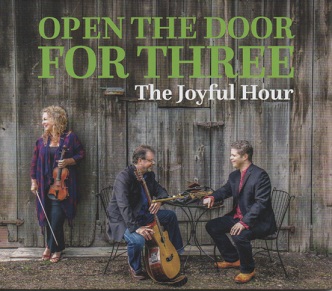
Open The Door For Three: The Joyful Hour
Open The Door For Three: The Joyful Hour
Open the Door for Three is fiddle player Liz Knowles, uilleann piper Kieran O’Hare, and Dublin-born singer and bouzouki player Pat Broaders. Their music is a rare combination of unearthed tunes from centuries-old collections, newly composed melodies, fresh arrangements of songs old and new, homages to the musicians and bands they grew up listening to, and the unmatched energy of a trio of good friends playing great Irish music together.
“A road-tested, audience-approved, high-octane, fist-in-glove, laughing-out-loud trio of Irish musicians…” “Theirs is a big and brilliant sound!” — Sean Smith, Boston Irish Reporter
Liz, Kieran, and Pat have been mainstays of the Irish music scene around the world, having distinguished themselves over the last two decades as soloists with Riverdance, Cherish the Ladies, String Sisters, Secret Garden, Anúna, and The New York Pops. As a trio, they have played to a wide range of audiences in venues large and small, from Irish festivals, to concert halls, house concerts, and pubs. They have performed around the world: on Broadway and at Carnegie Hall, at L’Olympia and the Palais des Congrès in Paris, in Malaysian rainforest festivals, in theatres from Shanghai to São Paulo, and even in a bullring in Mallorca. Most recently, they have been featured at The Kennedy Center’s Ireland 100 festival, the Celtic Colours festival in Cape Breton, at The Milwaukee Irish Festival, and in The Masters of Tradition series in Bantry, County Cork, Ireland.
Irish music is a living, breathing part of Irish and Irish-American culture, and there is no single story that can sum up its history, its charm, grace, and drive. The soul of Open the Door for Three’s music is filled with connections: the connections to people and places, to teachers and heritage and audiences, and to the stories and humor that bring us all together. From these connections comes inspiration, which fills a bottomless well that keeps the trio coming back again and again – to refill, refuel, reinvent, and share.
-
Various Artists – Kerry Fiddles
- Polkas: The Top of the Maol/ The Humours of Ballydesmond
- The Fisherman’s HP/ Byrne’s Hornpipe
- Muckross Abbey/ Mulvihill’s. Reels
- Cronin’s HP/ The Stack of Barley.
- O’Donnell’s Lament
- Danny Ab’s Slides
- The Frieze Breeches/ Paudeen O’Rafferty
- Chase Me Charlie/ Tom Billy’s Slides
- Kennedy’s Favourite/ The Woman of the House
- Apples in Winter/Maids on the Green/The Thrush in the Straw
- The Old Man Rocking the Cradle. Air
- Humours of Galtymore/ Callaghan’s/ The New Mown Meadows
- Callaghan’s Hornpipe/ The Rights of Man.
- Johnny When You Die/ The Swallow’s Tail/ Miss McLeod’s
We at Copperplate are delighted to be associated with this re-release of this timeless classic recording of Sliabh Luachra music, played by the acknowledged masters of the genre. Recorded by Seamus Ennis for the BBC, and released originally on Topic Records. Sliabh Luachra, “The Rushy Mountain”, is the old Irish name for the district on the Kerry/ Cork border surrounding the river Blackwater. For as long as anyone can remember, traditional music and dancing thrived here, and today there must be more active musicians and dancers per acre than any other Irish country district. Rather than reels which have come to dominate the repertoire everywhere else, polkas are most commonly played tunes in Sliabh Luachra, followed by jigs and “slides” (single jigs) and hornpipes, with reels a poor fifth. Most musicians play in a very rhythmic, relatively unadorned style. These distinctive characteristics have been dictated by the requirements of dancers, and the dancing of “sets”, (short for sets of quadrilles) is still very popular. Apart from the dance music, quite a few unusual set pieces are still performed and several musicians have specialised in the playing of song airs.
Padraig O’Keeffe, Denis Murphy and Julia Clifford were the thre greatest Sliabh Luachra musicians of recent times. O’Keeffe, who died in 1963, came from Glauntane, Co Kerry. which is about mid-way between Ballydesmond and Castleisland. After some academic training in Dublin as a teacher and musician, he returned to take over from his father as schoolmaster at Glauntane, but gave this up quite soon to devote himself to the life of a travelling fiddle teacher. He had many pupils all over the district and is still the single most talked about musical personality to this day. As such his nearest rival was Denis Murphy who died in 1974. Denis and his sister, Julia Clifford were born in Lisheen, Co Kerry and became Padraig’s pupils in the late 1920’s and early 30’s. Unlike Padraig they both spent long periods away from the district; Julia did spend most of her time since 1935 in London, while Denis lived for two lengthy periods in New York. When Seamus Ennis got them together in 1952 for this recording, Denis had only recently returned from his first stay in the States and Julia was over in Kerry for a few weeks on holiday. Alan Ward
This is one of the all time classic recordings of Irish Dance Music, and it’s great to see it available once again. Three giant figures of Sliabh Luachra fiddle music, Padraig O’Keeffe and his pupils, brother and sister, Denis Murphy and Julia Clifford are the musicians, and they play selections, not only of the slides and polkas associated with this area, but also jigs, reels and hornpipes. As well as solos from all three, there are 4 trios and 4 duets among the 14 tracks, which have a particular warm feel to them. If I can be personal for a moment, I have to say, I just love this recording. It has everything that makes Irish Dance Music so special. If you don’t like this, then you don’t like Irish music!
Press Reviews
Irish Music Review.com
These two wondrous reissues from the Cork-based Ossian label serve as welcome reminders of just how fixed (perhaps sometimes blinkered) our understanding of Ireland’s traditional music can be. Whereas reels tend to dominate most of Ireland’s sessions, the area spanning parts of counties Cork, Kerry and Limerick around Sliabh Luachra (the ‘rushy mountain’) is markedly different. Here reels are relegated to the bottom of the pile, below polkas, double- and single-jigs (a.k.a. slides) and hornpipes and even when played are done so in the remarkably plain, but ever rhythmic fashion which characterizes the area’s music. This metrical emphasis and lack of ornamentation reflected the needs of dancers and remains relatively unchanged to this day thanks to the continuing influence of musicians such as the accordionist Johnny O’Leary and the local popularity of set-dancing. Kerry Fiddles was recorded by Séamus Ennis at Charlie Horan’s bar in Castleisland in September, 1952 and features three of the most acclaimed Sliabh Luachra musicians. Pádraig O’Keeffe was for much of his life an itinerant fiddle-teacher and numbered Julia Clifford and her brother, Denis Murphy, amongst his most successful pupils. O’Keeffe was in his mid-sixties at the time of this recording and the selection of tunes here to some extent mirrors his own loathing of accompanying dancers, though draws more from his extensive repertoire acquired from not only other musicians but published and recorded sources. His meticulous styling is best heard on the solo pieces, especially the air The Old Man Rocking the Cradle, while the trio cuts are probably more typical of the Sliabh Luachra style. This review by Geoff Wallis first appeared in fRoots magazine — www.frootsmag.com/
The Irish World 2/5/03
Sliabh Luachra (The Rushy Mountain) is the old Irish name for the district on the Kerry/ Cork borders surrounding the river, Blackwater. Traditional music and dancing have always been a large part of the area and this recording, one of a series, has brought this individual music and culture of the region to a larger audience. Padraig O’Keeffe, Dennis Murphy and Julia Clifford were some of the region’s best musicians. Denis Murphy and his sister, Julia Clifford were students of O’Keeffe and together their sound is completely spellbinding. Kerry Fiddles is a recording made by Seamus Ennis for the BBC in Charlie Horan’s bar in Castleisland, County Kerry in September of 1952. One of the nicest things about this album, naturally aside from the gorgeous music, is the sleeve notes. Pat Ahern provides additional sleeve notes, but Alan Ward’s earlier notes are fascinating, informing us that on Padraig O’Keeffe’s version of The Old Man Rocking the Cradle, he imitated the sound of the baby’s cry by “intermittently muting the bridge of the fiddle with a large door key held between his teeth”. The style of playing on this album is very much Padraig’s with wide repertoire of material, mainly polkas, for which the Sliabh Luachra is famous. A beautifully polished piece of work, Kerry Fiddles is not only an important part of Irish music history, but has also been the inspiration for many musicians since. Xenia Poole
Musical Traditions Web Site
As well as their pioneering reissue programme, one of Topic’s other most important achievements in the 1970s, as far as Irish music was concerned, was their six-volume series documenting the music of Sliabh Luachra, ‘the district on the Kerry / Cork borders surrounding the river Blackwater’, as it is described in the booklet accompanying Kerry Fiddles, which was Volume I in the original series, and is here released unchanged on CD. This was the only one in the series which was not primarily new recordings, having been compiled from recordings in the BBC Sound Archives made by Seamus Ennis in 1952. O’Keeffe was a travelling fiddle teacher, and his influence on the development of the distinctive style of the area seems to have been very great. He is joined here by two of his most distinguished pupils, Julia Clifford, who emigrated to London, and her brother Denis Murphy, who had gone in the other direction and lived for many years in New York. Several tracks feature them all playing as a trio, Clifford and Murphy play a number of duets, and each of them play some solos. Individually, they are each quite clearly very fine players, but it is in the combination tracks, especially the trios, that the greatest beauty is to be found. The excitement they generate on the final set of reels is simply magnificent. But another quality that I think emerges from the playing of these musicians is one of warmth; there isn’t the hard edge that some fiddle players seem to bring out, nor – for me anyway – is there the wild and lonesome feeling of, say, some of the Donegal stylists. This should not be interpreted by any means as implying a failing – on the contrary, it is distinctions like these that make the music special, and these recordings stand testimony to a sadly long lost time when regional differences were the rule rather than the exception. Ennis had previously recorded O’Keeffe for Radio Éireann in 1948 and 1949, and the results of those sessions are collected on RTÉ’s CD The Sliabh Luachra Fiddle Master. Having known and loved Kerry Fiddles for about 15 years, it was a great pleasure to hear yet more music by this wonderful musician – he is solo on 14 out of 16 tracks, the other two being duets with Denis Murphy. Some tunes appear again, including both of the slow airs (along with another two), usually in different combinations, which is an interesting point in itself. This set comes with a booklet that provides more detailed biographical information than the Topic one; the latter originally had a companion booklet to the whole series, which I assume is long out of print. For anyone who doesn’t have a copy of that, the notes with the RTÉ CD help make the man behind the music come more to life. I enjoyed reading especially the section headed ‘His Way With Words’, where we learn of the wit and wisdom of the man, which somehow rings very true with the qualities that come across in his music. We are told also that O’Keeffe ‘wasn’t too fond of playing for dancers . . . He preferred ‘listening’ music as this gave him a chance to show the beauty and the depth of the tune.’ I find this interesting because although the latter point does come across in his playing, his handling of the tunes leaves out nothing that a dancer could wish for. Listen to the way he takes a stately and careful approach to Johnny Cope, bringing out the qualities of the six parts of the tune, yet never losing the essential pulse of the dance. Quite wonderful. His love of tunes for their own sake, of course, comes across most strongly in his playing of the slow airs, and indeed one sometimes gets the feeling he is milking them for all he can get. Finally, considering the age of the material on the last three discs reviewed here, the sound quality is excellent. But in almost any condition these recordings would be well worth having. Ray Templeton
£14.99