Tin Whistle
Showing 33–48 of 59 results
-
Kevin Crawford – Carrying the Tune
Lunasa flute player releases new solo album
Carrying The Tune is the latest solo album by Kevin Crawford. A member of the internationally acclaimed traditional Irish music group Lunasa, the ace flautist and whistle player has taken time out from his busy touring schedule with the band to record this new disc in West Clare. The album also features John Doyle on guitar and bouzouki, bodhran player Brian Morrissey plus Mick Conneely on bouzouki. Recorded by Martin O’Malley at Malbay Studios, Carrying The Tune contains fourteen tracks and is a joyful romp through an eclectic yet seamless collection of tunes that are sourced from both the deep well of tradition and from more recent compositions by the likes of Paddy O’Brien, Donal Lunny, Maurice Lennon and Crawford himself.
Born in Birmingham, England to parents from Miltown Malbay, Co Clare, Kevin Crawford’s early life was sound-tracked by the resonance of the lively traditional music scene in the midlands city. Moving to Co. Clare in 1989, he soon became a pivotal member of the effervescent session trail in the Banner county before enhancing his burgeoning reputation in the group Grianan and the trio Raise the Rafters. He then propelled himself to international recognition with Moving Cloud, with whom he recorded Moving Cloud in 1995 and Foxglove in 1998. Kevin joined Lunasa in January 1997 for a tour of Australia and has been ever-present in the group since. To date, the instrumental quintet have eight albums to their credit while Kevin has released two solo records, V Flute Album (1994) and In Good Company (2001). He joined fellow band member, piper Cillian Vallelly for a critically acclaimed duet album, On Common Ground, in 2009. The innovative flute player has appeared as a guest on several albums, including singer Sean Tyrrell’s Cry of a Dreamer (1994) accordionist Joe Derrane’s The Tie That Binds (1998). and American singer-songwriter Natalie Merchant’s 2010 release, Leave Your Sleep.
A year earlier along with his four fellow members of Lunasa, he performed on The Leitrim Equation. One of Kevin’s latest side-projects is the formation of a new super-trio, The Teetotallers alongside John Doyle and fiddler Martin Hayes. They have an Irish nationwide tour mid January 2012.
The music on Carrying The Tune is loving embraced and made anew through the mastery of Crawford’s technical prowess in conjunction with an informed passion for tradition. The overall result is an exuberant celebration of Irish music in its most innovative form. With sympathetic and inventive accompaniment by Doyle throughout and occasional contributions by Conneely and Morrissey, Crawford’s flute and whistle playing creates inspiring music that’s full of surprises sophisticated and completely accessible all at once.
Also available from Copperplate BOR 001 Kevin Crawford & Cillian Vallely: On Common Ground
Press Reviews
TRADCONNECT
The virtuoso flute and whistle player Kevin Crawford has gifted us once again with a superb exposition of the finest in flute and tin whistle playing with his latest solo album ‘Carrying the Tune’. His last solo album was entitled ‘D’ flute album (1994) so perhaps it is no coincidence that this latest album now features Eb, C and Bb flutes.
The album comprises 14 tracks, each containing lesser known tunes (the Hula Hoop reel anyone?) that now demand to be added to the common repertoire. Reels, jigs, airs, horos (yes I said horos) and self-compositions make up the tracks. For the most part the music is energetic, rhythmic and full of pace. However with the tempo turned down we also get to be carried away with sensitive and haunting sounds such as in his whistle rendition of ‘ The Dear Irish Boy ‘.
Crawford’s Grinter flutes purr like a cat, giving us a master class in tightly controlled phrasing, ornamentation and surgically delivered crans. Although a predominantly flute album, it is the measure of the man that his whistle tracks are on equal basis in terms of musicality and technical genius.
Recording standards are also being pushed to new levels. On Slippery Slope a combination of double and treble tracking is used. On the first tune in the set he has double tracked a counter melody line on the flute which drops out for the second tune leaving room for the bodhrán to shine. The third tune kicks in with three flute parts, one main melody flute and two harmony flute tracks basically playing thirds and fifths whilst sticking to the exact same phrasing as the melody line. Ingenious stuff and worth the cover price of the album alone.
Kevin is accompanied for the most part by John Doyle ( guitar/bouzouki ) whose steady and faithful rhythmic playing is a joy in itself. The accompaniment on Double Barrelled deserves repeated listens for its syncopated rhythms, again setting new standards.
Accompaniment is also provided by Brian Morrissey (bodhrán) and Mick Conneely (Bouzouki). Crawford’s latest creation joins the canon of great Irish traditional flute albums and comes highly recommended.
The Living Tradition
If you expect this solo album to resemble edited highlights of Kevin’s Lunasa career, you’re about half right. Fluter extraordinaire though he is, and a defining element of the best band in Irish music for a long time, Kevin Crawford has taken a step back from that intense modern trad vibe. A gentler mood prevails through most of Carrying The Tune, a return to simple arrangements of time-polished melodies. Kevin carries the tune alone: strings and drums are provided by Doyle, Morrissey and Conneely, but the front line is just flutes and whistles. Nothing wrong with that, certainly, and there’s few people better able to fill an album – plus there are none of Kevin’s terrible jokes and stories here. Instead, every minute is packed with the finest of Irish music.
Mostly Irish, anyway. In amongst the compositions of Paddy Taylor, Paddy O’Brien, Pat McNulty, Donal Lunny and Maurice Lennon are two tip-top Scottish waltzes from
Cunningham and Campbell, together with a Bulgarian horo picked up in Brittany. Kevin’s own fine compositions feature strongly too, of course – but only five of them, as he makes room for many traditional favourites.
He has a lovely light touch on John McKenna’s, and a hefty punch for Tom Dowd’s. The slow air The Dear Irish Boy is deeply moving on Bb whistle, and the twin whistles on Flatwater Fran are a clear echo of that great Lunasa sound. Kevin pairs whistle and flute, flute and flute, and mixes the keys from B to F. Its all first rate stuff, with several outstanding moments: Michael Hynes’ jig The Smithstown Jaunt, Willie Clancy’s slide, the traditional Ivy Leaf.
Crawford leaves the best to last, I think, as the three final tracks include a pair of fabulous slow reels, two perfectly crafted Crawford pieces, and the happy joining of a classic Irish air with a grand old reel. No fanfares, no fireworks, just flawless flute. Enjoy. Alex Monaghan
Hearth Music Web Site
This album has exactly what you’d expect from Kevin Crawford: rare and carefully sourced tunes, impeccable playing on the Irish wooden flute and tin whistles, tasteful accompaniment, and a modern edge to an old sound. Crawford’s best known as the Irish fluter in all-star ensemble Lunasa, and though a few tracks here have the kind of angular modern arrangements that made Lunasa one of the best and most in-demand Irish trad bands on the planet, most tracks are subtle, tasteful performances of purely traditional music. Carrying the Tune is an all-flute/whistle album, which can get a bit tiring, but Crawford’s one of the few who can pull off an album like this and make every track sound refreshing and different. It helps too that he’s got John Doyle on guitar. Doyle’s got quite the Midas touch in Irish trad today; everything he touches comes out golden. Together Crawford and Doyle are a formidable duo, and if you’re a big fat Irish trad nerd like me, I know you’re waiting very impatiently for the album from the new super-group The Teetotallers, which features Crawford and Doyle together with Irish fiddle genius Martin Hayes. But until that drops (and until you start your own blog to get a promo copy), we’ll have to content ourselves with this album. Actually, rumor has it that this album was intended to be a Teetotallers album, but schedule conflicts kept Hayes from joining Doyle and Crawford. Anyways, we’ll take what we can get, and this is certainly more than we expected! The liner notes here track the source of each tune, and the tunes range the gamut of Irish tune families (including two nice waltzes!), so there’s a ton of great material here for the budding Irish musician. And throughout there’s such a genuine love for the music that it’s hard not to fall in love too. In short, this is the kind of masterful album one would expect from Kevin Crawford. –Devon Leger
www.folkworks.org
In 1989, a young man from Birmingham, England moved to Ireland in order to concentrate more fully on his passion for Irish traditional music and most specifically, on the wooden flute. Instilled with a love and appreciation of Irish music and culture from his Irish-born parents, he quickly settled into the local session scene and a few short years later released his first solo CD. That young man was Kevin Crawford and the CD entitled simply, ‘D’ Flute Album, quickly became a classic of the Irish trad genre and required listening for Irish flute players worldwide. Crawford went on to join the band Moving Cloud, with whom he toured and released two albums. In 1997, he was asked to join the band Lunasa, replacing departing flute player Michael McGoldrick. Crawford’s addition to the then up and coming supergroup marked a turning point in the band’s sound and he has remained a driving force in the group’s arrangements over 7 albums as well as their frontman in concert. In 2001, he released In Good Company, an album of duets with favorite fiddle player friends, and in 2009 he collaborated with fellow Lunasa bandmate Cillian Vallely for On Common Ground, a duo album featuring Crawford on flute and Vallely on uilleann pipes. During this time, he continued to refine and expand his playing and the many years spent on the road and in the studio are highly apparent on his most recent offering, released in February of 2012. Carrying the Tune marks Crawford’s first return to the true solo album format since 1994s ‘D’ Flute Album and the wait, while long, has been more than worthwhile. Teaming up with Irish guitar phenomenon John Doyle, Kevin Crawford proves once again why he is one of the top Irish flute players in the world, and why he continues to be such an influence on the current generation of young Irish musicians.
Originally intended to be a Teetotaler’s album (a trio comprised of Crawford, Doyle and fiddler Martin Hayes) the project was quickly revised into a solo album when schedules conflicted. Mostly recorded over the short span of a few days, Crawford and Doyle recorded their tracks together live and then picked out what they felt to be the best performances of each track for the album. Later some additional bouzouki, guizouki and mandola were added by Doyle, along with some flute and whistle overdubbing from Crawford and some additional rhythm work from Mick Conneely on bouzouki and Brian Morrissey on bodhran. For the most part the overdubs are spare and this combined with the short recording period and rich, warm production value gives the album a lovely intimacy that is often lacking in the great wealth of trad albums now being offered.
The opening set of reels, titled McHugh’s/Michael Murphy’s/The Humors of Tullycrine, immediately dispels any uncertainties about what kind of an album this is. Crawford and Doyle are in top form as they effortlessly plow through a set of reels featuring Crawford on the Eb flute, soaring above Doyle’s driving, syncopated guitar. Indeed, perhaps in a nod to his original ‘D’ Flute Album, there is not a bit of ‘D’ pitched flute to be found on this recording, replaced by C and Eb flutes and D, C and Bb whistles. These differences in pitch from the usual concert D flute allow Crawford and Doyle to play with some interesting textures and tunings for the accompaniment instruments which further adds a very different vibe to the proceedings.
2 Days, the second track, consists of two slip jigs written by Kevin and originally pitched as a set to Lunasa. Vetoed by the band, the version here begins with some gorgeous textures set by Doyle on bouzouki and guitar with Crawford playing whistle and later layering in flute on the second tune. Lucky, Lucky Day, the second slip jig in the set, is a stunning tune that I predict will be making the Irish session rounds in the very near future and the tight, tasteful playing and chordal progressions make this track worth the price of the album alone.
Autumn’s Apples/Cormac O’Lunny’s/Paddy Sean Nancy’s is a light, straight ahead set of reels showcasing the two musicians’ obvious delight in playing together as the flute and guitar call and answer one another through one tune variations after the other. How many of these little bits of the musical “conversation” were planned out and how many were happy accidents in the studio we will probably never know but it is a wonderful track that nicely showcases two master musicians at the height of their craft.
Flatwater Fran/Mrs. Jean Cambell BSC is a set of waltzes, performed by Crawford on several overdubbed low F whistles and a low Bb harmony flute. For fans of Lunasa, this is probably the track that is closest in sound to the band’s now famous “low whistle trio” arrangements. The first tune is a composition of Scottish accordion maestro Phil Cunningham. The second comes from the playing of Scottish piper Rory Campbell and was originally recorded by the band Deaf Shepherd. I had not heard the tune in years and was pleasantly surprised as it is one of my favorite waltzes, and both tunes are given a wonderful life and quality here by Crawford and Co.
On an album that features primarily flute and guitar, even well played music can quickly become stale if the same formula is repeated over and over and Crawford wisely finds ways to avoid this problem without ever losing the essential momentum of the recording as a whole. I have long said that Kevin is one of the Irish music’s premiere air players and on The Dear Irish Boy he takes up one of the big standard pipe airs on the Bb whistle, infusing the tune with his usual sense of melodic taste and emotional clarity. The result is a truly haunting performance, supported by sparse but perfect guitar accompaniment from John Doyle. The two then continue on with a set of darkly rhythmic jigs, The Hole in the Boat/Sally Sloan’s.
The Slippery Slope may take my vote for favorite track on the album. Finely textured guitar opens this set of slip jigs with Crawford leaping forward on both melody and harmony flutes. I have always appreciated musicians who, while talented, restrain themselves from the absolute craziness you know they could ascend to if they wished, and instead choose to implement that prowess for just the right moments. Crawford exercises that tasteful restraint here though you hear his energy and enthusiasm bursting at the edges of his music until the track hits the final tune (a traditional Bulgarian ‘Horo’). He then unleashes several harmony flutes and, along with Doyle’s lush chordal arrangements, builds the track in intensity until the satisfying climax.
Repeal of the Union is a set of reels starting with the eponymous old piping tune before switching into one of the nicest and most interesting versions of the Ivy Leaf I have ever heard. This particular reel is oft played by many pipers and flute players and Kevin presents an interpretation that combines elements of many different versions of the tune while adding in various aspects of his own inimitable style.
Della the Diamond is a set of three tunes written by Crawford, each for a member of his family (mother-in-law, sister-in-law and wife, Tracy, respectively) and it provides a wonderful example of his tune writing abilities. This is one of several tracks that feature bouzouki player Mick Conneely. Conneely plays a Greek bouzouki with 6 strings and his style is very reminiscent of Alec Finn’s classic approach to the instrument. You would think that his rolling, old school playing on the bouzouki would clash with Doyle’s very modern, syncopated style on the guitar but in fact the two very different accompanists mesh perfectly on this track, providing a sure and measured textural net underneath Crawford’s lilting whistle playing.
The Hula Hoop opens with a jig written for a neighbor and snooker rival of Kevin’s and it is another example of his gifts for hiding subtle musical ‘winks’ in his playing. The tune takes some unexpected variational paths, replacing legato phrasing with a staccato phrase here and there and is a testament to the sheer joy and love of playing that is inherent in this album. The set then shifts gear into a reel and churns along to the solid, neatly locked rhythms of Doyle on guitar and Brian Morrissey on bodhran.
The album ends appropriately with the air Ag Taisteal na Blárnan (Travelling Through Blarney) on the low C flute, once again displaying the ease and understanding with which Crawford presents slower melodies. The air is then followed up by one last reel in the form of the session favorite, Come West Along the Road.
Kevin Crawford has said that this album was meant to be primarily about musicality rather than showy technique, and this choice becomes more and more evident upon both first and repeated listenings. The technique and pyrotechnics are there, but they never get in the way of the melody and there is a excitement and playfulness to his music that grabs the listener from the first note. All in all, this album succeeds brilliantly because it takes no shortcuts in how it presents the material. Talented and inventive musicians with a deep respect for their craft and tradition coupled with a simple approach to the arranging and a stellar production make this CD a must have for fans of the genre and for Irish flute players especially. Zac Leger
Folkworld 47
Kevin Crawford of Lúnasa fame is taking a break from the band’s hectic touring schedule. Together with the help of John Doyle on guitar and bouzouki and occasionally Mick Conneely on bouzouki and Brian Morrissey on the bodhran, Kevin recorded 14 tracks that weren’t meant to become part of Lúnasa’s repertoire, though I see no reason why not. It’s a party, it’s fresh and innovative as we knew it from Lunasa – though more stripped down here, of course. I love the nice slip jig set of Maurice Lennon’s “La Ollamh” and Donal Lunny’s “Lucky Lucky Day”. There’s a pair of lovely waltzes, Phil Cunningham’s “Flatwater Fran” and Rory Campbell’s “Mrs Jean Campbell (BSC),” and before finishing off Kevin throws in a couple of his own original jigs. The highlight though is in the middle of the album, the song air “Dear Irish Boy” followed by two jigs with a total lenght of seven minutes. For sure, Kevin Crawford can carry a tune. Great traditional Irish music, not only for flute afficionados!
£14.99 -
Liam Kelly – Sweetwood
Sweetwood is the name of the area in Co. Leitrim where his father hails from, and Sweetwcod is the name of Dervish flute-plijyer Liam Kelly’s debut album.
Celebrating his twentieth year with Dervish, one of Ireland’s most successful traditional-music group.s, which Liam co-founded in 1989, Sweetwood is a culmination of thirty years of
flute and whistle playing and of his experiences in travelling the world, meeting people and playing music.
He cites Matt Molloy, Seamus Tansey and Mary Bergin as major influences.
Sweetwood includes a lament written by Liam entitled ‘Sweetwood’.
Liam is performing at the flute concert at the Willie Clancy Summer School on July 7th and this summer is performing with Dervish in Stuttgart, New York and California.
Sweetwood will be launched on July 24th in The Glens Centre, Manorhamilton, Co. Leitrim.
Sweetwood is Dervish flute-player Liam Kelly’s debut album. Celebrating his twentieth year with Dervish, one of Ireland’s most successful traditional-music groups, which Liam co-founded in 1989, Sweetwood is a culmination of thirty years of flute and whistle playing and of his experiences in travelling the world, meeting people and playing music. Sweetwood includes a lament written by Liam entitled ‘Sweetwood’ and a tune co-written with Dervish bouzouki player Michael Holmes, ‘Bethnal Green’, which recalls their time in London.
£14.99 -
Mick O’Brien – May Morning Dew
- Statia Donnelly’s/ I Will if I Can/ Patsy Geary’s
- Higgin’s Hornpipe/ The Cuckoo’s Nest
- Kerry Reel/ Kerry Fling/ Joe Bane’s
- Bumper Squire Jones/ An Sean Duine/ O’Sullivan’s March
- Caslean an Oir/ Her Golden Hair Was Hanging Down Her Back
- May Morning Dew/ Sporting Nell
- Micko Russell’s/ Moneymusk
- An Rogaire Dubh/ Connaughtman’s Rambles/ Cailleach an Airgrid
- The Strawberry Blossom/ The Honeymoon
- Johnny Cope
- Farewell to Miltown/ West Clare Railway/ Sporting Molly
- Humours of Lisheen/ Tom Billy’s Fancy/ Humours of Kilkenny
- An Buachaill Dreoite
- The Camaronion/ Greenfields of Rossbeigh/ Connaught Heifers
Press Reviews
Irish Music Magazine
Concert and flat pipes, whistles and Flutes not only demonstrate Mick O’Brien’s great instrumental versatility, but also make a fine job of the challenge of presenting yet another fine piping album…award this piper his pedestal and to prove that the Uilleann pipes can still do what they were designed for; self accompaniment of a primary melody. Fintan Vallely,
Hot Press
May Morning Dew is a snapshot of the best in trad music with not an inch left over for ego. Get your record shop to stock it and put it on their play station and you’ll be seduced utterly. Siobhan Long, 11 out of a possible 12
Evening Herald
May Morning Dew offers an interesting selection of tunes played in an easy unpretentious style with tasteful accompaniment by fiddler Terry Crehan and producer Garry O’Briain on Mandocello and Keyboards. This recording is one the nicest packages I’ve seen in a long time, beautifully designed with lovely photography and detailed notes. With
Terry Crehan: Fiddle
Mick Giblin: Guitar
Gary O’Briain: Mandocello & Keyboards
Seamus Brett: Piano & Keyboards
£14.99 -
Mick O’Brien & Caoimhin O’Raghallaigh – Kitty Lie Over
Press Reviews
FolkWorld CD Reviews
The herrings are boiled and the praties are roasting, Kitty lie over close to the wall!
The a line borrowed from the Irish jig “The Frost is All Over”. Dubliners north and south, Mick O’Brien (uilleann pipes, whistle) and Caoimhín Ó Raghallaigh (fiddle, whistle), meet. And it wasn’t in the midst of the muddy river Liffey, though one may say this record is a landmark like the newly erected Millennium Spire on O’Connell Street.
These days there seems to be a trend to the pure drop. 15 tracks including 11 pipes/fiddle duets, 2 whistle duets, and 2 fiddle/whistle duets. The only accompaniment is the drones and regulators of the uilleann pipes. These are pitched in Bb, and the fiddle is obviously tuned down. Thus the sound is mellow and smooth.
There is a fondness for Sliabh Luachra music, Mick and Caoimhín pay homage to the great names, Denis Murphy, Patrick Kelly. The latter is almost forgotten:
Isn’t it shocking that with all the recordings available nowadays, you can’t get a single track of this most wonderful of fiddle players. If you were to give him a few bits of cast-off tunes, he would sculpt them into something that could fly – like making an aeroplane out of a scrapheap..
Mick and Caoimhín give their best to continue this legacy. As Peter Browne puts it in the liner notes: Everything sounds right! Walkin’ T:-)M
IRISH ECHO Newspaper. New York City
CEOL Column
By Earle Hitchner
Top 10 Traditional Albums of 2003
Number 1. KITTY LIE OVER, by Mick O’Brien and Caoimhín Ó Raghallaigh (ACMCD 102)
The uilleann piping of Dublin’s Mick O’Brien first earned international recognition through his teenage performances on two late-’70s recordings, “The Piper’s Rock” and “The Flags of Dublin.
” In 1996, he issued a superb solo debut, “May Morning Dew,” that finished in the Irish Echo’s list of top 10 albums.
Now comes “Kitty Lie Over,” a duet album with fellow Dublin-born musician Caoimhín Ó Raghallaigh that surpasses
O’Brien’s earlier achievements.
In Ó Raghallaigh, O’Brien has found a fiddler whose style is an ideal match to his tonally rich, expressive chanter, regulator,
and drone work. This is much more than two talented instrumentalists getting together in the studio for some tunes.
They’ve carefully worked out the repertoire (much of it drawn from Sliabh Luachra), arrangements, pitch (B or B-flat),
and harmonies that allow them to truly marry their instruments, one complementing and extending and bolstering the other.
Ó Raghallaigh is himself an accomplished uilleann piper and pipemaker (apprenticed to Geoff Wooff in Miltown Malbay, Co Clare), so his pipes-like style and reflexes on fiddle add immeasurably to his duets with O’Brien.
The 11 pipes-and-fiddle tracks are wondrous, with “Woman of the House/Rolling in the Ryegrass” a shining example of this interplay, and there are also some tantalizing whistle and fiddle-and-whistle duets.
Hands down (or should I say up?), this is the most impressive Irish traditional instrumental CD of 2003 and one of the best in many years. [Published on January 21, 2004, in the IRISH ECHO newspaper in New York City. Copyright
£14.99 -
Neansai Ni Choisdealbha – Draiocht na Feadoige
Press Reviews
The Living Tradition Jan/15
Well known in lreland and beyond as a broadcaster, Nancy Costello shows herself here to be an equally ?ne fluter. In a generous 21 tracks, she covers a wide range of lrish music from session tunes to slow airs, on flutes and whistles, joined by some excellent accompanists and other musicians.
The title of this CD might translate as ‘Woodwind Wizardry’ and that would be no great exaggeration, although Nancy has no pretentions to be a Finnegan or McGoldrick.
She breathes life into these tunes though and it’s the warmth and spirit which really comes across in her music, with enough technical skill to make her playing seem the most natural thing in the world. Most of these tunes are ones l often play myself, being a whistler, so l have to take a step back from the familiar and try to be objective.
The material here comes from the heart of the tradition, well loved but sometimes neglected melodies. John Brennan ‘s and George White’s Favourite are great old reels, not heard so much in sessions these days. Tommy Mulhaire’s Jig is another rarity, but Condon’s Frolics is currently in favour. A set of polkas rolls beautifully off the fingers – no slides though. There are some exemplary hornpipes here too: The Navigator is a politically correct title and The Swan is rather less well known. Oiche Nollaig is a tune which is usually only heard for about one week a year, which is a shame. Redican’s Mother; The Skylark, The Green Mountain and The Lark On The Strand are all welcome as old friends. Lorna Hunter’s Reel puts a name to a tune for me, and Nancy’s Reel is a composition of Michael Hynes who joins Nancy here to play it. Fiddles, button boxes, jaw harp and the pipes of Nancy’s mentor, the iconic Meaiti Jo Shéamuis, provide duets and an occasional kitchen session sound, but most tracks are flute or whistle solos with deft accompaniment.
Slow airs and waltzes are plentiful, some of them true solos. Taimse im Chodhladh, An Buachaillin Ban and Ballyvaughan Bay come from the lrish repertoire, while The Duchess Tree, Westering Home and Scottish Lament have crossed the North Channel at some stage.
Alter more than an hour of fine music, Nancy launches into the pair of challenging reels, Colonel Rogers and Happy Days Of Youth, before a final house céili on four reels from Patrick’s Night to Ormond Sound. Warm, spirited and inclusive: The Magic of the Flute is a charming album which will bring a smile to the face of any lrish music fan. Alex Monaghan
R2 Magazine Nov/Dec 14 * * * *
Nancy Costello is one of the foremost’ broadcasters on RTE Radio na Gaeltachta, where she was appointed Head of Music in 2010.
Originally from a Gaelic-speaking part of Galway, a small locality that has always been renowned for tradition, Nancy was first encouraged to play music by her parents.
Accompanied by some excellent musicians, including Michael Hynes, Johnny Connolly and Eoin O’Neill, The Magic of the Flute is a varied collection of jigs, reels, hornpipes and airs, led by Nancy on flute and whistle. The playing and arrangements are solidly traditional.
Nancy is a very capable flautist with a rock-steady rhythm. Her version of the C reel ‘Swinging On The Gate’ is beautifully played, with each rolling triplet adding to the flow of the tune. Likewise, Nancy is similarly adept on the whistle, as her excellent playing of ‘The Sweep’s Hornpipe’ demonstrates. The majestic slow air, ‘Taimse lm chodladh is na duistear Mé’ (I am Sleeping, do not awaken me) is, for me, a highlight of the CD. Here Nancy nicely decorates the melody and plays with true emotion.
Draiocht Na Feadoige translates as the ‘Magic Of The Flute’, which is a very fitting title for this lovely CD. Keith Whiddon
www.liveireland.com
One of my favorites is by a terrific flute player named Nancy Costello from the Connemara in Ireland. The title: The Enchantment of the Flute on Clo Iar-Chonnacht. There are 21 cuts of fab fluting. Good heavens, this girl can play. I’m going to suggest that you get to the Clo Iar-Chonnacht website or Alan O’Leary at Copperplate Distribution in London to get this. Why? For some reason, this cd has the title, ‘Draiocht Na Feadoige’ by Neansai Ni Choisdealbha. Good God. That translates to Enchantment of the Flute by Nancy Costello. The title cannot possibly help sales, and that is a shame. All 21 tunes here are played impeccably in a gorgeous style. Nancy is a master musician. We will be playing this a lot on our LiveIreland show to help introduce this wonderful talent. Part of the fun will be to try to pronounce it. We can hear the purists calling in now. This is a terrific album, and qualifies Nancy for serious consideration as Female Musician of the Year. Bill Margeson
£14.99 -
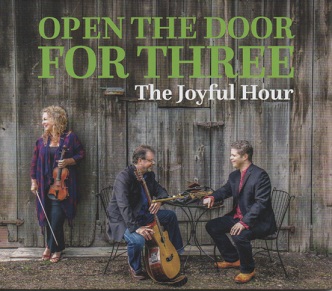
Open The Door For Three: The Joyful Hour

Open The Door For Three: The Joyful Hour
Open the Door for Three is fiddle player Liz Knowles, uilleann piper Kieran O’Hare, and Dublin-born singer and bouzouki player Pat Broaders. Their music is a rare combination of unearthed tunes from centuries-old collections, newly composed melodies, fresh arrangements of songs old and new, homages to the musicians and bands they grew up listening to, and the unmatched energy of a trio of good friends playing great Irish music together.
“A road-tested, audience-approved, high-octane, fist-in-glove, laughing-out-loud trio of Irish musicians…” “Theirs is a big and brilliant sound!” — Sean Smith, Boston Irish Reporter
Liz, Kieran, and Pat have been mainstays of the Irish music scene around the world, having distinguished themselves over the last two decades as soloists with Riverdance, Cherish the Ladies, String Sisters, Secret Garden, Anúna, and The New York Pops. As a trio, they have played to a wide range of audiences in venues large and small, from Irish festivals, to concert halls, house concerts, and pubs. They have performed around the world: on Broadway and at Carnegie Hall, at L’Olympia and the Palais des Congrès in Paris, in Malaysian rainforest festivals, in theatres from Shanghai to São Paulo, and even in a bullring in Mallorca. Most recently, they have been featured at The Kennedy Center’s Ireland 100 festival, the Celtic Colours festival in Cape Breton, at The Milwaukee Irish Festival, and in The Masters of Tradition series in Bantry, County Cork, Ireland.
Irish music is a living, breathing part of Irish and Irish-American culture, and there is no single story that can sum up its history, its charm, grace, and drive. The soul of Open the Door for Three’s music is filled with connections: the connections to people and places, to teachers and heritage and audiences, and to the stories and humor that bring us all together. From these connections comes inspiration, which fills a bottomless well that keeps the trio coming back again and again – to refill, refuel, reinvent, and share.