Guitar
Showing 65–80 of 91 results
-
Luke Daniels – The Mighty Box
Since releasing my first solo album Tarantella in 1994 I have made many different recordings but began to feel the need to make another record of my accordion playing after starting to explore the interesting possibilities of an A and B flat tuned keyboard. I have not changed any of the keys of the tunes on this record but instead, have enjoyed using a range of new fingering patterns thrown up by thinking a tone higher than normal to produce the old notes.
I recorded the tunes with Junior Davey over two days at Doolittle recording studios Co Sligo in a playing marathon I am unlikely to repeat. As a result the playing is raw, spontaneous and full of life. I’m especially grateful to the contributions of Seamie O’Dowd and Dennis Cahill whose accompaniment and musicianship helped turn this feast of Irish accordion playing into a wonderful listening experience.
Press Reviews
www.liveIreland.com
Luke Daniels is one of our favorite button box players in the world, and has been for some time. He is out with a fabulous double album, entitled The Mighty Box. We first heard him years ago with the iconic, Reeltime. He stayed with us here in Chicago, and we also met him in Ireland for a couple nights at Reeltime founder, Chris Kelly’s home. Magic memories, now lost in the veil of history. At that time, he had been selected by the BBC as Young Musician of the Year. That was many years ago (enough that it would be indelicate of you to ask what specific year) again, all lost in the veil. However, he has gone on to wonderful things since then. He is a master of the traditional form and is also extraordinarily creative at the same time. An extremely gifted musician. If you love Irish button box, this album is a must. Be aware that there are stretches of trad perfection, accompanied by brilliant modern touches. This is magic. This is Luke Daniels. This is the best. Wow! Let us repeat, Wow! Bill Margeson
The Living Tradition Jan/Feb 2012
The title is a suitable description for the elegantly constructed white box housing the two CDs constituting this amazing magnum opus from accordionist Luke Daniels. The statistics themselves are astonishing to anyone familiar with recording work. 71 tracks (compiled from traditional Irish music manuscript collections, other contemporary musicians’ sessions and recorded output, and eight of Luke’s own compositions) amounting to almost 110 minutes of music recorded over two days at a studio in County Sligo in, as Luke self-confessedly, and perhaps unsurprisingly, puts it, “a playing marathon I am unlikely to repeat!”
The wide assemblage of tunes embraces strathspeys, reels, jigs, slip jigs, hornpipes, slides and other Irish tunes spanning over three centuries and resonant with wider Celtic echoes, Cape Breton in particular. The pieces, each of which is described in detailed tune notes based on research at the Traditional Music Archive in Dublin, are organised in an array of 24 tune sets that must assure Luke’s perpetual place in the pantheon of great box players.
Consistent agility, fluidity and dynamic sense characterise his playing of a button accordion with the keyboard tuned to A/Bb allowing him to present the traditional tunes in conventional keys but using intricate fingering patterns that provide a refreshing originality. His playing forms the foreground of a beautifully balanced soundscape with, equally consistently, excellent and empathetic accompaniment from, in the main, Seamie O’Dowd (guitars – steel strung, 12 string and resonator; harmonica and fiddle), Junior Davey (bodhran) Dennis Cahill (guitar and cittern) and Rick Foot (double bass). The recording has a very live feel and is of such a clear quality as to suggest the musicians are in the room playing for you!
This album is a truly great achievement by this ever imaginative, interesting and versatile player imbued with an innate sense of Irish traditional music and the wider Gaelic tradition but open to contemporary ways of reinterpretation and arrangement. Personally, I’ve a modest interest in the button accordion as an instrument but found myself in no way tired or distracted at relentless exposure to so much instrumental tune music. The intricate melodic detail and rhythmic intensity of the music is both magnetic and compelling; indeed I challenge anyone to listen to it and sit still! Kevin T Ward
Irish Music Magazine
There’s so much to absorb in the latest release from the highly accomplished box player Luke Daniels. The Mighty Box encompasses a staggering seventy one tunes in its double CD format that are an amalgamation of his own compositions, session derivatives and tunes sourced from traditional music archives. His Doug Briggs crafted accordion tuned to A/Bb explores intricate fingering structures that toy with the traditional in a fresh and invigorating manner.
This successful experimentation is strengthened by the able accompaniment of guitar stalwarts, Seamie O’Dowd and Dennis Cahill, Junior Davey on bodhran, bass player Rick Foot, percussionist, Gigi Bioclati and Victor Nicholls on tuba.
Each a master in their field, the album illustrates their ability to enunciate with precision whilst ensuring each tune flows to its own pace. A great example of this being the Australian Waters set where strings, percussion and box merge together with rhythmic clarity. Style and range are a standout in the Doodley Dank set where slip jigs surge into a slide taken from the playing of Sliabh Luachra box player Johnny O’Leary. I’m drawn to the variation in tracks ranging from the use of harmonica which, along with all the instruments, provides a funky introduction to the Rainy Day set contrasted with the subtleness of instrumentals partnering Daniels expertise on a lovely set entitled Patsy Geary’s Doberman’s Wallet.
The standout of this double CD is the fact that with so many tunes to immerse yourself in, with one instrument as the common thread, your attention could dissipate yet Daniels engages with a variety of style, ornamentation and contrasting instrumental accompaniment whilst showcasing his obvious expertise on the box throughout.
The Mighty Box is the work of a mighty box player. Enough said! Eileen McCabe
£16.99 -
Niamh Ni Charra – From Both Sides
Niamh Ní Charra hails from Killarney, County Kerry in the south west of Ireland. Strongly influenced by the wealth of local Sliabh Luachra musicians, she started playing music at the early age of 4, under the tutelage of well known local musician Nicky McAuliffe. Equally talented on fiddle and concertina, she has won numerous awards, including Fleadh Cheoil na hÉireann, Oireachtas, and Slógadh Náisiúnta and has represented Ireland at folk festivals in Britain and France. Somewhat of a child prodigy, she had support gigs for The Chieftains, and Noel Hill under her belt before she reached her teens.
Despite this rich background, she put aside her music to persue a career in Electronic Engineering. After graduating with honours, Niamh was employed by an Irish software company who regularly sent her on business trips to Boston. Here she was exposed to a continuous flow of Irish musicians (Arcady, Sharon Shannon, Nomos) as well as locally based musicians (Paddy Keenan , Seamus Connolly, Tommy McCarthy).
The draw of the music proved too strong, and Niamh decided to resign from work to persue a career in music. She moved to Cork to take a year-long course in ‘Music, Management, and Sound’ at Coláiste Stiofáin Naofa, where she graduated with distinctions in every subject – the only student ever to have achieved this feat. The college subsequently awarded her “Musician of the Year”. She swiftly followed this with recordings for Irish radio and television, and performances with Riverdance ‘s european troupe in Europe, Asia and on board the QE2, before joining the U.S. troupe in 1998. Niamh performed with Riverdance from that date until December 2005, touring with them in North America. From Mexico to Vancouver, and Los Angeles to Broadway, New York, Niamh has delighted audiences with her fiery fiddling, fancy footwork and dazzling smiles. More recently she shared her talents in Riverdance’s Irish and Far East productions performing in her native capital as well as the more exotic locations of Tokyo and Taipei among others.
Niamh has returned to Dublin, Ireland where she is working as a freelance musician, regularly gigging accross the city. She also teaches both fiddle and concertina at Comhaltas Ceoltóirí Éireann’s national headquaters, An Cultúrlann in Monkstown, and will shortly be releasing her debut album “Ón Dá Thaobh / From Both Sides”.
It may appear to be a long journey from sessions in Buckley’s bar with the old Kerry greats to world wide spotlight in Riverdance.Niamh Ni Charra makes it seem like a short step across the road.
Real music knows no boundaries, after all, and Niamh demonstrates as uncommonly broad range of musical expression. She is equally at homein the sparse but beautiful An Raibh Tu ag an gCarraig and in full-throttle ensemble pieces such as The Broken Pledge. This breath of musical vision is also evident in her choice ot repertoire. Regondi’s Allegretto No 4 – an extraordinary piece of concertina whimsy – rubs shoulder with Micho Russell’s Jig. The Hungarian tune Dunantuli Friss Csardasok finds a ready partner in The Gravel Walks.)
While most musicians struggle to master one instrument, Niamh possesses as effortless fluency on fiddle and concertina, allowing her to communicate both sides of her musical personality. Scattered throughout this collection are several tunes from her fertile musical imagination. This can be a hazardous strategy inviting comparison with well-established favourites. Niamh carries it off with style; each tune sits comfortably with its neighbours while retaining its individuality.
On Da Thaobh / From Both Sides is a contemporary album with its feet firmly planted in the tradition. The old Kerry masters would be well pleased.
Pat Herring Ahern Jan 2007
Copperplate is very proud to have this title on our roster and to help it achieve its full potential will be supporting this release with a full-scale promotional mail out to media and retail.
Press Reviews
The Irish World
“From Both Sides is a wonderful musical experiment, and the results are more explosive than you could imagine. Just watch this blonde bombshell go…”
Folk Radio UK ” This is master-class musicianship, and legend in the making”…Alex Gallagher
‘There is spectacular work from Niamh Ní Charra, a gorgeous blonde who does things on the fiddle and the concertina, that must be seen and heard to be believed.’ Slidell Sentry, New Orleans 05/2005
‘Charming fiddler Niamh Ní Charra, who seemed to dance a jig while playing one, easily could have been a one-woman show.’
South Bend Tribune, South Bend 05/2005
‘Of special note (was the ) beguiling fiddler / concertinist Niamh Ní Charra, who roamed and skipped the stage as she played.’
Times – Picayune, New Orleans 05/2005
‘Niamh Ní Charra, the sassy electric fiddle and concertina player, was a crowd pleaser.’ Charleston Daily Mail, Charleston 06/2005
‘Kudos were in order for Niamh Ní Charra for her fancy fiddle work.’ Arkansas Times, Little Rock 01/2005
‘Fiddler Niamh Ní Charra, a striking blonde plays while skipping backward.’ Star-Telegram, Grand Prairie 06/2005
‘Blond fiddler phenom!’ Charleston Gazette, Charleston 06/2005
“The company’s indefatigable violinist, Niamh Ni Charra provides some fancy fiddling for the solo passages of this number, (America Wake) as well as for many other exciting moments in the show.” United Press International New York 03/05
‘jaunty fiddle playing’ New York Times 03/05
“The jovial violinist snapped a few of her bow’s strands as she rocked her space-age Stradivarius.” Erie Times 03/05
The Folk Diary
The former child prodigy from Killarney has grown into an outstanding performer on fiddle and concertina, and she is now currently becoming a world-touring superstar. After eight years globe-trotting with the “Riverdance” company, she is currently touring widely with Carlos Nunez.
There is an amazing facility with the wide range of Irish musical styles and rhythms that she tackles on this, her overdue debut album, but you don’t have to listen too hard to hear that she was introduced at a very early age to her wonderful local polka and slide music of Sliabh Luachra.
The album is full of exciting moments but it reaches its zenith in the last track where she plays music from her own county in the company of fellow-Kerryman Brendan Begley. Vic Smith.
TAPLAS The Welsh Folk Magazine 22.11.07 Adolygiadau
£14.99 -
Oisin MacDiarmada – On the fiddle (ar an bhfidil)
Press Reviews
Irish Music Review
One of the brightest young stars in the panoply of Ireland traditional music, this is fiddler Oisín Mac Diarmada’s third album, though the first to bear just his own name. First came, in 2000, the sparkling Traditional Music on Fiddle, Banjo & Harp, recorded with banjo player Brian Fitzgerald and harper Micheál Ó Ruanaigh, followed earlier this year by Oisín’s band Téada’s self-titled debut album, also on Ceol Records. However, Ar an bhFidil (‘On the fiddle’) tops the lot, fully confirming Mac Diarmada’s position as a wonderfully adept and evocative musician.
Oisín’s early years were spent in County Clare where he learnt his first music before the family moved to South Sligo where he took lessons from the notable fiddle teacher, Paddy Ryan. Now noted as a music tutor in his own right, and still only in his early twenties, Oisín’s playing on Ar an bhFidil creates a relaxed confection of the music of Sligo and Clare, topped with the delicacies of an astounding technique given full expression by the sheer imagination of his tune settings. His playing of the slow air Bean a ‘leanna, associated with the late Connemara singer Joe Heaney, simmers with an unrequited passion. Jigs and reels are threaded with an innate merriment and, above all, Oisín has the power to invest very familiar tunes, such as The Lark in the Morning with new life fashioned by the pure merriment in his playing. Thoroughly enjoyable throughout, this is unquestionably an album that merits repeated listening.
The Living Tradition Dec/ Jan 2004
This is really good fiddle playing by a 24 year old who’s got more talent than many older fiddlers. Moving from Clare to Sligo as a lad must have done something for him because he has a mixture of both styles as well as his own personality stamped on his playing.
He wrote his own concise but thorough sleeve notes giving due credit to the players he got the tunes from and they show the wide range of the players who influenced him, Coleman, James Morrison, John McKenna, and Ennis (of course).
He seems to be able to change style as easily as changing key, from the old Clare style of the first track, to the 1920s James Morrison/ Michael Coleman tracks on The Tap Room/The Kerryman’s Daughter, via John McKenna, Josie McDermott, Denis Murphy and Ed Reavy. Yet throughout, he puts his own style of playing on every tune. In some ways, his ability to do this is reminiscent of Frankie Gavin in one of his mischievous moods.
There’s a good mix of tunes, mostly well known but with rarities like a Seamus Ennis version of The Lark in the Morning that’s not often played now. Reels predominate, of course, but ther are single and double jigs, hornpipes, and Leitrim style polkas too. A big surprise is The Strayaway Child, composed by Maggie Barry (who’s become known as Margaret lately), that Michael German used to play But the big one for me is The Morning Thrush, composed by Seamus Ennis’s father James. I’ve never heard anyone else but Ennis play this, and Mac Diarmada makes a great fist of it. It’s a great pipe tune that deserves more playing.
My old friend Paddy Ryan wrote the introduction to the CD and says at the end that he can highly recommend it. I sometimes disagreed with Paddy in the past, but not this time. This is great music, well played by a fine young fiddler. I look forward to his next release. Mick Furey
Irish Music Magazine April 2003
Of late, there seems to have been a trend among traditional musicians of a younger generation to move from fiery blistering pyrotechnics to more mellower and laid back means of musical expression. By that, I mean players are engaging themselves with the details of the music and it’s manifold subtleties rather than kick stepping their ways to oblivion. Martin Hayes is one such example and on this showing, Oisin MacDiarmada is another.
Oisin MacDiarmada’s debut solo album, Ar an bhFidil typifies this laid back approach. MacDiarmada’s fiddle playing is rooted in the Sligo style. While the frantic wildness of a Michael Coleman is evident on, The Tap Room, he is no idle speed merchant. He favours the low-fi approach with the music speaking for itself; the result is a warm natural sounding album.
Ar an bhFidil revels in the small dry sounds so beloved of Television’s, Tom Verlaine on their seminal Marquee Moon album. This is low-key traditional music, yet rich in character, subtlety, and individual strength. The 17 tracks on show augurs well for the purse strings along with a plentiful supply of notes for each track detailing source musicians and other details. We aren’t talking encyclopedia type documentation, but enough for the casual reader to get the gist of what’s going on, and yet nail the vital facts down.
The accompaniments are also sparse with a minimum on one extra instrument whether, it’s piano, flute, second fiddle or bouzouki – the balance between featured protagonist and guests is just right. Add to that, a concise production from Harry Bradshaw and this becomes one well thought and enacted affair. Ar an bhFidil is a work of discernment and quality, check it out. John O’Regan.
Claddagh
A very pleasing trait of some current young musicians is that quite a few of them are happy to play in the way their antecedents played; one thinks immediatly of the Kane sisters, Harry Bradley, Martin Hayes. Oisin MacDiarmada is another such. He has the lonesome touch, and quite a few of the tracks are totaly unaccompanied. Where accompaniment is used, it is not as an offensive weapon, and throughout. he proves that he is not just a very fine fiddler, but a young man with an understanding of exactly what the music means. Yet another very worthwhile release in a year that has provided us with many great recordings.
Hot Press November 6th 2002
This debut solo CD by 24-year-old Sligo fiddler Oisín Mac Diarmada opens with a superbly confident set of tunes played without accompaniment, full of lovely raw scraping double-stops and rolls. Elsewhere on the album, Séamus Quinn contributes a bouncy piano to a few tracks, a set of reels played by Mac Diarmada on the whistle has bodhrán backing from Tristan Rosenstock, and several others feature bouzouki or guitar accompaniment; there are also a couple of fine duets with fellow fiddler John Carty. Mostly, though, it does exactly what it says on the tin – pure traditional fiddling, raw and unadorned, and all the better for it. The album was produced by RTÉ’s Harry Bradshaw, who’s done a beautiful job at keeping the sound natural and letting the tunes take centre stage. Sarah McQuaid. Nine out of Ten.
The Irish Times (Irish Newspaper) September 26th 2002
Fiddle music for folks who like their trad infusion unadulterated. Oisín Mac Diarmada, Sligo fiddler and member of young turks téada, is already on his second solo run, and how his pace has slowed – but admirably so. Ar An bhFidil is exactly what is says on the tin: a stripped down sally (back and) forth through the Sligo tradition. Duelling and duetting with fellow fiddler John Carty on the set of Michael Coleman jigs, Jackson’s Morning Brush/The Rambling Pitchfork, Mac Diarmada’s playing is feisty and earthy at the same time. Not afraid to let the fiddle’s hoarseness seep through, this is a player who cajoles his instrument through nooks and crannies in the tradition that lesser players would avoid. Lonesome magnificence.
Siobhán Long**** (4 stars)
The Irish Examiner (Irish Newspaper).September 26th 2002
In traditional music, as in other forms, solo albums are rarely what they claim to be. At a minimum, musicians like to use the safety net of an accompanist. Other players are added, sometimes in a perfectly valid attempt to recreate some fondly remembered session. When the process is taken to extremes, the leading player is often relegated to the background. In his new album, Ar an bhFidil, Oisín Mac Diarmada sets a brave course.
This is a solo fiddle album and, on many tracks, solo fiddle is exactly what we get. When he moves beyond the strictly solo format, it is in the company of another melody player – John Carty on fiddle and Damien Stenson on flute. Or in tandem with a single accompanist – Séamus Quinn on piano, Seán McElwain on bouzouki, Tristan Rosenstock on bodhrán and John Blake on guitar all take turns. Mary Brennan’s Favourite kicks off, slow and steady. The pace picks up for The White Leaf, but the velocity remains on the leisurely side. John Carty joins for the jigs, Jackson’s Morning Brush/The Rambling Pitchfork, and the hornpipe/schottische Peter Wyper’s/The Killarney Wonder. The two players meld wonderfully. Mac Diarmada shows another part of his musical personality in switching to whistle for the reels The Flannel Jacket/The Maid That Dare Not Tell. The Cisco Hornpipe and Walsh’s Hornpipe are taken at a strolling pace, which allows both the music and the musician room to breathe. The Morning Thrush – written by Séamus Ennis’ father James – is a beautifully clear and expressive slow reel. A jokey piano line introduces The Tap Room, pushing forward to the point of interference. In contrast, the bouzouki background on The Rainy Day is unobtrusive.
Ar an bhFidil is warm, rich music that combines a high level of technical skill with a sense of humour. Pat Ahern
Pay The Reckoning Web Site
Pay The Reckoning was captivated by Teada’s recent offering and so we were excited to hear rumours that Oisin MacDiarmada, the band’s fiddler, was in the process of putting together a solo recording. Well, folks, the patient wait is at an end and the results of MacDiarmada’s time in the studio have surpassed our high expectations.
MacDiarmada proves himself yet again to be one of the most sensitive and soulful fiddlers around. The album’s design, simple and straightforward, reflects his own approach to his craft. MacDiarmada isn’t a man for pyrotechnics, he doesn’t batter a tune into submission and then bends it to his will. His is a more subtle approach; he gives the tune room to develop in a seemingly organic way, so that his ornamentation and embellishments seem natural, unforced.
However, as any musician will tell you, such apparently natural ease with a tune is the product of two elements – natural talent and hard work. MacDiarmada has no end of the former and has no fear of the latter. The result is pure magic!
MacDiarmada’s knowledge of, and captivation by, the music of the 20s and the 30s (the “golden age” of Irish music, as some have dubbed the period) is worn proudly on his sleeve as he gives us versions of a number of tunes and sets on the album which were recorded by such legends as Coleman, Morrison, John McKenna, Patsy Tuohey and Paddy Killoran. However, you mustn’t get the impression that MacDiarmada’s an academic. His interest isn’t so much in the history of the tunes as their timelessness and his playing of the tunes represents a reawakeneing rather than a resurrection.
There are moments of savage, soulful (there goes that word again) perfection on this album. His playing of “The White Leaf” – a version of the more widely known “Mason’s Apron” – is so elementally powerful a sound as to cause the listener to wonder how one tune can express at the same time such extremes of joy and melancholy.
On the polka set “The Merry Girl/Charlie O’Neill’s”, MacDiarmda lays claim to Sligo/Leitrim influences. But to our ears, the latter tune in particular sounded as if it was being played by the ghost of the long-dead John Doherty (and we know of no higher compliment), so refined was the blend of dazzling technique and sheer emotion.
The reel set “The Flannel Jacket/The Maid That Dare Not Tell” is of interest in that MacDiarmada shows us another aspect of his musical ability as he gives both tunes an airing on the whistle. Accompanied by Tristan Rosenstock on inventive, yet rock-solid bodhran, the “spare” feel of the track conjures up an atmosphere which a more busy production could never capture.
And so, throughout the album, MacDiarmada, along with various musical sparring partners (Seamus Quinn on piano, John Carty on fiddle, Damien Stenson on flute, with guest cameos by fellow Teada members Sean McElwain on bouzouki, John Blake on guitar and Trisan Rosenstock on bodhran), lays out his stall of mighty talent, a great ear for a tune and a great feel for capturing mood.
However, even amid all the excellent music which MacDiarmada provides, his solo version of “The Strayaway Child” stands out as a defining moment of the album. Played to great effect by Kevin Burke in his Bothy Band days, MacDiarmada nevertheless manages to inject the tune with so much of his own feeling that it’s difficult to imagine it ever having been played by anyone before and almost impossible to imagine anyone else ever doing the tune justice.
A massive album. Honest, passionate and quietly defiant. You’d do well to visit http://go.to/copperplate and get yourself a copy. And while you’re at it, grab hold of a copy of Teada’s debut!
Live Reviews
Teada Live Review
The Herald (Scottish Newspaper) April 25th 2003
The name, like k d lang’s, is determinedly lower case. It’s pronounced “tay-day”. It’s Irish for “strings”, and it might be advisable to get used to it because there was a feeling of portent as pronounced as a poteen hangover about this gig. The band are young – how young you can guess by the news of teada’s bodhran player’s absence due to exams – and maybe it was the novelty of having an accordionist make up the quartet, but loathers of football clichés look away because I’m going to use one: this was a game of two halves – bloody good and bleedin’ marvellous. The first established the group’s liking for variety of metre and arrangement, pairing off for fiddle and flute duets, and employing numerous other instrumental permutations, from solo to quartet. It also confirmed that, in Oisin Mac Diarmada, teada have a fiddler of quite starting old-head-on-young-shoulders ability. You could hear centuries of tradition and doubtless long hours of dedication in his sweet and graceful melodiousness. If at times, then, his colleagues seemed to be playing catch-up, later they were right on the pace, adding richness and precision on banjo, bouzouki, box, and flute. Flautist John Blake, English-accented but Galway-based, takes stick for his origins but brings natural aptitude and technique on tunes, and in doubling upon guitar he offers harmonic invention and real drive. One complaint might be their one song per set ration. Mac Diarmada sings well, interestingly, and with feeling, and might do even more so with some practice. But with such quality of musicianship and attention to a tune’s essential shape, they’ll so as they are for now. Rob Adams
Teada Live Review
Edinburgh Evening News (Scottish Newspaper) April 24th 2003
Edinburgh’s Ceilidh Culture programme continued last night as young Irish band Teada brought their classic Celtic credentials to town in their debut Scottish gig. Now a five-piece outfit since the recruitment of accordion player Paul Finn earlier this year, Teada were shorn of their bodhran player Tristan Rosenstock, back home in Dublin preparing for his finals, but, in his absence, the band, with Oisin Mac Diarmada leading on fiddle and excellent vocals certainly passed this test. Traditionally Irish but with a punkish edge to their style, Teada, which is Irish for strings, genuinely enjoy their music, and their repertoire had enough shifts in pace and style to keep the band, and their audience, on their toes, raucous one minute, sensitive and serene the next, traditional Irish music with attitude. Seemingly playing well within themselves in their first set, with an intriguing mix of reels, jigs and hornpipes, the band cut loose in a second set that got one encore, but could have received several, such was the reception they received. Mac Diarmada is a real talent, his fiddle-playing of the highest order, but with a distinctive, almost discordant edge to it, and his Irish vocals were full of Irish passion. Teada, however, are no one-man-band, and with banjo/bouzouki player Sean McElwain offering subtlety and style, Finn on accordion and John Blake on guitar and flute, they are a refreshing addition to the genre. The highlights were the numbers in celebration of the piping tradition shared on both sides of the Irish Sea, and the hornpipes, especially Tom Connor’s and Mayday, and reels such as Teetotaller and Billy McCumiskey’s showed the versatility of Teada goes across the spectrum of Irish music. Teada are a tight, traditional Irish band with something quite intangible to separate them from the rest, and if there is a better new band on the Emerald Isle, then they must be very, very good. Mike J. Wilson
Customers Comments.
I was having a few tunes with Marcus O’Murchu this evening, (as you do) & he happened to have a few copies of this new CD about his person, so I took out one of those crisp foldy things & exchanged it for Oisin’s brilliant new CD – fair exchange is no robbery.
It is lovely piece of work, from this highly accomplished young musician, who is confident enough to play many of the tracks without any accompaniment, & his playing stands up beautifully on it’s own, a joy, especially for Fiddlers, to listen to.
He is joined by John Carty on a couple of tracks for some super double Fiddle magic. Seamus Quinn comes in on a couple of tracks on Piano, while Sean McElwain does the same on Bouzouki, John Blake lends a hand on Guitar on one track & Tristan Rosenstock accompanies Oisin’s whistle playing, on Bodhran, on track No. 5.
Paddy Ryan writes about how ‘the music is tastefully played by a musician who knows his art form. He has a deep understyanding of the richness & beauty of the music & an innate ability to interpret a good tune.
The imaginative tune settings, the intricate variations & technical mastery, & the full-bodied, sweet tone are the hallmarks of his superb musicianship. His style is very distinctive & very personal with influences from Clare & North Connaught showing through. This recording encapsulates the artistry of Oisin MacDiarmada as a top class Fiddler. The music flows with clarity & fluency, & the rich variety of tunes displays his extensive musical range.’
Paddy concludes by saying he ‘can highly recommend it’. Well I concur, it’s a beezer, & if your a Fiddler, it will be added to your collection, sooner or later, mark my words.
One wee gripe, & it’s nothing to do with this CD, or it’s incredible music, which is sure to delight all who are fortunate to listen to it. It’s just that since James Morrison’s Orchestra recorded this tune in the 20’s, & someone miss spelt the name, nobody has since checked up, they just copy the fault. For anyone interested, take out an atlas & find Aberdeen, on the NE coast of Scotland, now travel due west until you come to the village of Monymusk – not Money Musk. OK – you have now been warned!
Posted on August 30th 2002 by PtarmiganSligo fiddle-player Oisin Mac Diarmada, at 24 years of age, is an honours graduate in Music Education from Trinity College, Dublin. In addition to widespread performing activity whish has brought performances in venues and festivals throughout Europe and the USA, Oisin is respected internationally as a fiddle tutor and his journalistic, lecturing, examining and production work. He is fast becoming one of the most exciting young musicians on the traditional music scene, his playing on a previous release, CICD144 Traditional Music on Fiddle, Banjo and Harp (available from Copperplate) was described by renowned music journalist, Simon Jones as “so sensitive it’s enough to make grown men cry”.
Now, performing with exciting young traditional band, teada, who have released their highly successful debut album (available from Copperplate) recently, Oisin’s performances bring a strong flavour of the rich Sligo tradition of fiddle-playing, together with what fiddler/ researcher/ broadcaster, Paddy Ryan describes as ” a deep understanding of the richness and beauty of the music, and an innate ability to interpret a good tune”.
On this new release, Oisin predominately features traditional Irish fiddle-playing in a pure, solo context, performed in a uniquely personal and traditional style with flavours of the great Sligo fiddle tradition. Additionally there are a number of tracks which separately feature artists of the calibre of John Carty, on fiddle, Seamus Quinn on piano, Sean McElwain on bouzouki, Damien Stenson on flute, John Blake on guitar and Tristan Rosenstock on Bodhran.
We at Copperplate will be supporting this release with a high profile promotional campaign and full-scale mail out to media and retail sectors. Feedback always welcome. Thank you for your support.
£14.99 -
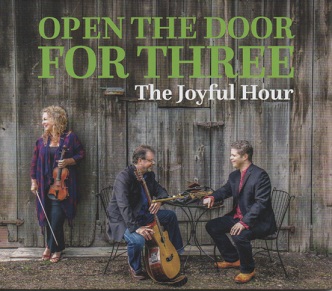
Open The Door For Three: The Joyful Hour
Open The Door For Three: The Joyful Hour
Open the Door for Three is fiddle player Liz Knowles, uilleann piper Kieran O’Hare, and Dublin-born singer and bouzouki player Pat Broaders. Their music is a rare combination of unearthed tunes from centuries-old collections, newly composed melodies, fresh arrangements of songs old and new, homages to the musicians and bands they grew up listening to, and the unmatched energy of a trio of good friends playing great Irish music together.
“A road-tested, audience-approved, high-octane, fist-in-glove, laughing-out-loud trio of Irish musicians…” “Theirs is a big and brilliant sound!” — Sean Smith, Boston Irish Reporter
Liz, Kieran, and Pat have been mainstays of the Irish music scene around the world, having distinguished themselves over the last two decades as soloists with Riverdance, Cherish the Ladies, String Sisters, Secret Garden, Anúna, and The New York Pops. As a trio, they have played to a wide range of audiences in venues large and small, from Irish festivals, to concert halls, house concerts, and pubs. They have performed around the world: on Broadway and at Carnegie Hall, at L’Olympia and the Palais des Congrès in Paris, in Malaysian rainforest festivals, in theatres from Shanghai to São Paulo, and even in a bullring in Mallorca. Most recently, they have been featured at The Kennedy Center’s Ireland 100 festival, the Celtic Colours festival in Cape Breton, at The Milwaukee Irish Festival, and in The Masters of Tradition series in Bantry, County Cork, Ireland.
Irish music is a living, breathing part of Irish and Irish-American culture, and there is no single story that can sum up its history, its charm, grace, and drive. The soul of Open the Door for Three’s music is filled with connections: the connections to people and places, to teachers and heritage and audiences, and to the stories and humor that bring us all together. From these connections comes inspiration, which fills a bottomless well that keeps the trio coming back again and again – to refill, refuel, reinvent, and share.
-
Providence – A Fig for a Kiss
- The Road to Lisdoonvarna / Carthy’s Reel / The Mermaid of Mullaghmore. (4.16)
- Smuggling the Tin. (3.20)
- The Lurgadaun / Dancing Eyes / Down the Back Lane. (3.44)
- The Curlew Hills / Father Dollard’s. (4.04)
- Will Ye Go to Flanders. (4.02)
- The Arragh Mountains / The Rakes of Westmeath / A Fig for a Kiss. (3.55)
- The Providence / Roscommon Reels/ Fred Finn’s. (4.24)
- Muiris O Coinnleain. (3.10)
- McDonagh’s Air. (4.08)
- The Jolly Young Ploughboy. (3.37)
- In Memory of Coleman / Farewell to London / The Sunny Banks. (3.20)
- Se Fath Mo Bhurtha. (3.42)
- Music in the Glen / Sean sa Cheo. (4.14)
Providence
Providence have just completed a very successful year of gigging which saw them release their second album A Fig for a Kiss, RoRi CD 002, on their own label Rolling River Productions. Their eponymous debut album received great acclaim both in Ireland and abroad. The band’s first tour outside Ireland brought them to the Arctic Circle for St. Patrick’s Day. The band also appeared at some major European festivals during the summer including Dranouter Festival in Belgium and Waidhofen Festival in Austria, the Finnish Irish Folk Festival Tour as well as making numerous appearances around Ireland, Éigse Mrs Crotty, Mary of Dungloe Festival and the world famous Queens Festival in Belfast to mention but a few. Providence were also special guests on the prestigious Iain Anderson Show on BBC Radio Scotland prior to an appearance at the Callander Festival. Since the launch of their second album the band have featured live on the legendary John Creedon Show, RTÉ Radio 1 and on RTÉ TV’s Open House. They also featured on the award-winning series on TG4 Geantraí. Apart from touring Ireland in February the band will also be touring Italy, Germany, UK, Norway and the USA over the coming months.
Providence are:
Joan McDermott from County Wexford is the group’s singer. Joan formerly sang with the famed a cappella group The Fallen Angels which included Frances Black and Máire Bhreathnach among its ranks over the years. Joan toured extensively with the Fallen Angels and appeared at many major festivals including Cambridge Folk Festival, Leysin Rock Festival in Switzerland, and Fairport Convention’s Reunion Festival. She has also performed with Kieran Halpin, Kieran Goss, Steve Cooney, Manus Lunny, Mark Kelly, and Macalla among others.
Mícheál Ó Raghallaigh hails from a musical family in County Meath. He has played concertina and accordion from an early age. Mícheál has taught workshops and has toured all over Europe and the USA. He is also a member of the three-time All-Ireland winning Táin Céilí Band.
John Wynne plays flute and whistle. From Roscommon, he was immersed in the North Connacht flute tradition, playing with such eminent players as Patsy Hanly, Tommy Guihan, and Peter Horan to mention a few. John has won numerous All-Ireland titled for whistle and flute. He plays and teaches at various workshops and festivals around the country.
Clodagh Boylan also comes from a musical family from Glenullin, Co. Derry. She plays with members of her family in the Gleann an Iolair Céilí Band. She has toured England, USA and Australia extensively with Comhaltas Ceoltóirí Éireann and has also toured Italy with All Set.
Paul Doyle is the band’s bouzouki/guitar player. Formerly he was a member of Arcady which included Frances Black, Sharon Shannon and Cathal Hayden. Paul also played with Martin Hayes, the Máire Bhreathnach Band, and the Seán Keane Band with whom he toured such countries as Poland, Germany, Finland, Sweden. Over the years Paul has also recorded with many of Ireland’s most respected musicians among them Matt Molloy, Paul O’Shaughnessy, Paul McGrattan, Gay McKeon, and Arty McGlynn.
Press Reviews
Pay The Reckoning August 2002
Pay The Reckoning has already waxed lyrical over the solo CD “The Nervous Man”, by Providence’s concertinist and accordionist Micheal O’Raghallaigh. We are no less impressed by this, the second CD by one of Ireland’s most exciting traditional groups, which in addition to O’Raghallaigh comprises Clodagh Boylan (fiddle), John Wynne (flute, low whistles), Joan McDermott (vocals) and Paul Doyle (guitar, bouzouki, backing vocals, bodhran).
The instrumentation invites comparisons to Altan, and indeed if Providence have musical peers, then the Donegal-based outfit are a convenient reference point. (Or at least the early incarnation of the band, when Frankie Kennedy was still with us and the band were wedded to exploring the rich musical traditions of North-West Ulster.) However, although they may be as exciting, as vibrant and as accessible (without ever diluting the music) as the early Altan, Providence plough their own furrow, and a deep and productive furrow at that.
The album’s opening is perfectly judged to raise the hairs on the back of the tradophile’s neck. The opening reel in the set of three (The Road To Lisdoonvarna/Carty’s Reel/The Maid Of Mullaghmore) kicks off with Boylan underpinning O’Raghallaigh’s edgy concertina with an eerie, bittersweet drone. The tension between the two instruments builds to a climax at the end of the first go-round and then, as we knew – or hoped – resolves at the repeat as Boylan picks up the melody with O’Raghallaigh. Wynne takes up the rein for the second tune and then all democracy breaks loose as the band give the final reel (long associated with John Doherty) a lash.
The precise yet characterful playing and intelligent, uncluttered arrangements witnessed in this first set set a standard for the album which Providence never after fail to meet. On reel sets such as “The Providence Reel/Roscommon Reel/Fred Finn’s”, “In Memory of Coleman/Farewell To London/The Sunny Banks” and “Music In The Glen/Sean Sa Cheo”, the same spine-tingling mixture of control and abandon is in evidence. McDermott’s voice is a revelation. Clear as a bell, unforced and untainted by any form of “artfulness”, she is utterly compelling in her renditions of “Muiris O Coinnleain” and “Se Fath Mo Bhuartha”. However her best work is reserved for the English language songs “Smuggling The Tin” and “The Jolly Young Ploughboy”. The former is a great comic song from the Second World War when there was a trade in smuggled tin between Northern Ireland and the Free State and concerns the misadventures of a group of hapless reprobates whose efforts at lawlessness come to nothing. The second, originally from England, McDermott picked up from the singing of the saintly Frank Harte and delivers with great commitment. (Incidentally, are we alone in detecting in the song’s air the embryo of the tune of that American folk classic “Jesse James”?)
Two tune sets in particular are worthy of special mention. The jig set “The Lurgadaun/Dancing Eyes/Down The Back Lane” is instantly gripping and as fine an example of ensemble musicianship as you’re likely to hear. And as for the hornpipe set “The Curlew Hills/Father Dollard’s”, we’re at a loss to describe the inventiveness and sophistication of the band’s mastery of the crooked rhythm. The second tune in this set in particular must surely rank as one of the most definitive of Irish hornpipes.
“A Fig For A Kiss” is the sort of CD which, given a wide audience, will establish Providence at the very forefront of the trad mob! So, do your bit for a great band; via http://go.to/copperplate and order a copy for yourself (and your friends – converted and non-believers alike!). For more information about the band itself, visit http://www.providence-trad.com
The Living Tradition. 01/02
I first came across Providence after hearing John Wynne’s solo flute album. Wanting to hear more, I bought the groups first album and liked it. This is their second, which is usually the trickiest for anybody. Not to worry, this is up to the standard of the previous outing. The only line up change is Clodagh Boylan on fiddle instead of Meabh O’Hare The instrumental balance is slightly different with a wee bit more prominence to Micheal O’Raghallaigh’s concertina this time out, but that’s no harm. They’re not out to make a particular sound, but to show different blends of instruments
Seven dance tracks, one slow air and five songs with nothing you wouldn’t be happy to listen to for a long time. The Road to Lisdoonvarna is mostly played as a jig, odd times as a reel, but Providence play a fling version that works well. The other tunes are a mix of old friends and less widely known tunes.
They’ve even adapted a tune learded from the McDonagh brothers of Ballinafad as a waltz and made a slow air of it. It probably was originally an air, as many of the older players used to play airs in 3:4 time, so they’ve restored it to its rightful place.
I get the feeling that Joan McDermott is more at home with the two songs in Irish than the three in English. Maybe they’re more suited to her singing style, but they do flow more easily. None of the songs are hackneyed though and include some gems. She’s done her homework in the National Archives, and found a fine song in ‘Muiris O’ Coinnleain’, from the Waterford tradition.
Providence have overcome the dreaded ‘second CD’ hazard; we’ll see more of them in future. Mick Furey.
Taplas Dec/Jan 02 (The Welsh Folk Magazine)
As I had predicted, Dublin based Providence’s second album marks a significant advance on their debut. When I reviewed that, I claimed their fiddler was Claire Boylan, Oops! On that CD it was Meabh O’Hare, whom Boylan replaces this time round. Otherwise, the line up is unchanged, with Roscommon flute player John Wynne and concertina player Micheal O’Raghallaigh very much to the fore. I still have reservations about singer Joan McDermott and really dislike the sleeve design. But, don’t let that put you off. This is fine traditional Irish music played with great swing and vitality. Nick Passmore.
Teletext
Some strong Irish albums emerge on the horizon, notably Providence’s A Fig For A Kiss. Top notch instrumentals plus a classy singer in Joan McDermott supplying a light and shade that bears comparison with the immortal Bothy Band. Colin Irwin
Hot Press
The Irish music scene is blessed with an embarrassment of riches where traditional bands are concerned, with outfits such as Sliabh Nulor, Dervish and many more appealing to a variety of constituancies. To that list must now be added the name of Providence. A Fig For A Kiss is their second album, and quite an advance on their debut. A sound, which will be refined even further, is beginning to evolve – a lively interplay between fiddle, flute and double leads, heard to fine effect on tunes sets like, The Road to Lisdoonvarna and The Arragh Mountains, jig set.
There is great internal space created within these tunes, with lead instruments dipping, weaving and walloping where appropraite, and backed up by Paul Doyle’s ever solid guitar work never threatening to overwhelm either the music or the listener.
In every crown there is a jewel and for this listener it’s the voice of Joan McDermott, bell like in its clarity, skittish as a young pup on Smuggling The Tin and solemn as is appropriate on Se Fath mo Bhurtha. With this album, Providence have done themselves a wealth of good, and I’d venture to say that it is one of the finest records of the year so far. Oliver P. Sweeney 10 out of 12
The Examiner
Dark fiddle provides the opening drone for the jaunty concertina driven fling, The Road to Lisdoonvarna. The tune develops nicely, maintaining its shape with the addition of flute and a drop of an octave on the fiddle. This is Providence, more mature and more assured than before.
A Fig for a Kiss is a mix of tunes and songs, a well designed vehicle for the individual and collective talents of Clodagh Boylan, fiddle; Micheal O’Raghallaigh, concertina/ accordion; John Wynne, flute/whistles; Joan McDermott, vocals and Paul Doyle, guitar/ bouzouki/ bodhran. There is a natural interplay on Junior Crehan’s sprightly Lurgadaun Jig, with an increasingly dense sound leading into Dancing Eyes. Precise fiddle opens The Curlew Hills, a second cousin of The Glenbeigh Hornpipe. The bands signature tune, The Providence Reel, is given a special surge of power, as is its follow up, Roscommon Reel. Fred Finn’s has a hint of raggedness that gives the music its fourth dimension. Doyle’s guitar comes to the fore on an air learned from the McDonagh Brothers of Sligo. He may rarely emerge from the background, yet his playing is the glue that holds the Providence sound together. The songs have a good balance. Smuggling The Tin, refers to cross – border trade during the Second World War. Will Ye Go To Flanders is an 18th century Scotish anti war song. The album closes with a live set, Music In The Glen/ Sean sa Cheo, recorded at Dougie McLean’s bar in Taybank, Scotland. Pat Ahern
£14.99 -
Rattle the Boards – The Parish Platform
BIOG:
Playing together since 1992,Rattle the Boards have been praised as one of the best traditional acts in Irelands music scene. Pat,John and Benny were all members of the Knocknagow Ceili Band who were based in Clonmel,Co.Tipperary and spend many years playing for dancers throughout Ireland.Benny is also leader of the International supergroup”Danu”and has toured all over the world. In 1999 Rattle the boards released their debut album to much acclaim. With many performances in Ireland and Europe over the past years Rattle the boards have grown into an act very much sought after.In 2002 Rattle the Boards provided the musical inspiration for a major Irish theatre show called Teac A Bloc by famous visual artist Des Dillon.Rattle the boards arranged and performed with Teac A Bloc to sold-out venues throughout Ireland and also performed two sketches from the show on Irelands premier tv show”The Late Late Show”This is only one of many TV appearances by Rattle The Boards todate.In March 2008 Rattle the boards released their long awaited second album “The Parish Platform”nearly a decade after the debut release.Their scense of fun and lift in the music of Rattle the boards makes them unique among their contempories.As their name suggests this is a group that will have its audience on their feet and rattling the floorboards.
Copperplate is very proud to have this title on our roster and to help it achieve its full potential will be supporting this release with a full-scale promotional mail out to media and retail. Contact Copperplate for all your PR needs.
The lads are generally available for interviews; please contact us to arrange a mutually convenient time. Please copy us on any reviews/features/airplay. Feedback always welcome.
Press Reviews
www.liveireland.com
THE LIVIES 2009
Newcomers of the Year: Rattle the Boards: Rattle the Boards
Benny McCarthy on accordion, Pat Egan on fiddle and banjo, John T. Egan on vocals, John Nugent on guitar and vocals and Donnchadh Gough on bodrhan have stormed onto the scene this year with one of the biggest selling and most loved debut albums in memory. The key? It is fun. It is a BALL!! Terrific tunes and songs, all imbued with a real sense of the joy that Irish music is. Mason’s Apron is our favorite tune, and Patrick Was a Gentleman our fav song. These guys get it. No self-involved navel-gazing here about ‘the meaning of the tradition’, and all that crap. No pretentious egos. Just a sense of the fun of it all. We love these guys and cannot wait to see them in person! Bill Margeson
Folk World Editors Best Loved Albums of the Year
Irish traditional music at its best — lively and real, spontaneous and passionate. Central to the band’s sound is the wonderful accordion playing of Danu’s Benny McCarthy, and he is joined by Pat Ryn (fiddle, guitar, mandolin), John Nugent (guitar) and the singing of John T Egan. A great mix of traditional tunes — from jigs and reels via polkas and airs to hornpipes and quicksteps — plus a number of trad songs. A few friends have joined the lads for a few numbers — and there is a bit of an unusual but very welcome interlude of a trumpet in one of the numbers, giving the number some jazzy flair.
All of this played with so much passion that the listener’s feet won’t stand still. This lot managed to distil the spirit of traditional music onto a CD, giving the listener the feeling that the foursome would just sit around the corner in his/her kitchen. And don’t be surprised that you find yourself rattling the boards of your wooden floor dancing away. An album that lifts your soul and just makes happy. Great stuff! Michael Moll
Rock’n’Reel
The brain child of Danu frontman, Benny McCarthy, Rattle the Boards second album continues their intention to revive the joie de vivre inherent in Irish music performed for pleasure and dancing before The Clancy’s and the ballad boom exposed the music and song of Ireland to a wider world.
It succeeds in its core ideal, in the verve, authority and drive of the performers attacking of the polkas, jigs and reels with flair and invention.
Of course, time hasn’t stood still and along the way, the players, John Nugent, John T Ryan, Pat Ryan, McCarthy and assorted guests contribute something of their own musical personalities. Consequently, there’s nothing precious here, with the rugged St Patrick Was A Gentleman making way for the innovative Whistling Rufus quickstep, where Decky O’Dwyer’s trumpet adds an air of Mariachi to the performance, and classic reels such as The Mason’s Apron are given a new alacrity and tempo courtesy of some dazzling melodeon from McCarthy.
Unpretentious and packing so much into its 12 tracks, Rattle The Boards enable much of the Irish tradition to breath anew. Danny Moore
The Living Tradition Aug/Sept 08
As if playing in Danu isn’t enough to fill in his days (and nights!), Benny McCarthy has got together with a bunch of his local musician friends, plus a few other guests, to produce an album of music for a good old hooley. This is not a recording for purists or musicologists to analyse and contemplate; rather it’s one for everyone just forgetting about the rest of life’s boring stuff, getting carried away with the atmosphere and having a dance, or, if that’s too much like hard work, just listen and enjoy, since this is a delight throughout.
The band line-up is Benny McCarthy on button box and melodeon; Pat Ryan, fiddle, mandolin and banjo; John Nugent, guitar; and John T Egan, vocals. Guests are Donnchadh Gough, bodhran; Des Dillon, harmonica; Jon Kenny, vocals; Decky O’Dwyer, trumpet (yes, trumpet!); Albie Grace, bass Paul Ryan, button box; and Bruno Stachelin, percussion. There is a strong Tipperary connection, with many having played in the Knocknagow Ceili Band. This is not a ceili band album, however, ditching the strict-tempo approach in favour of a free-flowing, good-time sound.
The majority of the tunes and songs are very well known and very popular indeed, and it sometimes takes a fresh, lively attack on them like this to help us all realise why they became popular in the first place. From the vocal hilarities of St Patrick was a Gentleman, via the inspired trumpet breaks on Whistling Rufus through to any other track you mention, this CD just oozes with the sounds of talented guys having a good time and infecting everyone who hears them with their sense of enjoyment.
As a nice touch, the CD is designed to look like an old-fashioned vinyl record (remember them?). Listen to this, but make sure you’ve left some space for dancing – that’s what you’ll feel like doing! Gordon Potter
TAPLAS, the Welsh folk magazine
The Parish Platform, on the other hand, is about as different as you can get while remaining within the style and repertoire of the traditional Irish genre.
Even- track is completely unlike the last. It is bright, sparkly and energetic. Each musician’s individual characteristics shine through.
The band includes Danu’s Benny McCarthy on accordion, John Nugent on guitar, John T. Egan on vocals and Pat Ryan on fiddle, mandolin and banjo.
There is also a long list of guest musicians including a cracking bodhran player and even some brass!
With all these different instrumentalists chopping and changing, soloing and blending and all playing with exuberance, dexterity and vigour, it doesn’t get stale for a second. The couple of songs are extremely engaging and entertaining and you even get to find out what happened to all the snakes in Ireland! This is a great one for the collection! Imogen O’Rourke
The Irish Democrat
EIGHT YEARS on from the release of their self-titled debut album, Rattle The Boards have come up with another toe-tapping collection of traditional Irish dance tunes and songs.
Based around a nucleus of founder members Benny McCarthy (button accordionist), John Nugent (guitar/vocals), Pat Ryan (fiddle/banjo) and former guest singer John T. Egan (vocals), Rattle The Boards have produced an album that is unashamedly nostalgic in feel. This time around featured guests include Jon Kenny (vocals), Decky O’Dwyer (trumpet), Donnchadh Gough (bodhran), Des Dillon (harmonica), Paul Ryan (accordion) and Bruno Staelhelin (percussion).
What could so easily have ended up as mere pastiche is anything but. This is entirely down to the excellent quality and vitality of the playing – though you’d hardly expect anything less from an ensemble that features two members of Irish traditional ‘supergroup’ Danu (McCarthy and Gough) and a bevy of renowned and respected musicians with more ceilis under their belt than you could shake a stick at.
While their unrepentantly backward-looking tribute pays homage to the musical culture of a bygone era it does so in style. Although their approach won’t please everyone, you’ll need a narrow mind and a cold heart not to find your spirit lifted and your feet tapping, providing a reminder of a time when virtually the sole purpose of music was to get folk on their feet.
In fact, if these tunes and songs don’t get you in the mood the volume’s probably not up loud enough – either that or you’re under the boards rather than in any position to rattle them. David Granville
“Tunes familiar to every parish but with a bit of fire under them” THE IRISH TIMES
Shake, ‘Rattle,’ and Roll On Music Meant for the Dancer in You
[Published on June 4, 2008, in the IRISH ECHO newspaper, New York City. Copyright (c) Earle Hitchner. All rights reserved. Reprinted by permission of author.]
The self-titled debut recording in 1999 by Rattle the Boards raised a smile for me when I read the group’s track note for “The Controversial Reel.” Listed as “trad.,” it was described as “a lovely reel which is around a long time.” Thirty-one years ago, the reel appeared on “Kiss Me Kate,” an album by fiddler Liz Carroll and button accordionist Tommy Maguire. So the track note is accurate–except for “trad.” It isn’t. The reel was composed by Brooklyn-born, Baltimore resident button accordionist Billy McComiskey. But the compliment to McComiskey comes from the assumption that a tune that good must be “trad.”
“Trad.” instrumental music is mainly dance music, and the latter dominates “The Parish Platform,” the new recording by Rattle the Boards. My hope is that the group, like “The Controversial Reel,” will be around a long time, for their music is an unvarnished joy meant to get your feet moving and, yes, rattling the boards.
The founding members of Rattle the Boards are Danu button accordionist Benny McCarthy from Waterford, banjo, fiddle, and mandolin player Pat Ryan from Tipperary, and guitarist John Nugent, Ryan’s brother-in-law, from Tipperary. All three formerly played with the Knocknagow Ceili Band, based in Clonmel, and have gotten together to play music almost weekly since 1992.
The guest singer on the first Rattle the Boards album was Tipperary’s Martha Beardmore, and the full-fledged member now singing with the group is Tipperary’s John T. Egan. He possesses a gruff voice well suited to the two songs on the new CD, “St. Patrick Was a Gentleman” (Jon Kenny shares lead vocal) and “The Nightingale.”
The rest of the dozen tracks on “The Parish Platform” are tunes, and the album’s most dazzling performance comes from button accordionist Benny McCarthy on “The Mason’s Apron.” It’s a warhorse traditional reel that was boosted in popularity by fiddler Sean Maguire with the Four Star Quartet and then boosted again through the solo turn by flutist Matt Molloy in the Chieftains’ concerts. The embellishments by McCarthy in this reel refreshen it. Accompanied by Nugent on guitar and McCarthy’s Danu colleague Donnchadh Gough on bodhran, the button accordionist plays with triplet-flecked swing and inventive panache while never losing his grip on the tune’s melodic spine. This tour de force matches McCarthy’s best work with Danu.
“McKillop’s/Love at the Endings/High Reel” is a medley initially showcasing Pat Ryan’s skill on the fiddle. With Nugent and Gough backing him, Ryan plays the first reel with limber energy and pulse, all ratcheted up when McCarthy enters on the second reel and Ryan himself switches to banjo on the third reel. Even nailing your shoes to the floor won’t prevent you from tapping them to this percolating beat.
In the “Galway/Peacock’s Feather” hornpipes, McCarthy’s accordion playing, which sports some well-placed, Derrane-like triplets, and Ryan’s banjo playing, which ably complements the box and also allows it to veer off on nimble flights of fancy, form a crisp, cohesive whole, backed unobtrusively by Nugent on guitar.
“The Irish Washerwoman” is a jig still shunned by many Irish traditional musicians, who feel it has been done to death in the past and also conjures up a cultural image of demeaning stereotype. But no matter how long this jig may be mothballed, it is instantly recognizable when dusted off and performed. The reason is its enduring melodic and rhythmic appeal. Both are obvious in the vibrant new airing the jig receives from McCarthy on accordion, Ryan on banjo, Nugent on guitar, and Gough on bodhran in a medley that includes “Maid in the Meadow” and “Humours of Drinagh.”
Among the other medleys packing a punch on the new album are “Farrell O’Gara/Gan Ainm/The Flying Irishman” reels, “Cuz Teahan’s/Gan Ainm/Johnny O’Leary’s” polkas, and “Jimmy’s Jig/Gan Ainm.”
Where ceili band and showband merge (collide, if you’re a purist) is “Whistling Rufus,” a hoot of a quickstep tune played a little too loosely. It additionally melds Irish trad with New Orleans jazz strains, especially through guest Decky O’Dwyer’s trumpet playing.
A critic in Ireland wrote that “The Parish Platform” may veer near “caricature.” I suppose the plain woolen caps, work shoes, and other attire worn by the quartet in sepia-toned album photos–one shows them dancing and playing music on a small wooden platform laid on a dirt country lane with an old car parked close by–may give off that impression to some. But it’s a mistake to suggest that “The Parish Platform” inadvertently swerves toward “caricature” or, worse, constitutes a deliberate goof or spoof smirking at a musical style and attitude rooted in the rural Ireland of the not-so-distant past. This album is not a lampoon but a lively, winsome tribute, full of fun and motivated by respect, recalling a time when spurring people to dance was all that mattered. What’s not to like about that? Earle Hitchner
www.liveIreland.com
Next up is a new fav, The Parish Platform by Rattle the Boards. Four musicians, with guest stars. John Nugent, Benny McCarthy, John Egan and Pat Ryan offer an album of great fun and a sense of the real trad. This is not the honed studio perfection of so many albums today. This is a big, blousy thing with a great sense of the music, the rhythms and the meaning. It is the most fun we have had listening to anything in quite a while. We frequently smiled, and even got up to shake a foot occasionally ourselves! The role of ceili and set dancing is well recorded in Irish music, and vastly overrated. And, if this album in description pays a little too much of a tip of the hat to the dancing tradition, it delivers the essential goods—the music itself. You will love this album. It will be a contender for Vocal/Instrumental Album of the Year. It is their second album and is offered through Doon Productions. Go to www.rattletheboards.com. Find this album and buy it. Then turn it up. Smile. Rating: Four Harps. Bill Margeson
Irish Music Magazine
Rattle the Boards tread a fine line between ceoltoir and caricature. I’d say they carry it off, their music is meant to be fun and it is. From the opening notes of ‘Cuz Teehan’s Polka’ we’re clearly well down the country, the whole album is a triumph of exuberance.
All the old favourites are trotted out: ‘The Mason’s Apron, The Irish Washerwoman, The Galway Hornpipe’ and The High Reel’. Box and banjo front men, Benny McCarthy and Pat Ryan are well known from Danu and the Knockgow band. They’re joined by John Nugent on guitar, and John T Egan for the occasional song, on this follow-up to their 1999 debut CD.
Amidst plenty of good stuff, the majority is pure traditional: ‘Johnny Leary’s, Off to California, McKillop’s Reel, Humours of Drinagh’, and a couple of ‘Can Ainmneacha’. The showband standard, ‘Whistling Rufus’ adds a note of jazz and pays homage to Clonmel’s other musical heritage (Mick Delahunty’s big band). The big band on this track is a one man horn section from Decky O’Dwyer and some deft finger work on the box from McCarthy.
Benny excels on his ‘Mason’s Apron’ solo, with enough variations to please any Dubliners die-hards, while ‘Autumn Sky’ and The Nightingale’ are firmly back in showband territory. There are just two songs on The Parish Platform’; the other is a rough-and-ready romp through the comic ballad ‘St Patrick Was a Gentleman’, a duet with comedian John Kenny. A set of reels headed up by ‘Farrell O’Gara’ provides the big finish, played straight and not too fast, a satisfying conclusion to a most entertaining CD. There’s an engagingly antiqued website at www.rattletheboards.com. Alex Monaghan
£14.99 -
Sean Casey – The Porthole of the Kelp
1. The Musical Priest / Jenny’s Chickens
2. The Humours of Lissadel / The Queen of May
3. Tommy Coen’s / The Reel of Mullinavat
4. The Templehouse / Toss The Feathers
5. The Pipe on the Hob / Brendan Tonra’s Jig
6. Farewell to Miltown / The Star of Munster
7. Pol Ha’penny
8. Colonel Fraser
9. The Bank of Ireland / The Woman of the House
The Drunken Gauger
Banish Misfortune / The Cliffs of Moher
Lucy Campbell
Paddy Ryan’s Dream / Over the Moor to Maggie
Rakish Paddy / The Green Fields of Rossbeigh
The Tempest / The West Wind
The Porthole of the Kelp / The Hare’s Paw
Press Reviews
Irish Music Magazine 1/2003
Bow Hand is the baby of Dermot Kearney, banjo-player and erstwhile sparring partner of the fiddler Jimmy Power when the latter led the sessions on The Victoria in London’s Holloway Road in the 1980s. The label’s first release was ‘Navvy on the Shore’ by the larger than life and twice as frisky, Donegal fidddler, Danny Meehan, and now comes an equally valuable recording from another key figure on the London Irish music scene.
Sean Casey is, of course, the son of the late Bobby Casey, from the Crosses of Annagh in Co Clare, whom many reckon to be one of the greatest fiddlers of the latter half of the last century and, sadly also one of the most under-recorded. Brought up in London’s Camden Town in a house where Willie Clancy was the lodger, oddly enough Sean was never taught by his father, but acquired early tuition from the concertina player and piper, Tommy McCarthy, also learning fiddle technique from Tony Linnane, and Brendan Mulkere. Yet it was on the mandolin that Sean first made his name, later also acquiring skills on the mandola and banjo, on the last of which he would often be requested to play a solo at The Victoria. Ill-health forced Jimmy Power to retire from the pub’s sessions and Dermot Kearney latched upon Sean as his replacement, much to the latter’s surprise, on the fiddle and he’s never looked back since.
Porthole of the Kelp is his debut solo album, and was recorded in the Cricklewood living room of Paddy Gallagher, who accompanies on guitar and bouzouki, with Pete Quinn dropping in for the odd tune on the keyboard. Those who’ve heard Sean play at a session will instantly recognise the wit, sensitivity and effortless vigour which characterizes his playing, ever willing to let the melody do the work, but keen to explore its possibilities. There were, of course, essential facets of his father’s music and there are many echoes of the great man here, not least in two swooping jigs, The Pipe on the Hob and Brendan Tonra’s.
Admittedly, the sound quality (direct to DAT) is not the best, though the accompaniment is always spot on whether it’s Paddy’s stylish tracking of Casey’s every move, or the resonant chordal landscape painted by Pete’s keyboard. As on the reel, ‘Colonel Fraser’, the letter seems to inspire Sean to broaden his canvas even further, offering a rich concoction of technical agility married to essential soulfulness.
Sean never plays a tune the same way twice, so this is very much a one-off recording, but, hopefully not the last that those outside London will hear of him. Geoff Wallis
Musical Traditions Web Site
One of the younger musicians referred to by Reg in his aforementioned liner notes is the fiddler Seán Casey who was born some thirty-five or so years ago in North London. His father was, of course, Bobby Casey whose own father was Scully Casey which is some lineage to live up to. The Porthole is simply one hell of a fiddle player doing precisely what comes naturally! (It is suggested, however, that those of a nervous disposition do not look too closely at the CD itself which, thanks to the position of its central hole, appears to show Seán shot through the head.) Geoff Wallis
£14.99