Fiddle
Showing 97–112 of 134 results
-
Oisin MacDiarmada – On the fiddle (ar an bhfidil)
Press Reviews
Irish Music Review
One of the brightest young stars in the panoply of Ireland traditional music, this is fiddler Oisín Mac Diarmada’s third album, though the first to bear just his own name. First came, in 2000, the sparkling Traditional Music on Fiddle, Banjo & Harp, recorded with banjo player Brian Fitzgerald and harper Micheál Ó Ruanaigh, followed earlier this year by Oisín’s band Téada’s self-titled debut album, also on Ceol Records. However, Ar an bhFidil (‘On the fiddle’) tops the lot, fully confirming Mac Diarmada’s position as a wonderfully adept and evocative musician.
Oisín’s early years were spent in County Clare where he learnt his first music before the family moved to South Sligo where he took lessons from the notable fiddle teacher, Paddy Ryan. Now noted as a music tutor in his own right, and still only in his early twenties, Oisín’s playing on Ar an bhFidil creates a relaxed confection of the music of Sligo and Clare, topped with the delicacies of an astounding technique given full expression by the sheer imagination of his tune settings. His playing of the slow air Bean a ‘leanna, associated with the late Connemara singer Joe Heaney, simmers with an unrequited passion. Jigs and reels are threaded with an innate merriment and, above all, Oisín has the power to invest very familiar tunes, such as The Lark in the Morning with new life fashioned by the pure merriment in his playing. Thoroughly enjoyable throughout, this is unquestionably an album that merits repeated listening.
The Living Tradition Dec/ Jan 2004
This is really good fiddle playing by a 24 year old who’s got more talent than many older fiddlers. Moving from Clare to Sligo as a lad must have done something for him because he has a mixture of both styles as well as his own personality stamped on his playing.
He wrote his own concise but thorough sleeve notes giving due credit to the players he got the tunes from and they show the wide range of the players who influenced him, Coleman, James Morrison, John McKenna, and Ennis (of course).
He seems to be able to change style as easily as changing key, from the old Clare style of the first track, to the 1920s James Morrison/ Michael Coleman tracks on The Tap Room/The Kerryman’s Daughter, via John McKenna, Josie McDermott, Denis Murphy and Ed Reavy. Yet throughout, he puts his own style of playing on every tune. In some ways, his ability to do this is reminiscent of Frankie Gavin in one of his mischievous moods.
There’s a good mix of tunes, mostly well known but with rarities like a Seamus Ennis version of The Lark in the Morning that’s not often played now. Reels predominate, of course, but ther are single and double jigs, hornpipes, and Leitrim style polkas too. A big surprise is The Strayaway Child, composed by Maggie Barry (who’s become known as Margaret lately), that Michael German used to play But the big one for me is The Morning Thrush, composed by Seamus Ennis’s father James. I’ve never heard anyone else but Ennis play this, and Mac Diarmada makes a great fist of it. It’s a great pipe tune that deserves more playing.
My old friend Paddy Ryan wrote the introduction to the CD and says at the end that he can highly recommend it. I sometimes disagreed with Paddy in the past, but not this time. This is great music, well played by a fine young fiddler. I look forward to his next release. Mick Furey
Irish Music Magazine April 2003
Of late, there seems to have been a trend among traditional musicians of a younger generation to move from fiery blistering pyrotechnics to more mellower and laid back means of musical expression. By that, I mean players are engaging themselves with the details of the music and it’s manifold subtleties rather than kick stepping their ways to oblivion. Martin Hayes is one such example and on this showing, Oisin MacDiarmada is another.
Oisin MacDiarmada’s debut solo album, Ar an bhFidil typifies this laid back approach. MacDiarmada’s fiddle playing is rooted in the Sligo style. While the frantic wildness of a Michael Coleman is evident on, The Tap Room, he is no idle speed merchant. He favours the low-fi approach with the music speaking for itself; the result is a warm natural sounding album.
Ar an bhFidil revels in the small dry sounds so beloved of Television’s, Tom Verlaine on their seminal Marquee Moon album. This is low-key traditional music, yet rich in character, subtlety, and individual strength. The 17 tracks on show augurs well for the purse strings along with a plentiful supply of notes for each track detailing source musicians and other details. We aren’t talking encyclopedia type documentation, but enough for the casual reader to get the gist of what’s going on, and yet nail the vital facts down.
The accompaniments are also sparse with a minimum on one extra instrument whether, it’s piano, flute, second fiddle or bouzouki – the balance between featured protagonist and guests is just right. Add to that, a concise production from Harry Bradshaw and this becomes one well thought and enacted affair. Ar an bhFidil is a work of discernment and quality, check it out. John O’Regan.
Claddagh
A very pleasing trait of some current young musicians is that quite a few of them are happy to play in the way their antecedents played; one thinks immediatly of the Kane sisters, Harry Bradley, Martin Hayes. Oisin MacDiarmada is another such. He has the lonesome touch, and quite a few of the tracks are totaly unaccompanied. Where accompaniment is used, it is not as an offensive weapon, and throughout. he proves that he is not just a very fine fiddler, but a young man with an understanding of exactly what the music means. Yet another very worthwhile release in a year that has provided us with many great recordings.
Hot Press November 6th 2002
This debut solo CD by 24-year-old Sligo fiddler Oisín Mac Diarmada opens with a superbly confident set of tunes played without accompaniment, full of lovely raw scraping double-stops and rolls. Elsewhere on the album, Séamus Quinn contributes a bouncy piano to a few tracks, a set of reels played by Mac Diarmada on the whistle has bodhrán backing from Tristan Rosenstock, and several others feature bouzouki or guitar accompaniment; there are also a couple of fine duets with fellow fiddler John Carty. Mostly, though, it does exactly what it says on the tin – pure traditional fiddling, raw and unadorned, and all the better for it. The album was produced by RTÉ’s Harry Bradshaw, who’s done a beautiful job at keeping the sound natural and letting the tunes take centre stage. Sarah McQuaid. Nine out of Ten.
The Irish Times (Irish Newspaper) September 26th 2002
Fiddle music for folks who like their trad infusion unadulterated. Oisín Mac Diarmada, Sligo fiddler and member of young turks téada, is already on his second solo run, and how his pace has slowed – but admirably so. Ar An bhFidil is exactly what is says on the tin: a stripped down sally (back and) forth through the Sligo tradition. Duelling and duetting with fellow fiddler John Carty on the set of Michael Coleman jigs, Jackson’s Morning Brush/The Rambling Pitchfork, Mac Diarmada’s playing is feisty and earthy at the same time. Not afraid to let the fiddle’s hoarseness seep through, this is a player who cajoles his instrument through nooks and crannies in the tradition that lesser players would avoid. Lonesome magnificence.
Siobhán Long**** (4 stars)
The Irish Examiner (Irish Newspaper).September 26th 2002
In traditional music, as in other forms, solo albums are rarely what they claim to be. At a minimum, musicians like to use the safety net of an accompanist. Other players are added, sometimes in a perfectly valid attempt to recreate some fondly remembered session. When the process is taken to extremes, the leading player is often relegated to the background. In his new album, Ar an bhFidil, Oisín Mac Diarmada sets a brave course.
This is a solo fiddle album and, on many tracks, solo fiddle is exactly what we get. When he moves beyond the strictly solo format, it is in the company of another melody player – John Carty on fiddle and Damien Stenson on flute. Or in tandem with a single accompanist – Séamus Quinn on piano, Seán McElwain on bouzouki, Tristan Rosenstock on bodhrán and John Blake on guitar all take turns. Mary Brennan’s Favourite kicks off, slow and steady. The pace picks up for The White Leaf, but the velocity remains on the leisurely side. John Carty joins for the jigs, Jackson’s Morning Brush/The Rambling Pitchfork, and the hornpipe/schottische Peter Wyper’s/The Killarney Wonder. The two players meld wonderfully. Mac Diarmada shows another part of his musical personality in switching to whistle for the reels The Flannel Jacket/The Maid That Dare Not Tell. The Cisco Hornpipe and Walsh’s Hornpipe are taken at a strolling pace, which allows both the music and the musician room to breathe. The Morning Thrush – written by Séamus Ennis’ father James – is a beautifully clear and expressive slow reel. A jokey piano line introduces The Tap Room, pushing forward to the point of interference. In contrast, the bouzouki background on The Rainy Day is unobtrusive.
Ar an bhFidil is warm, rich music that combines a high level of technical skill with a sense of humour. Pat Ahern
Pay The Reckoning Web Site
Pay The Reckoning was captivated by Teada’s recent offering and so we were excited to hear rumours that Oisin MacDiarmada, the band’s fiddler, was in the process of putting together a solo recording. Well, folks, the patient wait is at an end and the results of MacDiarmada’s time in the studio have surpassed our high expectations.
MacDiarmada proves himself yet again to be one of the most sensitive and soulful fiddlers around. The album’s design, simple and straightforward, reflects his own approach to his craft. MacDiarmada isn’t a man for pyrotechnics, he doesn’t batter a tune into submission and then bends it to his will. His is a more subtle approach; he gives the tune room to develop in a seemingly organic way, so that his ornamentation and embellishments seem natural, unforced.
However, as any musician will tell you, such apparently natural ease with a tune is the product of two elements – natural talent and hard work. MacDiarmada has no end of the former and has no fear of the latter. The result is pure magic!
MacDiarmada’s knowledge of, and captivation by, the music of the 20s and the 30s (the “golden age” of Irish music, as some have dubbed the period) is worn proudly on his sleeve as he gives us versions of a number of tunes and sets on the album which were recorded by such legends as Coleman, Morrison, John McKenna, Patsy Tuohey and Paddy Killoran. However, you mustn’t get the impression that MacDiarmada’s an academic. His interest isn’t so much in the history of the tunes as their timelessness and his playing of the tunes represents a reawakeneing rather than a resurrection.
There are moments of savage, soulful (there goes that word again) perfection on this album. His playing of “The White Leaf” – a version of the more widely known “Mason’s Apron” – is so elementally powerful a sound as to cause the listener to wonder how one tune can express at the same time such extremes of joy and melancholy.
On the polka set “The Merry Girl/Charlie O’Neill’s”, MacDiarmda lays claim to Sligo/Leitrim influences. But to our ears, the latter tune in particular sounded as if it was being played by the ghost of the long-dead John Doherty (and we know of no higher compliment), so refined was the blend of dazzling technique and sheer emotion.
The reel set “The Flannel Jacket/The Maid That Dare Not Tell” is of interest in that MacDiarmada shows us another aspect of his musical ability as he gives both tunes an airing on the whistle. Accompanied by Tristan Rosenstock on inventive, yet rock-solid bodhran, the “spare” feel of the track conjures up an atmosphere which a more busy production could never capture.
And so, throughout the album, MacDiarmada, along with various musical sparring partners (Seamus Quinn on piano, John Carty on fiddle, Damien Stenson on flute, with guest cameos by fellow Teada members Sean McElwain on bouzouki, John Blake on guitar and Trisan Rosenstock on bodhran), lays out his stall of mighty talent, a great ear for a tune and a great feel for capturing mood.
However, even amid all the excellent music which MacDiarmada provides, his solo version of “The Strayaway Child” stands out as a defining moment of the album. Played to great effect by Kevin Burke in his Bothy Band days, MacDiarmada nevertheless manages to inject the tune with so much of his own feeling that it’s difficult to imagine it ever having been played by anyone before and almost impossible to imagine anyone else ever doing the tune justice.
A massive album. Honest, passionate and quietly defiant. You’d do well to visit http://go.to/copperplate and get yourself a copy. And while you’re at it, grab hold of a copy of Teada’s debut!
Live Reviews
Teada Live Review
The Herald (Scottish Newspaper) April 25th 2003
The name, like k d lang’s, is determinedly lower case. It’s pronounced “tay-day”. It’s Irish for “strings”, and it might be advisable to get used to it because there was a feeling of portent as pronounced as a poteen hangover about this gig. The band are young – how young you can guess by the news of teada’s bodhran player’s absence due to exams – and maybe it was the novelty of having an accordionist make up the quartet, but loathers of football clichés look away because I’m going to use one: this was a game of two halves – bloody good and bleedin’ marvellous. The first established the group’s liking for variety of metre and arrangement, pairing off for fiddle and flute duets, and employing numerous other instrumental permutations, from solo to quartet. It also confirmed that, in Oisin Mac Diarmada, teada have a fiddler of quite starting old-head-on-young-shoulders ability. You could hear centuries of tradition and doubtless long hours of dedication in his sweet and graceful melodiousness. If at times, then, his colleagues seemed to be playing catch-up, later they were right on the pace, adding richness and precision on banjo, bouzouki, box, and flute. Flautist John Blake, English-accented but Galway-based, takes stick for his origins but brings natural aptitude and technique on tunes, and in doubling upon guitar he offers harmonic invention and real drive. One complaint might be their one song per set ration. Mac Diarmada sings well, interestingly, and with feeling, and might do even more so with some practice. But with such quality of musicianship and attention to a tune’s essential shape, they’ll so as they are for now. Rob Adams
Teada Live Review
Edinburgh Evening News (Scottish Newspaper) April 24th 2003
Edinburgh’s Ceilidh Culture programme continued last night as young Irish band Teada brought their classic Celtic credentials to town in their debut Scottish gig. Now a five-piece outfit since the recruitment of accordion player Paul Finn earlier this year, Teada were shorn of their bodhran player Tristan Rosenstock, back home in Dublin preparing for his finals, but, in his absence, the band, with Oisin Mac Diarmada leading on fiddle and excellent vocals certainly passed this test. Traditionally Irish but with a punkish edge to their style, Teada, which is Irish for strings, genuinely enjoy their music, and their repertoire had enough shifts in pace and style to keep the band, and their audience, on their toes, raucous one minute, sensitive and serene the next, traditional Irish music with attitude. Seemingly playing well within themselves in their first set, with an intriguing mix of reels, jigs and hornpipes, the band cut loose in a second set that got one encore, but could have received several, such was the reception they received. Mac Diarmada is a real talent, his fiddle-playing of the highest order, but with a distinctive, almost discordant edge to it, and his Irish vocals were full of Irish passion. Teada, however, are no one-man-band, and with banjo/bouzouki player Sean McElwain offering subtlety and style, Finn on accordion and John Blake on guitar and flute, they are a refreshing addition to the genre. The highlights were the numbers in celebration of the piping tradition shared on both sides of the Irish Sea, and the hornpipes, especially Tom Connor’s and Mayday, and reels such as Teetotaller and Billy McCumiskey’s showed the versatility of Teada goes across the spectrum of Irish music. Teada are a tight, traditional Irish band with something quite intangible to separate them from the rest, and if there is a better new band on the Emerald Isle, then they must be very, very good. Mike J. Wilson
Customers Comments.
I was having a few tunes with Marcus O’Murchu this evening, (as you do) & he happened to have a few copies of this new CD about his person, so I took out one of those crisp foldy things & exchanged it for Oisin’s brilliant new CD – fair exchange is no robbery.
It is lovely piece of work, from this highly accomplished young musician, who is confident enough to play many of the tracks without any accompaniment, & his playing stands up beautifully on it’s own, a joy, especially for Fiddlers, to listen to.
He is joined by John Carty on a couple of tracks for some super double Fiddle magic. Seamus Quinn comes in on a couple of tracks on Piano, while Sean McElwain does the same on Bouzouki, John Blake lends a hand on Guitar on one track & Tristan Rosenstock accompanies Oisin’s whistle playing, on Bodhran, on track No. 5.
Paddy Ryan writes about how ‘the music is tastefully played by a musician who knows his art form. He has a deep understyanding of the richness & beauty of the music & an innate ability to interpret a good tune.
The imaginative tune settings, the intricate variations & technical mastery, & the full-bodied, sweet tone are the hallmarks of his superb musicianship. His style is very distinctive & very personal with influences from Clare & North Connaught showing through. This recording encapsulates the artistry of Oisin MacDiarmada as a top class Fiddler. The music flows with clarity & fluency, & the rich variety of tunes displays his extensive musical range.’
Paddy concludes by saying he ‘can highly recommend it’. Well I concur, it’s a beezer, & if your a Fiddler, it will be added to your collection, sooner or later, mark my words.
One wee gripe, & it’s nothing to do with this CD, or it’s incredible music, which is sure to delight all who are fortunate to listen to it. It’s just that since James Morrison’s Orchestra recorded this tune in the 20’s, & someone miss spelt the name, nobody has since checked up, they just copy the fault. For anyone interested, take out an atlas & find Aberdeen, on the NE coast of Scotland, now travel due west until you come to the village of Monymusk – not Money Musk. OK – you have now been warned!
Posted on August 30th 2002 by PtarmiganSligo fiddle-player Oisin Mac Diarmada, at 24 years of age, is an honours graduate in Music Education from Trinity College, Dublin. In addition to widespread performing activity whish has brought performances in venues and festivals throughout Europe and the USA, Oisin is respected internationally as a fiddle tutor and his journalistic, lecturing, examining and production work. He is fast becoming one of the most exciting young musicians on the traditional music scene, his playing on a previous release, CICD144 Traditional Music on Fiddle, Banjo and Harp (available from Copperplate) was described by renowned music journalist, Simon Jones as “so sensitive it’s enough to make grown men cry”.
Now, performing with exciting young traditional band, teada, who have released their highly successful debut album (available from Copperplate) recently, Oisin’s performances bring a strong flavour of the rich Sligo tradition of fiddle-playing, together with what fiddler/ researcher/ broadcaster, Paddy Ryan describes as ” a deep understanding of the richness and beauty of the music, and an innate ability to interpret a good tune”.
On this new release, Oisin predominately features traditional Irish fiddle-playing in a pure, solo context, performed in a uniquely personal and traditional style with flavours of the great Sligo fiddle tradition. Additionally there are a number of tracks which separately feature artists of the calibre of John Carty, on fiddle, Seamus Quinn on piano, Sean McElwain on bouzouki, Damien Stenson on flute, John Blake on guitar and Tristan Rosenstock on Bodhran.
We at Copperplate will be supporting this release with a high profile promotional campaign and full-scale mail out to media and retail sectors. Feedback always welcome. Thank you for your support.
£14.99 -
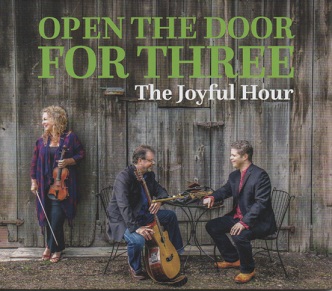
Open The Door For Three: The Joyful Hour
Open The Door For Three: The Joyful Hour
Open the Door for Three is fiddle player Liz Knowles, uilleann piper Kieran O’Hare, and Dublin-born singer and bouzouki player Pat Broaders. Their music is a rare combination of unearthed tunes from centuries-old collections, newly composed melodies, fresh arrangements of songs old and new, homages to the musicians and bands they grew up listening to, and the unmatched energy of a trio of good friends playing great Irish music together.
“A road-tested, audience-approved, high-octane, fist-in-glove, laughing-out-loud trio of Irish musicians…” “Theirs is a big and brilliant sound!” — Sean Smith, Boston Irish Reporter
Liz, Kieran, and Pat have been mainstays of the Irish music scene around the world, having distinguished themselves over the last two decades as soloists with Riverdance, Cherish the Ladies, String Sisters, Secret Garden, Anúna, and The New York Pops. As a trio, they have played to a wide range of audiences in venues large and small, from Irish festivals, to concert halls, house concerts, and pubs. They have performed around the world: on Broadway and at Carnegie Hall, at L’Olympia and the Palais des Congrès in Paris, in Malaysian rainforest festivals, in theatres from Shanghai to São Paulo, and even in a bullring in Mallorca. Most recently, they have been featured at The Kennedy Center’s Ireland 100 festival, the Celtic Colours festival in Cape Breton, at The Milwaukee Irish Festival, and in The Masters of Tradition series in Bantry, County Cork, Ireland.
Irish music is a living, breathing part of Irish and Irish-American culture, and there is no single story that can sum up its history, its charm, grace, and drive. The soul of Open the Door for Three’s music is filled with connections: the connections to people and places, to teachers and heritage and audiences, and to the stories and humor that bring us all together. From these connections comes inspiration, which fills a bottomless well that keeps the trio coming back again and again – to refill, refuel, reinvent, and share.
-
Peter Horan & Gerry Harrington – Fortune Favours the Merry
Press Reviews
#13 / Best Irish Traditional Albums of 2005
The Irish Echo / CEOL Column By Earle Hitchner
Irish Music Magazine 8.05
Fortune Favours the Merry, and if you buy nothing else this year you wont be disappointed, perhaps as they say in crossword clues you’ll be blessed and delighted by your windfall! Sean Laffey
The Irish Post
“This is an album of joyous, uncontrived music on flute, and fiddle from two musicians with both talent and experience”. Joe Mullarkey
The art of duet playing has long been an integral part of the traditional music ethos. One has only to look back to the recordings of the great masters of traditional music in the early years of the last century; along with their solo recordings, they also recorded duets with fellow musicians. This tradition is continued with this release.
Peter and Gerry create a tight blend of wind and string in which neither dominates. The music is played in a clean, spirited fashion without sacrificing any of their individual capacity to grace the music. You will enjoy listening to their music as much as they enjoy playing it. Paddy Ryan
Both are well-known musicians and being from different musical backgrounds, parts of Ireland and even generations, is not a problem as far as their blend of flute and fiddle music is concerned. There is freshness and life in the wide variety of tunes they have chosen – some are classics of our tradition – and while others are not so well-known, you’ll wonder why when you hear them played on this disc.
There are reels, jigs, hornpipes and other dance tunes, as well as a slow air. There are solos and duets, music with and without accompaniment and, where there is accompaniment, the piano of Ollie Ross (a very well-known name in traditional music through his father, the legendary accordion player, George Ross) does this most ably in a way which complements and adds to the overall pleasure of hearing this music. Peter Browne, RTE Producer and uilleann piper. February 2005
The Irish Echo / CEOL Column By Earle Hitchner
Best Irish Traditional Albums of 2005
Shortly after coming to the Irish Echo in 1991, I decided to compile an annual top 20 list of Irish traditional recordings that would stubbornly resist the trend to place albums in several, often arbitrary categories. I felt then, as I do now, that such category-crammed lists were thinly veiled attempts to pacify as many musicians, publicists, and record labels as possible by spreading acclaim like cheap margarine.
Critics, if they really are critics, should have the courage of their convictions and rank the recordings, no matter how difficult the process and unwieldy the challenge. To me, it’s a matter of put up or shut up, and each year I choose to put up for “Ceol” readers.
Every one of these standout albums from 2005, unflinchingly ranked 1 to 10, belongs in your listening library.
(13) “Fortune Favours the Merry,” by Peter Horan and Gerry Harrington (CICD 158):
Sliding into the fiddle chair beside Killavil, Sligo, flutist Peter Horan, whose nearly 30-year partnership with fellow Sligoman Fred Finn (1919-1986) on fiddle is the stuff of legend, could have unnerved another fiddler, but Kenmare, Kerry-born Gerry Harrington complemented Horan beautifully. The pace was exemplary, and the investment of feeling in every note conveyed a sincerity that was nearly palpable.
[Published on January 25, 2006, in the IRISH ECHO newspaper, New York City. Copyright (c) Earle Hitchner. All rights reserved. Reprinted by permission of author.]
The Irish Post 17th Dec.05
Traditionalists play a merry tune going back to their roots
FORTUNE Favours The Merry is the new album from Peter Horan and Gerry Harrington. Peter and Gerry create a tight blend of wind and string in which neither instrument dominates. The music is played in a clean, spirited fashion without sacrificing any of their individual capacity to grace the music.
This is an album of joyous, uncontrived music on flute, and fiddle from two musicians with both talent and experience.
Peter Horan is from Killavil in Co. Sligo and is a veteran of Irish traditional music. Growing up in fiddle country meant that his flute style was largely free of the influence of other players and he is now the last exponent of a unique style of playing which is not unlike the local fiddle style.
Gerry Harrington is from Kenmare in Co. Kerry and is now living in Lismore in Co. Waterford. His fiddle style is predominantly that of Sliabh Luchra. Gerry is a highly-respected musician who has made several other recordings.
Ollie Ross brings a lovely touch to the album with lively, intuitive accompaniment on piano.
Although Gerry and Peter are from different generations and from musical backgrounds they blend beautifully. Like many older musicians Peter values expression within music far more than technicality.
The music on this album is full of feeling and comes from the very roots of the tradition. Tunes on the album include Tell Her I Am, Lord Gordon, Lad O’Beirne’s Hornpipe, The Skylark and the slow air She Sailed From Dublin. Joe Mullarkey
East Bay Express Best of 2005
Though they represent not only very different regional styles but different generations, flutist Horan and fiddler Harrington combine beautifully on this beguiling record. Nobody is trying to prove anything here, but like all great traditionalists, these guys know how to let a tune tell its own magical tale. They also know how to select a fine program. It really doesn’t get much better than this. Duck Baker
The Irish Echo 27.7.05 CEOL Column.
Give Kenmare, Kerry-born fiddler Gerry Harrington credit. It is not easy sliding into the fiddle chair beside 79-year-old Killavil, Sligo, flutist Peter Horan, whose nearly 30-year partnership with fellow Sligoman Fred Finn (1919-1986) on fiddle is the stuff of legend. Horan and Finn were a hand-in-glove duo, beautifully in sync with each other, so comfortable and capable that the music they made seemed effortless and was seamless.
Two years after Finn’s death in Jan. 1986, Comhaltas Ceoltóirí Éireann released the “Music of Sligo” LP. It comprised five tracks from a Dec. 1985 recording session by Horan and Finn in Dublin, four tracks from their 1976 session in Dublin, two tracks from a 1959 Radio Éireann recording of them made by Ciarán Mac Mathúna, and five tracks selected from their playing during the 1970s in South Sligo. Albums cobbled together in this fashion are often uneven, and the sonic quality of the LP was that. But the playing was extraordinary and has stood the test of time.
Gerry Harrington is from a younger generation and different regional style, Sliabh Luachra, so the match between him and Horan in their “Fortune Favours the Merry” CD on Cló Iar-Chonnachta may appear strange and improbable. But this album of more than an hour of music recorded at Doddy’s Pub in Ballymote, Sligo, largely works because these two instrumentalists start from a bond of respect and care for the tradition they serve. If speed in Irish traditional music is about ego and effect, then the more fluid, unhurried tempo heard on this CD is about melody and how to deepen its appeal without artifice.
Is Peter Horan on “Fortune Favours the Merry” the Peter Horan of “Music of Sligo”? No. But that doesn’t mean he still can’t put across a tune with all the soul and spirit for which he’s known.
The grace and lift Horan brings to his flute playing in “The Pigeon on the Gate/Trim the Velvet” reels dovetail expertly with Harrington’s steady, dance-inspired fiddling, backed by Ollie Ross on keyboards. The pace is exemplary, and the investment of feeling in every note played conveys a sincerity that’s nearly palpable.
In one sense, it’s hard to make “The Skylark/Roaring Mary” reels, “Tell Her I Am/Brennan’s Favourite” jigs, “The Foxhunter/Captain Rock” reels, “Lord Gordon” reel, and “Dowd’s No. 9/The Hunter’s House” reels sound new, given the countless times they’ve been recorded over the decades.
Horan and Harrington reinvigorate them not with machine-gun velocity, exotic ornamentation, or winking novelty in arrangement, but with sheer, expressive joy in playing them. This isn’t old wine in old or new bottles, but old wine allowed to breathe and spread its bouquet naturally. Not to strain the metaphor, but this is a sipping rather than a guzzling contest overseen by two sommeliers of impeccable taste.
Hornpipes such as “John J. Kimmel’s/O’Callaghan’s” from Harrington and “McDermott’s/The Flowers of Antrim” from Horan and Harrington, backed by
Ross, luxuriate in melodic texture, while “The Corkin Cross/The Lakes of Sligo/Memories of Ballymote” show Horan’s ability to match his Sliabh
Luachra partner in some polkas.
My sole, small complaint about the album is in the relationship between melody and rhythm instruments on occasion. In “Lad O’Beirne’s/Sault’s
Hornpipe,” for example, fairly inflexible dynamics and almost paint-by-numbers vamping on keyboards by Ross, an otherwise able player, distract from Horan’s lovely flute solo.
Accompanists must adjust to melody players, not vice versa, especially when the melody player is a flutist of Horan’s reputation. This has nothing to do with that silly saw, “A good backer is the one you don’t notice.” Listeners should notice–and appreciate–rhythmic accompaniment that sets into relief or elicits standout melody playing.
If fast and flashy Irish traditional music is what you’re seeking, then skip this CD. But if you’re looking for unslick, turf-scented instrumental music rooted in and drawing on the longstanding strength of the Irish tradition, “Fortune Favours the Merry” is for you.
Kudos to Cló Iar-Chonnachta (CIC), an independent recording label in Inverin, Connemara, Galway, for its commitment over the past 20 years to
preserve and present Irish traditional music as well as Irish-language and Gaeltacht culture of quality. Earle Hitchner
The Irish Echo
For anyone who loves Irish traditional music in its pure drop state, unvarnished and unflashily virtuosic, there are two new, can’t-miss albums from Galway’s Cló Iar-Chonnachta label: “Fortune Favours the Merry” by Sligo flutist Peter Horan and Kerry fiddler Gerry Harrington, with piano accompaniment from Ollie Ross (his father was Wexford’s 1956 All-Ireland senior button accordion champion George Ross), and “Within a Mile of Kilty” by John Gordon, Brian Rooney, Séamus Quinn, and Ben, Charlie, and Maurice Lennon, with backing from Altan’s Ciarán Curran on cittern, Beginish’s Noel O’Grady on bouzouki, Frank Kilkelly on guitar, and Gabriel McArdle on concertina.
Harrington has absurdly large musical shoes to fill, as the flute-fiddle duo of Horan and fellow Sligoman Fred Finn (1919-1986) is the stuff of legend. But the Sliabh Luachra fiddler acquits himself well beside Horan, who will only increase his reputation as one of Ireland’s finest flutists ever with this new CD. If you enjoyed Mike Rafferty’s exceptional “Speed 78” solo debut last year, you will also revel in this Horan-Harrington collaboration, recorded in Doddy’s Pub, Ballymote, Sligo. Earle Hitchner
Irish Music Magazine 8.05
Gerry Harrington told me that there were only two days of rehearsals allotted for this exceptional album. “Peter Horan reckoned that if I was good enough then I’d be able to get it all down in those two days, if not then I’d never be good enough to play with him” he told me. Well the judgement is that there really was some thermal chemistry going on when these two met and the combination of flute and fiddle resulted in an alloy of truly astounding properties.
The album opens with The Gold Ring/The Rambling Pitchfork with Ollie Ross adding the undertow of piano accompaniment. The tracks just gets better as the musicians settle into their playing, giving the album a really live sound.
Recorded by Bruno Staehlin in his Open Ear Studios in Galway, he has a great set of lugs and has recorded this album so that you can hear every nuance from the fiddle and flute. And you really have to hear this album, it’s simply not enough to passively listen to it; Peter Horan’s flute playing is so full of variety, little yelps and barks, unexpected trills and flourishes, and yet all the time Harrington matches these pyrotechnics with tight ensemble playing never once thrown off by the vibrancy of Horan’s work.
There are chances for solo performances too, with Harrington first out to bat with John J. Kimmel’s Hornpipe/ O’Callaghan’s both from the Sliabh Luachra tradition (attributed on the album liner notes to Julia Clifford and Dennis Murphy). Horan’s masterpiece is the slow air She Sailed from Dublin, he has an original method of playing slow airs, about as far from Keltic Muzak and all those wispy low whistle albums as you can imagine, slow the air may be, but is full of music. And a word about those liner notes, short perhaps but full of information on where their source recordings can be found.
One remarkable feature of the album is how well Horan and Harrington have gelled together, as they come from truly distinct Irish music traditions, did they really get on musically I asked Gerry Harrington, well he told me Peter is already keen to make another album. And if you need proof of the potential inspect track fifteen, Dowd’s No. 9 and The Hunter’s House, the latter taken at a handy pace, it’s composer Ed Reavy would surely be delighted by it’s treatment here.
For the time being you’ll have to do with Fortune Favours the Merry, and if you buy nothing else this year you wont be disappointed, perhaps as they say in crossword clues you’ll be blessed and delighted by your windfall! Sean Laffey
The Irish World 15.07.05
Peter Horan and Gerry Harrington are two musicians from very different traditional Irish musical backgrounds. With a large generation gap between them and different styles of playing, hailing from almost opposite ends of Ireland, Peter from Sligo and Gerry from Kerry, maybe you’d dismiss the thought of these two men putting together fiddle and flute to bring us a collection of ‘oh-I-recognise-that-one’ Irish tunes.
Well you’d be mistaken. Peter grew up in Killavil Co. Sligo, known as ‘fiddle country’, and he developed a style of playing which was very much his own. He has carried with him this unique style and is a veteran of traditional Irish music today, earning much respect over the years.
Gerry Harrington, despite being of a younger age is also a respected musician whose fiddle style is that of Sliabh Luachra, an area spanning the Cork, Kerry and Limerick borders, famous for its contribution to Gaelic cultural heritage.
Gerry’s collaboration with Peter Horan in ‘Fortune Favours The Merry’ is the latest in a series of duets with other respected musicians, namely Charlie Piggott and Nancy Conescu.
For those of you who have remained in touch with the traditional Irish music scene I’m sure you’ll be delighted to hear such tunes as ‘The Skylark’, ‘She Sailed from Dublin’ and ‘Lad O’Brien’s Hornpipe’. For those who have perhaps lost touch a little there are, and I’ll say it again, ‘oh-I-recognise-that-one’ tunes which ring a bell and bring back memories of times spent in Ireland or with the relatives.
The fruit of this collaboration, with the lively accompaniment of Ollie Ross on the piano, brings you back to your roots. The fiddle and flute skilfully compli-ment each other and in the words of Peter Horan in reference to their music “You have to feel it”. PATRICK COYLE
£14.99 -
Peter Horan & Gerry Harrington – The Merry Love to Play
Peter Horan is a legendary flute player from Killavil, Co. Sligo and this is the second album that he has recorded with Gerry Harrington, a talented fiddler from Kenmare, Co. Kerry.
Their first album, Fortune Favours the Merry, was released in 2005 to critical acclaim and The Merry Love to Play will do much to confirm their excellence as a duet. The new album is completely unaccompanied, a very rare occurrence in commercial music, allowing the listener to focus entirely on the two melody instruments and also maximizing the opportunity to hear Peter Horan’s unique flute playing. The musicians’ distinct styles complement each other superbly, with Gerry’s delicate and airy playing providing the perfect counterbalance to Peter’s rhythm-driven style. For Peter Horan to undertake an unaccompanied album at the age of 81 was no mean feat; however both musicians felt strongly that an unaccompanied recording was the best choice for the new album. They wanted to go back to the roots of the music, to a simpler sound that would showcase the instruments and best reflect the way that music has traditionally been played. The Merry Love to Play does just that, and provides listeners with a rare example of traditional Irish music in its purest state.
Gerry Harrington has provided meticulous notes in the booklet on the sources for the tunes. The Merry Love to Play will be launched on Monday 16 July in Tubbercurry, Co. Sligo as part of a tribute concert to Peter Horan during the South Sligo Summer School.
Copperplate is very proud to have this title on our roster and to help it achieve its full potential will be supporting this release with a full-scale promotional mail out to media and retail.
Also available from Copperplate Distribution
CICD158: Peter Horan & Gerry Harrington: Fortune Favours The Merry
CICD142: Gerry Harrington & Charlie Piggott: The New Road
Press Reviews
Irish Music Magazine
One of the great things about our music is that it’s meant for sharing among friends. No finer example could be found than this collection. It’s a follow-up to the first CD, Fortune favours the merry. It is also a powerful argument for having at least some tunes played unaccompanied, especially when the players have such good rhythm and understanding. And the solos are very fine. Listen to Peter Horan at the age of 81, giving a masterly account of the “High Level” hornpipe, not an easy tune at any age. And he also has a lovely waltz, the “Killavil Waltz”, that came from his own mother.
There’s sometimes a complaint that traditional players don’t achieve great tone. Gerry’s playing on the slow air “Her Mantle So Green” will easily give the lie to that. Full praise to CIC for the detailed bi-lingual notes, including background on each tune. Listen to the instinctively good playing on an old war-horse like “The old grey goose”. Gerry shows his Kerry roots with a couple of fine polkas, including the showpiece “Primrose”, once made famous by Jimmy Shand.
Above all, this is happy and contented music, no shapes to throw, nothing to prove, except that when you love the music as much as this, the sharing is wonderful. John Brophy
www.liveireland.com
For the pure trad lover comes a “must have”. “The Merry Love To Play”. Out of the West comes 81 year old Peter Horan on wooden flute (of course!) and Gerry Harrington on fiddle. This is a follow up to their highly regarded and loved, “Fortune Favours The Merry” of a few years ago. This is unaccompanied. A daunting challenge today, both in artistic and commercial areas. This takes musicians of quality and real substance. This is not easy to pull off. These two do it gloriously. Again, this is for the real, true, down to the bone trad fanatic. Others of a more commercial bent may want to stay away. But, if the real deal is your deal, this is for you. This is brilliant. Horan’s solo version of “The Coolin” is worth the price of admission, alone! Rating: Highly Recommended For The True Trad Purist! Bill Margeson
£14.99 -
Rattle the Boards – The Parish Platform
BIOG:
Playing together since 1992,Rattle the Boards have been praised as one of the best traditional acts in Irelands music scene. Pat,John and Benny were all members of the Knocknagow Ceili Band who were based in Clonmel,Co.Tipperary and spend many years playing for dancers throughout Ireland.Benny is also leader of the International supergroup”Danu”and has toured all over the world. In 1999 Rattle the boards released their debut album to much acclaim. With many performances in Ireland and Europe over the past years Rattle the boards have grown into an act very much sought after.In 2002 Rattle the Boards provided the musical inspiration for a major Irish theatre show called Teac A Bloc by famous visual artist Des Dillon.Rattle the boards arranged and performed with Teac A Bloc to sold-out venues throughout Ireland and also performed two sketches from the show on Irelands premier tv show”The Late Late Show”This is only one of many TV appearances by Rattle The Boards todate.In March 2008 Rattle the boards released their long awaited second album “The Parish Platform”nearly a decade after the debut release.Their scense of fun and lift in the music of Rattle the boards makes them unique among their contempories.As their name suggests this is a group that will have its audience on their feet and rattling the floorboards.
Copperplate is very proud to have this title on our roster and to help it achieve its full potential will be supporting this release with a full-scale promotional mail out to media and retail. Contact Copperplate for all your PR needs.
The lads are generally available for interviews; please contact us to arrange a mutually convenient time. Please copy us on any reviews/features/airplay. Feedback always welcome.
Press Reviews
www.liveireland.com
THE LIVIES 2009
Newcomers of the Year: Rattle the Boards: Rattle the Boards
Benny McCarthy on accordion, Pat Egan on fiddle and banjo, John T. Egan on vocals, John Nugent on guitar and vocals and Donnchadh Gough on bodrhan have stormed onto the scene this year with one of the biggest selling and most loved debut albums in memory. The key? It is fun. It is a BALL!! Terrific tunes and songs, all imbued with a real sense of the joy that Irish music is. Mason’s Apron is our favorite tune, and Patrick Was a Gentleman our fav song. These guys get it. No self-involved navel-gazing here about ‘the meaning of the tradition’, and all that crap. No pretentious egos. Just a sense of the fun of it all. We love these guys and cannot wait to see them in person! Bill Margeson
Folk World Editors Best Loved Albums of the Year
Irish traditional music at its best — lively and real, spontaneous and passionate. Central to the band’s sound is the wonderful accordion playing of Danu’s Benny McCarthy, and he is joined by Pat Ryn (fiddle, guitar, mandolin), John Nugent (guitar) and the singing of John T Egan. A great mix of traditional tunes — from jigs and reels via polkas and airs to hornpipes and quicksteps — plus a number of trad songs. A few friends have joined the lads for a few numbers — and there is a bit of an unusual but very welcome interlude of a trumpet in one of the numbers, giving the number some jazzy flair.
All of this played with so much passion that the listener’s feet won’t stand still. This lot managed to distil the spirit of traditional music onto a CD, giving the listener the feeling that the foursome would just sit around the corner in his/her kitchen. And don’t be surprised that you find yourself rattling the boards of your wooden floor dancing away. An album that lifts your soul and just makes happy. Great stuff! Michael Moll
Rock’n’Reel
The brain child of Danu frontman, Benny McCarthy, Rattle the Boards second album continues their intention to revive the joie de vivre inherent in Irish music performed for pleasure and dancing before The Clancy’s and the ballad boom exposed the music and song of Ireland to a wider world.
It succeeds in its core ideal, in the verve, authority and drive of the performers attacking of the polkas, jigs and reels with flair and invention.
Of course, time hasn’t stood still and along the way, the players, John Nugent, John T Ryan, Pat Ryan, McCarthy and assorted guests contribute something of their own musical personalities. Consequently, there’s nothing precious here, with the rugged St Patrick Was A Gentleman making way for the innovative Whistling Rufus quickstep, where Decky O’Dwyer’s trumpet adds an air of Mariachi to the performance, and classic reels such as The Mason’s Apron are given a new alacrity and tempo courtesy of some dazzling melodeon from McCarthy.
Unpretentious and packing so much into its 12 tracks, Rattle The Boards enable much of the Irish tradition to breath anew. Danny Moore
The Living Tradition Aug/Sept 08
As if playing in Danu isn’t enough to fill in his days (and nights!), Benny McCarthy has got together with a bunch of his local musician friends, plus a few other guests, to produce an album of music for a good old hooley. This is not a recording for purists or musicologists to analyse and contemplate; rather it’s one for everyone just forgetting about the rest of life’s boring stuff, getting carried away with the atmosphere and having a dance, or, if that’s too much like hard work, just listen and enjoy, since this is a delight throughout.
The band line-up is Benny McCarthy on button box and melodeon; Pat Ryan, fiddle, mandolin and banjo; John Nugent, guitar; and John T Egan, vocals. Guests are Donnchadh Gough, bodhran; Des Dillon, harmonica; Jon Kenny, vocals; Decky O’Dwyer, trumpet (yes, trumpet!); Albie Grace, bass Paul Ryan, button box; and Bruno Stachelin, percussion. There is a strong Tipperary connection, with many having played in the Knocknagow Ceili Band. This is not a ceili band album, however, ditching the strict-tempo approach in favour of a free-flowing, good-time sound.
The majority of the tunes and songs are very well known and very popular indeed, and it sometimes takes a fresh, lively attack on them like this to help us all realise why they became popular in the first place. From the vocal hilarities of St Patrick was a Gentleman, via the inspired trumpet breaks on Whistling Rufus through to any other track you mention, this CD just oozes with the sounds of talented guys having a good time and infecting everyone who hears them with their sense of enjoyment.
As a nice touch, the CD is designed to look like an old-fashioned vinyl record (remember them?). Listen to this, but make sure you’ve left some space for dancing – that’s what you’ll feel like doing! Gordon Potter
TAPLAS, the Welsh folk magazine
The Parish Platform, on the other hand, is about as different as you can get while remaining within the style and repertoire of the traditional Irish genre.
Even- track is completely unlike the last. It is bright, sparkly and energetic. Each musician’s individual characteristics shine through.
The band includes Danu’s Benny McCarthy on accordion, John Nugent on guitar, John T. Egan on vocals and Pat Ryan on fiddle, mandolin and banjo.
There is also a long list of guest musicians including a cracking bodhran player and even some brass!
With all these different instrumentalists chopping and changing, soloing and blending and all playing with exuberance, dexterity and vigour, it doesn’t get stale for a second. The couple of songs are extremely engaging and entertaining and you even get to find out what happened to all the snakes in Ireland! This is a great one for the collection! Imogen O’Rourke
The Irish Democrat
EIGHT YEARS on from the release of their self-titled debut album, Rattle The Boards have come up with another toe-tapping collection of traditional Irish dance tunes and songs.
Based around a nucleus of founder members Benny McCarthy (button accordionist), John Nugent (guitar/vocals), Pat Ryan (fiddle/banjo) and former guest singer John T. Egan (vocals), Rattle The Boards have produced an album that is unashamedly nostalgic in feel. This time around featured guests include Jon Kenny (vocals), Decky O’Dwyer (trumpet), Donnchadh Gough (bodhran), Des Dillon (harmonica), Paul Ryan (accordion) and Bruno Staelhelin (percussion).
What could so easily have ended up as mere pastiche is anything but. This is entirely down to the excellent quality and vitality of the playing – though you’d hardly expect anything less from an ensemble that features two members of Irish traditional ‘supergroup’ Danu (McCarthy and Gough) and a bevy of renowned and respected musicians with more ceilis under their belt than you could shake a stick at.
While their unrepentantly backward-looking tribute pays homage to the musical culture of a bygone era it does so in style. Although their approach won’t please everyone, you’ll need a narrow mind and a cold heart not to find your spirit lifted and your feet tapping, providing a reminder of a time when virtually the sole purpose of music was to get folk on their feet.
In fact, if these tunes and songs don’t get you in the mood the volume’s probably not up loud enough – either that or you’re under the boards rather than in any position to rattle them. David Granville
“Tunes familiar to every parish but with a bit of fire under them” THE IRISH TIMES
Shake, ‘Rattle,’ and Roll On Music Meant for the Dancer in You
[Published on June 4, 2008, in the IRISH ECHO newspaper, New York City. Copyright (c) Earle Hitchner. All rights reserved. Reprinted by permission of author.]
The self-titled debut recording in 1999 by Rattle the Boards raised a smile for me when I read the group’s track note for “The Controversial Reel.” Listed as “trad.,” it was described as “a lovely reel which is around a long time.” Thirty-one years ago, the reel appeared on “Kiss Me Kate,” an album by fiddler Liz Carroll and button accordionist Tommy Maguire. So the track note is accurate–except for “trad.” It isn’t. The reel was composed by Brooklyn-born, Baltimore resident button accordionist Billy McComiskey. But the compliment to McComiskey comes from the assumption that a tune that good must be “trad.”
“Trad.” instrumental music is mainly dance music, and the latter dominates “The Parish Platform,” the new recording by Rattle the Boards. My hope is that the group, like “The Controversial Reel,” will be around a long time, for their music is an unvarnished joy meant to get your feet moving and, yes, rattling the boards.
The founding members of Rattle the Boards are Danu button accordionist Benny McCarthy from Waterford, banjo, fiddle, and mandolin player Pat Ryan from Tipperary, and guitarist John Nugent, Ryan’s brother-in-law, from Tipperary. All three formerly played with the Knocknagow Ceili Band, based in Clonmel, and have gotten together to play music almost weekly since 1992.
The guest singer on the first Rattle the Boards album was Tipperary’s Martha Beardmore, and the full-fledged member now singing with the group is Tipperary’s John T. Egan. He possesses a gruff voice well suited to the two songs on the new CD, “St. Patrick Was a Gentleman” (Jon Kenny shares lead vocal) and “The Nightingale.”
The rest of the dozen tracks on “The Parish Platform” are tunes, and the album’s most dazzling performance comes from button accordionist Benny McCarthy on “The Mason’s Apron.” It’s a warhorse traditional reel that was boosted in popularity by fiddler Sean Maguire with the Four Star Quartet and then boosted again through the solo turn by flutist Matt Molloy in the Chieftains’ concerts. The embellishments by McCarthy in this reel refreshen it. Accompanied by Nugent on guitar and McCarthy’s Danu colleague Donnchadh Gough on bodhran, the button accordionist plays with triplet-flecked swing and inventive panache while never losing his grip on the tune’s melodic spine. This tour de force matches McCarthy’s best work with Danu.
“McKillop’s/Love at the Endings/High Reel” is a medley initially showcasing Pat Ryan’s skill on the fiddle. With Nugent and Gough backing him, Ryan plays the first reel with limber energy and pulse, all ratcheted up when McCarthy enters on the second reel and Ryan himself switches to banjo on the third reel. Even nailing your shoes to the floor won’t prevent you from tapping them to this percolating beat.
In the “Galway/Peacock’s Feather” hornpipes, McCarthy’s accordion playing, which sports some well-placed, Derrane-like triplets, and Ryan’s banjo playing, which ably complements the box and also allows it to veer off on nimble flights of fancy, form a crisp, cohesive whole, backed unobtrusively by Nugent on guitar.
“The Irish Washerwoman” is a jig still shunned by many Irish traditional musicians, who feel it has been done to death in the past and also conjures up a cultural image of demeaning stereotype. But no matter how long this jig may be mothballed, it is instantly recognizable when dusted off and performed. The reason is its enduring melodic and rhythmic appeal. Both are obvious in the vibrant new airing the jig receives from McCarthy on accordion, Ryan on banjo, Nugent on guitar, and Gough on bodhran in a medley that includes “Maid in the Meadow” and “Humours of Drinagh.”
Among the other medleys packing a punch on the new album are “Farrell O’Gara/Gan Ainm/The Flying Irishman” reels, “Cuz Teahan’s/Gan Ainm/Johnny O’Leary’s” polkas, and “Jimmy’s Jig/Gan Ainm.”
Where ceili band and showband merge (collide, if you’re a purist) is “Whistling Rufus,” a hoot of a quickstep tune played a little too loosely. It additionally melds Irish trad with New Orleans jazz strains, especially through guest Decky O’Dwyer’s trumpet playing.
A critic in Ireland wrote that “The Parish Platform” may veer near “caricature.” I suppose the plain woolen caps, work shoes, and other attire worn by the quartet in sepia-toned album photos–one shows them dancing and playing music on a small wooden platform laid on a dirt country lane with an old car parked close by–may give off that impression to some. But it’s a mistake to suggest that “The Parish Platform” inadvertently swerves toward “caricature” or, worse, constitutes a deliberate goof or spoof smirking at a musical style and attitude rooted in the rural Ireland of the not-so-distant past. This album is not a lampoon but a lively, winsome tribute, full of fun and motivated by respect, recalling a time when spurring people to dance was all that mattered. What’s not to like about that? Earle Hitchner
www.liveIreland.com
Next up is a new fav, The Parish Platform by Rattle the Boards. Four musicians, with guest stars. John Nugent, Benny McCarthy, John Egan and Pat Ryan offer an album of great fun and a sense of the real trad. This is not the honed studio perfection of so many albums today. This is a big, blousy thing with a great sense of the music, the rhythms and the meaning. It is the most fun we have had listening to anything in quite a while. We frequently smiled, and even got up to shake a foot occasionally ourselves! The role of ceili and set dancing is well recorded in Irish music, and vastly overrated. And, if this album in description pays a little too much of a tip of the hat to the dancing tradition, it delivers the essential goods—the music itself. You will love this album. It will be a contender for Vocal/Instrumental Album of the Year. It is their second album and is offered through Doon Productions. Go to www.rattletheboards.com. Find this album and buy it. Then turn it up. Smile. Rating: Four Harps. Bill Margeson
Irish Music Magazine
Rattle the Boards tread a fine line between ceoltoir and caricature. I’d say they carry it off, their music is meant to be fun and it is. From the opening notes of ‘Cuz Teehan’s Polka’ we’re clearly well down the country, the whole album is a triumph of exuberance.
All the old favourites are trotted out: ‘The Mason’s Apron, The Irish Washerwoman, The Galway Hornpipe’ and The High Reel’. Box and banjo front men, Benny McCarthy and Pat Ryan are well known from Danu and the Knockgow band. They’re joined by John Nugent on guitar, and John T Egan for the occasional song, on this follow-up to their 1999 debut CD.
Amidst plenty of good stuff, the majority is pure traditional: ‘Johnny Leary’s, Off to California, McKillop’s Reel, Humours of Drinagh’, and a couple of ‘Can Ainmneacha’. The showband standard, ‘Whistling Rufus’ adds a note of jazz and pays homage to Clonmel’s other musical heritage (Mick Delahunty’s big band). The big band on this track is a one man horn section from Decky O’Dwyer and some deft finger work on the box from McCarthy.
Benny excels on his ‘Mason’s Apron’ solo, with enough variations to please any Dubliners die-hards, while ‘Autumn Sky’ and The Nightingale’ are firmly back in showband territory. There are just two songs on The Parish Platform’; the other is a rough-and-ready romp through the comic ballad ‘St Patrick Was a Gentleman’, a duet with comedian John Kenny. A set of reels headed up by ‘Farrell O’Gara’ provides the big finish, played straight and not too fast, a satisfying conclusion to a most entertaining CD. There’s an engagingly antiqued website at www.rattletheboards.com. Alex Monaghan
£14.99 -
Seamus Quinn & Gary Hastings – Slan le Lough Eirne
- The Kiss Behind the Door / Bonnie Ann / The Granny in the Wood.
- The Humours of Ballyconnell / Swinging on the Gate.
- The Mayo Snaps / The Boys of the Town.
- Paddy Kiloran’s Highland / Hannah Mhici Mhicheail’s.
- Farewell Dear Erne, I Now Must Leave You.
- The New Copperplate / Patsy Hanley’s.
- The Bugle Hornpipe / Number 5.
- Edward the Seventh / The Lark on the Strand.
- The Shaskeen.
- The Banks of the Clyde.
- Na Ceannabhain Bhana / Dever the Dancer.
- P. Flanagan’s / The Gossoon That Beat His Father.
- The Maids of Castlebar / The Morning Star.
- Last Nights Fun / The Sligo Maid.
- The Heel & Toe / Devlin’s.
The three first met in Coleraine University. Gary is now Church of Ireland rector in Westport, Seamus is a Catholic priest in Monaghan, and Ciaran is from the parish of Altan. Seamus plays fiddle, Gary plays flute and Ciaran plays bouzouki. This is superb music, much of it based on the tradition of County Fermanagh where Seamus grew up. These men had the same mentors as Cathal McConnell, the musicians of South Fermanagh and North Leitrim. Seamus also has a special allegiance to the music of Coleman, and the couple of slow airs included are based on the songs and style of Fermanagh. It’s as good as you are going to hear. Claddagh Records
£14.99 -
Sean Casey – The Porthole of the Kelp
1. The Musical Priest / Jenny’s Chickens
2. The Humours of Lissadel / The Queen of May
3. Tommy Coen’s / The Reel of Mullinavat
4. The Templehouse / Toss The Feathers
5. The Pipe on the Hob / Brendan Tonra’s Jig
6. Farewell to Miltown / The Star of Munster
7. Pol Ha’penny
8. Colonel Fraser
9. The Bank of Ireland / The Woman of the House
The Drunken Gauger
Banish Misfortune / The Cliffs of Moher
Lucy Campbell
Paddy Ryan’s Dream / Over the Moor to Maggie
Rakish Paddy / The Green Fields of Rossbeigh
The Tempest / The West Wind
The Porthole of the Kelp / The Hare’s Paw
Press Reviews
Irish Music Magazine 1/2003
Bow Hand is the baby of Dermot Kearney, banjo-player and erstwhile sparring partner of the fiddler Jimmy Power when the latter led the sessions on The Victoria in London’s Holloway Road in the 1980s. The label’s first release was ‘Navvy on the Shore’ by the larger than life and twice as frisky, Donegal fidddler, Danny Meehan, and now comes an equally valuable recording from another key figure on the London Irish music scene.
Sean Casey is, of course, the son of the late Bobby Casey, from the Crosses of Annagh in Co Clare, whom many reckon to be one of the greatest fiddlers of the latter half of the last century and, sadly also one of the most under-recorded. Brought up in London’s Camden Town in a house where Willie Clancy was the lodger, oddly enough Sean was never taught by his father, but acquired early tuition from the concertina player and piper, Tommy McCarthy, also learning fiddle technique from Tony Linnane, and Brendan Mulkere. Yet it was on the mandolin that Sean first made his name, later also acquiring skills on the mandola and banjo, on the last of which he would often be requested to play a solo at The Victoria. Ill-health forced Jimmy Power to retire from the pub’s sessions and Dermot Kearney latched upon Sean as his replacement, much to the latter’s surprise, on the fiddle and he’s never looked back since.
Porthole of the Kelp is his debut solo album, and was recorded in the Cricklewood living room of Paddy Gallagher, who accompanies on guitar and bouzouki, with Pete Quinn dropping in for the odd tune on the keyboard. Those who’ve heard Sean play at a session will instantly recognise the wit, sensitivity and effortless vigour which characterizes his playing, ever willing to let the melody do the work, but keen to explore its possibilities. There were, of course, essential facets of his father’s music and there are many echoes of the great man here, not least in two swooping jigs, The Pipe on the Hob and Brendan Tonra’s.
Admittedly, the sound quality (direct to DAT) is not the best, though the accompaniment is always spot on whether it’s Paddy’s stylish tracking of Casey’s every move, or the resonant chordal landscape painted by Pete’s keyboard. As on the reel, ‘Colonel Fraser’, the letter seems to inspire Sean to broaden his canvas even further, offering a rich concoction of technical agility married to essential soulfulness.
Sean never plays a tune the same way twice, so this is very much a one-off recording, but, hopefully not the last that those outside London will hear of him. Geoff Wallis
Musical Traditions Web Site
One of the younger musicians referred to by Reg in his aforementioned liner notes is the fiddler Seán Casey who was born some thirty-five or so years ago in North London. His father was, of course, Bobby Casey whose own father was Scully Casey which is some lineage to live up to. The Porthole is simply one hell of a fiddle player doing precisely what comes naturally! (It is suggested, however, that those of a nervous disposition do not look too closely at the CD itself which, thanks to the position of its central hole, appears to show Seán shot through the head.) Geoff Wallis
£14.99 -
Teada
Press Reviews
Irish Dancing International March 2003
Sharp eyed readers of this column will recognise any references to Oisin MacDiarmada, the fiddler with this band, Teada, as the self same that ran away with our ‘Album of the Year’ in December’s issue. Since last year, Oisin has moved on and now jets around the world with Teada, one of a core of excellent, young trad Irish bands.
The band comprises Oisin, John Blake, Sean McElwain, and Tristan Rosenstock. John is a Londoner and when he first came to Ireland, his forte was acoustic guitar. He is also a multi-instrumentalist and an excellect ‘fluter’, (I know I could say flautist, but tradders hate that), Sean brings more strings in the form of the banjo and the bouzouki. Tristan completes the quartet with virtouso bodhran talent and backing vocals. Oisin himself is noting short of a genius when it comes
to playing the fiddle, as we already eulogised in the December issue.
And so to this, their debut album. It’s a fine album indeed and those with a keener understanding of the finer points of Irish trad that myself have spoken volumes about it. It is a fair compendium of jigs, reels and hornpipes and a significant confidence builder forthe group in these early years. It’s a pointer to what we might expect in a year or two. Donal Lynch.
Folk On Tap March 2003
Here we have another young band emerging from the Emerald Isle playing traditional tunes on a variety of instruments, led by a fiddle or a flute, backed up by tenor banjo, bouzouki, piano and bodhran. Their playing is slick and professional as you might expect froma country so steeped in traditional music and musicians, but a creeping suspicion nags me, a sense of deja-vu perhaps. Haven’t we heard this music before, in fact many times over?
There have been so many good Irish bands playing reels, and jigs, with the occasional song thrown in for good measure, that I find hard to differentiate between them anymore. That said, however, they are at least as good as anything that has gone before, but not ground breaking and inovative they are not but maybe, they don’t want to be. Phil Hugill
The Irish Echo Téada comes with “strings” attached By Earle Hitchner
Youth is very well served on “Téada,” the Irish word for “strings” adopted as the name of a new band and their debut album on their own Sligo-based imprint, Ceol Records.
The accent on strings comes from 24-year-old, Clare-born Oisín Mac Diarmada, the 1999 All-Ireland senior champion on fiddle, London-born John Blake on guitar, and Monaghan’s Seán McElwain on bouzouki and tenor banjo. Mac Diarmada also sings and plays whistle and piano, Blake adds flute, whistle, and piano, and Dublin’s Tristan Rosenstock, Téada’s fourth member, plays bodhrán, so this “string thing” really only goes so far. (I mean, is Altan with two fiddlers, two guitarists, and a bouzouki player also a “string” band?)
Semantics aside, “Téada” represents a fresh force in Irish traditional music. Two years ago, Mac Diarmada made an excellent recording with Monaghan harper Mícheál Ó Ruanaigh and Limerick banjoist Brian Fitzgerald, and guesting on that album were Blake and Rosenstock, so the rudiments of Téada were largely in place then.
Part of what makes their debut CD impressive is the variety of moods and tempos they achieve. The band opens the album not with a customary blast of reels but a hornpipe and jigs medley that is admirably paced, especially by Mac Diarmada’s tender fiddling of “Tom Connor’s Hornpipe.” In “Teresa Halpin’s/Rathlin Island/Michael Hynes’,” McElwain’s banjo and Rosenstock’s bodhrán establish at the outset a steady, rhythmic pace that gains in power with Mac Diarmada’s fiddle and Blake’s flute coming in on the second reel. Then the third reel shifts into almost a céilí band sound, as Blake doubles on piano and McElwain adds bouzouki to the mix.
There’s a lot of adroit dueting — fiddle and flute, flute and bodhrán, bodhrán and banjo, banjo and fiddle — within the arrangements. This juicy subtext courses through the main musical reading and piques the overall listening pleasure.
Fiddle and banjo, for example, shoulder the melody throughout “The Liffey Banks/Pat Molloy’s” reels, backed at first by guitar and then by guitar, piano, and bodhrán. Fiddle and flute start off “The Surround/Up in the Garret/Port na Deoraí” slip jigs, then give way to flute and bodhrán, then to banjo and fiddle. The progression is natural, not constrained, and changes between tunes are like smooth hand-offs in a relay race, with no strides broken.
“Tom Roddy’s,” a tasty jig written by Mac Diarmada and played by him on fiddle and Rosenstock on bodhrán, effortlessly segues into two traditional tunes, “The Old Firm Jig/The Maid at the Well,” featuring all four band members. Again, the seams don’t show.
Nowhere is that more apparent and accomplished than in the album-concluding medley of “The Crock of Gold/Johnny Has Gone to France/The Tailor’s Thimble,” where the change to the last reel is brought off with a quick swoop into a lower register.
Instrumentally, Téada is exciting, but vocally, they’re much less so. Mac Diarmada sings lead on two songs, “Peigín Is Peadar” and “A Bhean a’ Tí,” backed by harmonies from McElwain and Rosenstock. The vocals are thin and tentative, especially when compared with past popular renditions of those songs by Dervish and Clannad.
Other shortcomings on the album are its brevity, clocking in at a pre-CD-era 38 minutes and 16 seconds, and its production, where some tracks end with an unsettling scissors-like snip.
But don’t be put off by these faults. Oisín Mac Diarmada is one of the most talented fiddlers in Ireland today, someone who imaginatively breaks free of convention, and John Blake’s skills on guitar and keyboard are exceptional not just with Téada but with At the Racket, the Carberry family, flutist Harry Bradley, and fiddlers Brian Rooney, Jesse Smith, and Liz and Yvonne Kane. Blake is also a good flute player, and Tristan Rosenstock on bodhrán and Seán McElwain on bouzouki and banjo are solid complements to him and Mac Diarmada.
Together, they are a quartet whose age belies how fully seasoned they are as instrumental performers. I recommend “Téada,” both the band and the CD, strings attached. Earle Hitchner
Folk Roots Review Aug/ Sept 02
Teada are a traditional quartet with a rising reputation, thanks in parts to the spirited unison playing of fiddler Oisin MacDiarmada and flautist JohnBlake, backed by first rate banjo and bouzouki from Sean McElwain and the sensitive bodhrah of Tristan Rosenstock.
Hugely enjoyable throughout and definitely one to watch out for. Thumbs UP!
Taplas June/July. The Welsh Folk Magazine
Teada, (say tay-do) are a boy band of the exciting young, traditional variety.
Interestingly they are a bit different in their laid-back and more ‘traditional’ approach to the music. Translation: they tend not to play fast and frantic, there are no cheesy ‘arrangements’, synthesisers or crossover attempts.
The band features flowing fiddle and singing from Oisin MacDiarmada, contrasting with exciting flute of John Blake, with banjo/ bouzouki and bohran completing the line up. Oisin’s singing isn’t totally convincing but that’s maybe a matter of personal preference (think Marcus O’Murchu).
The arrangements and choice of songs are a good mix of favourites, done a bit differently, and more unusual stuff. It’s a shame the production is marred all the way through by over loud fiddle, which has led to a somewhat bare sound, the instruments not quite blending. Teresa Clark
Pay The Reckoning April 2002
Pay The Reckoning know what we like (and we like what we know, but that’s a different story). And we LIKE this album.
Are you fed up with ham-fisted, hob-nailed approaches to Irish traditional music? Do you hanker after playing with depth, soul, meaning? Music where the wild, “high lonesome” sound is at the heart of its being?
Then look no further than Téada, the young 4-piece who have redefined the word sensitive and elevated understatement to an art-form.
The musicianship on this collection is impeccable. John Blake (flute/guitar/piano/whistle), Seán McElwain (bouzouki/banjo/backing vocals) and Tristan Rosenstock (bodhrán/backing vocals) display a talent which can only be described as virtuoso. However I’m sure that they will forgive our waxing lyrical for a few moments over Oisín MacDiarmada’s utterly mesmerising way with the fiddle.
Here is a young lad whose voice and style are unique. While aspects of his playing call to mind, variously, the approach of the Sligo maestri Coleman and Morrison (MacDiarmada’s a Sligo man himself!), the fluid style of Kevin Burke, the keen intelligence of Martin Hayes and the heart-stopping subtlety of Paddy Canny, there’s little doubt that MacDiarmada walks alongside the greats; not in their footsteps!
The opening track on the album (Tom Connor’s Hornpipe/The Joy Of My Life/Handy With The Stick) showcases MacDiarmada’s playing to great effect. His solo work on the hornpipe is delicate, yet assured. Smooth, elegant, stately. Unhurried (as opposed to slow). And then the band join him on the jigs. Not with the wham-bam with which other outfits might choose to treat us, but rather with an ensemble approach whose atmosphere of mutual respect mirrors the respect for the music which MacDiarmada demonstrated in his opening solo.
And from then on in, it’s one treat after another. On the reel set which follows (Teresa Halpin’s/Rathlin Island/Michael Hynes’), Blake’s flute is much more to the fore alongside McElwain’s intricate banjo picking. The touch of piano towards the end of the set lends it an air of nostalgia as its position in the mix calls to mind those now-ancient American recordings of the 20s and 30s.
The slip jig set (The Surround/Up In The Garret/Port Na Deoraí) is a stunner. The first tune is a little-heard and idiosyncratic number and the follow-ons are so well-constructed to serve as archetypes for the 9/8 form.
MacDiarmada, McElwain and Rosenstock are in fine voice on the first song on the album “Peigín’s Peadar”, before they deliver a beltin’ set of reels (Micho Russell’s/Bill Harte’s/The Green Gates).
The next set (The Chaffpool Post/The Mayday Hornpipe) epitomises Téada’s approach to musical direction. The first tune, a barndance, was selected from a set of barndances recorded by Michael Coleman in 1927 – and not played much since. Nevertheless the musicians have spotted its great potential and, set alongside the hornpipe which got an outing on the legendary “Dog Big, Dog Little” album, it sparkles.
On the next reel set (The Liffey Banks/Pat Molloy’s) the piano is to the fore again, this time creating a mental link with the dancing masters and mistresses of the recent past (i.e. before Riverdance and the conversion of as graceful and restrained form of self-expression into something which approaches the Folies Bergeres in hob-nailed boots).
On the song “A Bhean A Tí”, MacDiarmada treats us to another of his talents when, as well taking the lead vocals, he plays whistle.
The jig set “Tom Roddy’s/The Old Firm Jig/The Maid At the Well” kicks off with a MacDiarmada-composed tune which sits very happily alongside the two traditonal tunes.
MacDiarmada gives us a great version of Charlie Lennon’s hornpipe “Rossinver Braes”. The emotional depth of his playing comes as no surprise, given what we’ve already heard. What perhaps does surprise is the degree of restraint which he shows.
And then – too soon! – the finale. A flawlessly executed set of reels, “The Crock Of Gold/Johnny’s Gone To France/The Tailor’s Thimble”. Having paid homage to Coleman on their version of The Chaffpool Post, the lads bend the knee to his fellow Sligo-man Morrison who recorded the two closing reels with John McKenna in the late ’20s.
Young, ferociously talented, sensitive, intelligent. Pay The Reckoning cannot overstate just how accomplished this album is. The band have dug deep and constructed tune sets which are truly their own and yet which hold together so well that the listener could easily be fooled into thinking that time itself had brought the tunes together in a happy coincidence. The lads play like they’ve each been at the music for longer than their collective years. Let’s hope they stick around for another two or three albums at least!
Finally … a request. Next time around, any chance of nodding in The Professor’s direction once again and giving us a Téada version of “The Tailor’s Twist/The Flowers Of Spring”? There’s a prospect that would have Pay The Reckoning towers buzzing for months!
Teada Live Review
The Herald (Scottish Newspaper) April 25th 2003
The name, like k d lang’s, is determinedly lower case. It’s pronounced ‘tay-day’. It’s Irish for ‘strings’, and it might be advisable to get used to it because there was a feeling of portent as pronounced as a poteen hangover about this gig. The band are young — how young you can guess by the news of teada’s bodhran player’s absence due to exams — and maybe it was the novelty of having an accordionist make up the quartet, but loathers of football clichés look away because I’m going to use one: this was a game of two halves — bloody good and bleedin’ marvellous. The first established the group’s liking for variety of metre and arrangement, pairing off for fiddle and flute duets, and employing numerous other instrumental permutations, from solo to quartet. It also confirmed that, in Oisin Mac Diarmada, teada have a fiddler of quite starting old-head-on-young-shoulders ability. You could hear centuries of tradition and doubtless long hours of dedication in his sweet and graceful melodiousness. If at times, then, his colleagues seemed to be playing catch-up, later they were right on the pace, adding richness and precision on banjo, bouzouki, box, and flute. Flautist John Blake, English-accented but Galway-based, takes stick for his origins but brings natural aptitude and technique on tunes, and in doubling upon guitar he offers harmonic invention and real drive. One complaint might be their one song per set ration. Mac Diarmada sings well, interestingly, and with feeling, and might do even more so with some practice. But with such quality of musicianship and attention to a tune’s essential shape, they’ll so as they are for now. Rob Adams
Teada Live Review
Edinburgh Evening News (Scottish Newspaper) April 24th 2003
Edinburgh’s Ceilidh Culture programme continued last night as young Irish band Teada brought their classic Celtic credentials to town in their debut Scottish gig. Now a five-piece outfit since the recruitment of accordion player Paul Finn earlier this year, Teada were shorn of their bodhran player Tristan Rosenstock, back home in Dublin preparing for his finals, but, in his absence, the band, with Oisin Mac Diarmada leading on fiddle and excellent vocals certainly passed this test. Traditionally Irish but with a punkish edge to their style, Teada, which is Irish for strings, genuinely enjoy their music, and their repertoire had enough shifts in pace and style to keep the band, and their audience, on their toes, raucous one minute, sensitive and serene the next, traditional Irish music with attitude. Seemingly playing well within themselves in their first set, with an intriguing mix of reels, jigs and hornpipes, the band cut loose in a second set that got one encore, but could have received several, such was the reception they received. Mac Diarmada is a real talent, his fiddle-playing of the highest order, but with a distinctive, almost discordant edge to it, and his Irish vocals were full of Irish passion. Teada, however, are no one-man-band, and with banjo/bouzouki player Sean McElwain offering subtlety and style, Finn on accordion and John Blake on guitar and flute, they are a refreshing addition to the genre. The highlights were the numbers in celebration of the piping tradition shared on both sides of the Irish Sea, and the hornpipes, especially Tom Connor’s and Mayday, and reels such as Teetotaller and Billy McCumiskey’s showed the versatility of Teada goes across the spectrum of Irish music. Teada are a tight, traditional Irish band with something quite intangible to separate them from the rest, and if there is a better new band on the Emerald Isle, then they must be very, very good. Mike J. Wilson A band focused upon creating a soulful, traditional sound with a subtle approach to adornment. Featuring the uniquely sweet fiddle playing and vocals of Sligo musician, Oisin MacDiarmada. In tandem with the flowing flute playing of John Blake and rhythmic banjo playing from Seán McElwain, the thoughtfully crafted tune settings are enhanced sensitively by Tristan Rosenstock on bodhran. Superbly aided by the harmonic understanding of London born Blake’s guitar playing and complimentary buozouki accompaniment of McElwain from Monaghan.
Téada have undertaken tours of USA, Scandinavia and Germany in the run up to the launch of this debut recording.
Oisin MacDiarmada: Sligo fiddle-player aged 23 is an honours graduate in Music Education from Trinity College, Dublin/ RIRM. In addition to his widespread performing activity, Oisin is respected internationally as a fiddle tutor and for is journalistic, lecturing and production work. Fast becoming one of the most exciting young musicians on the traditional scene. His playing on his previous recording. (CICD 148 Traditional Music on the Fiddle, Banjo and Harp, available from Copperplate) released in 2000 was described by Simon Jones of UK magazine, Traditional Music Maker as ‘so sensitive it’s enough to make grown men weep’.
John Blake was brought up in the thriving music scene in London, where he learned to play flute from Brendan Mulkere. Since moving over to Ireland in 1998, he has become a regular performer here and abroad. In the process establishing himself as a talented multi-instrumentalist, whose contribution has been notable on an increasing number of albums in recent times. John currently lives in Galway.
Seán McElwain hails from Monaghan and brings a strong string dimension to téada through his energetic contributions on banjo and bouzouki. In recent times, touring performances have seen Seán gain growing accolades for his accompaniment and melodic skills from many quarters. Having recently completed a degree in Commerce. Seán is presently based in Galway pursuing postgraduate studies in the field of electronic Commerce.
Tristan Rosenstock, from Glengarry in Co Dublin, Tristan’s bodhran playing encompasses a distinctive musical sensitivity, evident on the number of recordings and tours with he has had involvement. Prominent in Dublin musical circles in recent years. Tristan is currently pursuing studies in Irish and Old Irish at Trinity College, Dublin.
£14.99